
In the tire industry, performance is never the result of a single parameter. A tire does not behave well on the road only because of its geometry, tread pattern or compound name. Its real behavior depends on a complex interaction between material properties, temperature, road texture, contact pressure, wear, aging and the way the tire tread responds to repeated deformation. This is why tire testing, tire measurement and tire characterization are essential for manufacturers, racing teams, research laboratories and companies involved in vehicle dynamics.
Among the most important aspects to evaluate are the tire’s viscoelastic properties. Tire tread compounds are not purely elastic solids and they are not viscous fluids. They belong to the family of viscoelastic materials, meaning that their response to deformation depends on time, temperature and excitation frequency. This behavior influences how the tire absorbs energy, how it dissipates heat, how it generates grip and how its performance changes during its lifecycle.
Traditionally, the analysis of viscoelastic materials has relied on laboratory methods such as Dynamic Mechanical Analysis, often known as DMA. These methods are valuable, but they usually require cutting a sample from the tire. As a result, the tested tire becomes unusable, the measurement cannot be repeated on the same tire during its life, and the test is not always practical for fast on-site evaluations. This limitation is particularly relevant in motorsport, production quality control and field analysis, where rapid, repeatable and nondestructive data can make a significant difference.
The VESevo technology was developed to address this problem. It is a portable and nondestructive testing methodology designed to evaluate the viscoelastic properties of rubber and polymer materials, with a strong focus on tires and tire tread compounds. By using a controlled indentation principle, VESevo can provide information about storage modulus, loss factor, compound behavior, tire uniformity, tire wear and material degradation without destroying the tire.
For tire manufacturers, tire producers, motorsport teams and research centers, this type of measurement opens a practical way to understand tire performance, tire behavior, tire wear and tire uniformity in a more objective way. Instead of relying only on destructive laboratory tests or subjective feedback, nondestructive tire analysis makes it possible to collect useful material information directly from the tire, while preserving the product for further use, comparison or lifecycle monitoring.

Tire Testing: Why Nondestructive Analysis Matters
A reliable approach to tire testing must consider that tires operate under constantly changing conditions. During their lifecycle, they can be exposed to different road surfaces, temperature ranges, loads, speeds and wear levels. The same tread compound can behave differently when it is cold, warm, new, worn, aged or thermally treated. For this reason, testing should not only describe the material in a controlled laboratory setting, but also help understand how the tire behaves in realistic operating conditions.
Traditional destructive testing methods can provide detailed information about tire compounds, but they introduce practical limitations. When a specimen is cut from the tire tread, the original tire structure is altered. Internal stress and strain conditions may change, sample geometry can influence the result, and the tire can no longer be used after the test. This is a major issue when the objective is to monitor the same tested tire across time, compare its properties before and after use, or perform analysis directly in the field.
In motorsport, this limitation becomes even more critical. Racing tires are often supplied under strict regulations, and teams may not be allowed to perform destructive analysis on them. Yet understanding the real behavior of a racing tire is essential for interpreting grip, degradation, thermal windows and driver feedback. A nondestructive tire-centered methodology allows the same tire to be tested without compromising its usability.
For tire manufacturers, nondestructive tire testing can also support production control. Instead of relying only on laboratory samples or destructive checks, producers can evaluate the viscoelastic consistency of tires directly along the tire production line or on finished products. This can help identify differences between tire tread areas, production batches or specific tire formulations before they become performance or quality issues.
The main advantage of nondestructive analysis is therefore not only that it preserves the tire. It also allows repeated measurements, lifecycle monitoring and more direct comparison between measured material properties and the tire’s real behavior during use.
Tire Measurement: From Indentation Signals to Viscoelastic Data
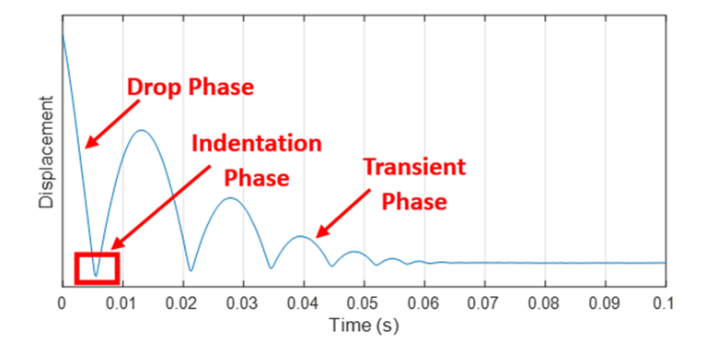
With VESevo, tire measurement starts from a controlled mechanical interaction between a small indenter and the surface of the tested material. The indenter is released under repeatable conditions, then its motion is measured as it contacts, penetrates and rebounds from the rubber surface. The principle is direct, but the information extracted from the signal can describe much more than a simple hardness value.
During the test, the device is positioned vertically on the tire tread area or on a rubber sample. A controlled release mechanism ensures that the indenter starts from a repeatable initial position. When it falls and interacts with the material, the system acquires the displacement signal and measures the compound temperature through an infrared sensor. This is important because tire temperature is one of the main variables affecting viscoelastic response.
The acquired signal includes several phases. First, there is the drop phase, where the indenter moves toward the surface. Then there is the indentation phase, where the rod penetrates the viscoelastic layer. Finally, there is a transient phase, where the indenter undergoes damped oscillation before reaching a final static contact condition. The analysis of this signal allows the system to extract information related to the material’s stiffness and damping behavior.
This process is particularly relevant because it translates a physical interaction with the tire tread surface into measurable indexes connected to the rubber’s viscoelastic response. The displacement of the indenter, the energy dissipated during impact and the temperature of the compound are all part of the measurement process. These parameters are then processed to estimate quantities related to storage modulus and loss factor.
In practical terms, this means that a tire can be tested quickly without removing material. The same tire can be measured in different tread zones, before and after use, after thermal cycles or at different mileage levels. This creates a more flexible approach to analysis on tires, especially when the goal is to compare the behavior of multiple tire compounds or to monitor changes in a single tested tire over time.
The value of this methodology lies in its balance between portability and technical depth. It is not simply a hardness test. It is a way to obtain viscoelastic information from a fast, localized and nondestructive interaction with the tire tread.
Tire Characterization: Understanding Storage Modulus and Loss Factor
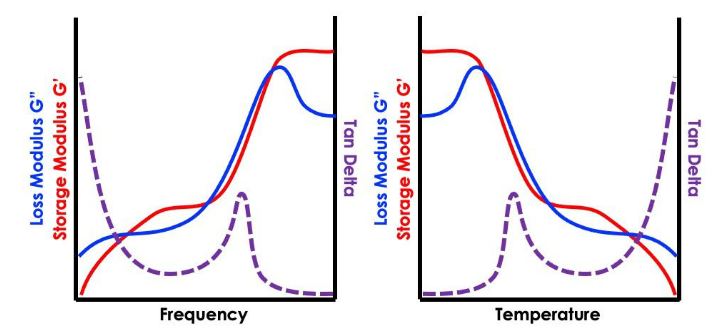
Effective tire characterization begins when measurement data are connected to physical properties. In viscoelastic materials, two of the most important parameters are the storage modulus and the loss factor. These parameters help describe how the compound stores and dissipates energy when it is deformed.
The storage modulus is associated with the elastic component of the material. It describes the tendency of the compound to store energy and recover its shape after deformation. A higher storage modulus generally indicates a stiffer material response. In the context of tire tread compounds, this can influence the way the rubber interacts with road asperities, how it deforms in the contact patch and how it contributes to adhesive behavior.
The loss factor, often expressed as tan δ, is related to the material’s capacity to dissipate energy. This is particularly important for hysteretic friction, where the rubber is continuously deformed by road texture and dissipates energy during repeated excitation. A compound with a specific loss factor profile can behave differently depending on temperature and frequency. This is why viscoelastic data are essential for understanding tire friction, grip generation and tire tread performance.
One of the key challenges in tire analysis is that these properties are not constant. They change with temperature and excitation frequency. A compound can behave differently at low temperature compared with high temperature, and its response can vary when it is excited by different road textures or operating conditions. This is why master curves are so important: they show how the compound’s viscoelastic properties evolve across a range of temperatures or frequencies.
For tire manufacturers and tire producers, this type of characterization can support compound development, quality control and product comparison. For motorsport teams, it can help transform generic compound descriptions such as “soft”, “medium” or “hard” into more objective information about viscoelastic response. For research and simulation, it can provide useful parameters for friction models, wear models, finite element analysis and vehicle dynamics studies.
In a broader sense, tire characterization is not only about knowing whether one compound is softer or harder than another. It is about understanding how a tire tread compound behaves under real operating conditions and how that behavior changes with temperature, wear, aging, manufacturing conditions and use.
Tire Behavior: How Temperature, Frequency and Road Interaction Affect Grip
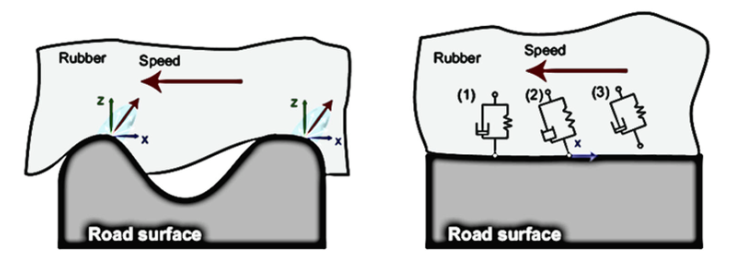
The real-world tire behavior of a tread compound depends strongly on how rubber interacts with the road. The contact between a tire and a road surface is not a simple static contact. The tread continuously deforms against roughness at different dimensional scales, from macrotexture to microtexture. At the same time, molecular interactions occur between rubber and counter-surface. These mechanisms contribute to the total friction available between tire and road.
Two main phenomena are particularly relevant: hysteretic friction and adhesive friction. Hysteretic friction is linked to the deformation of rubber caused by road texture. As the tire slides or rolls over surface asperities, the tread compound is excited at different frequencies and dissipates energy. This energy dissipation is closely related to the loss factor of the material.
Adhesive friction, on the other hand, is connected to molecular interactions at smaller scales. It depends on the ability of the rubber to establish contact with the surface and interact chemically or physically with it. The elastic component of the material, associated with storage modulus, plays an important role in this mechanism as well.
This explains why the tire’s ability to generate grip cannot be understood only by looking at tread pattern or compound category. The same tire tread can respond differently when temperature changes, when the road surface changes, or when the tire becomes worn. A tire operating outside its optimal thermal range may show a different balance between stiffness, damping and frictional behavior.
Temperature is especially important. The viscoelastic properties of rubber compounds are strongly temperature-dependent. A tire compound that performs well within a certain temperature window may lose part of its expected behavior when used outside that range. In racing, this is one of the reasons why tire thermal management is so important. In passenger mobility, it helps explain why tire performance can vary between seasons, road conditions and levels of use.
A nondestructive method that can measure the tire tread’s viscoelastic response helps connect laboratory-level material science with real tire behavior. It allows users to observe how tire characteristics evolve and how those changes may influence performance, safety, grip and consistency.
Tire Performance: From Motorsport Compounds to Real-World Applications
Understanding tire performance requires more than knowing whether a compound is classified as soft, medium or hard. In motorsport, these labels are useful from an operational point of view, but they do not fully describe the material’s physical response. Two compounds may have different glass transition behavior, different damping properties and different sensitivity to temperature, even if their commercial or sporting classification appears simple.
By measuring the master curves of different tire compounds, VESevo can help objectivize these differences. This means that the compound is no longer interpreted only through subjective feeling, lap time or generic classification. It can also be described through measurable viscoelastic parameters. In a racing tire, this can support compound selection, setup interpretation and correlation between vehicle telemetry and driver feedback.
The same approach can be useful beyond motorsport. Passenger tires, motorcycle tires, bike tires, truck tires and aircraft tires all rely on tread compounds designed for specific operating targets. Some are optimized for durability, others for wet grip, low rolling resistance, high load capacity or thermal stability. Viscoelastic analysis can help compare these targets more objectively.
In real-world applications, tire performance is never limited to peak grip. It includes consistency over mileage, resistance to degradation, behavior across different temperatures, quality of production and the ability to maintain expected characteristics during the tire’s lifecycle. A nondestructive testing methodology can therefore support both performance development and product validation.
This is especially valuable when a tire is reported as underperforming. In many cases, driver or user feedback is subjective and may not be supported by vehicle data. A direct viscoelastic measurement can help identify whether the tested tire actually exhibits a different material response compared with other tires expected to behave normally. It does not replace full vehicle testing, but it adds an objective material-level layer to the analysis.

For this reason, tire performance analysis benefits from a method that can connect racing tire behavior, tire tread compounds, tire formulations and tire-centered testing in a single measurement workflow. The more objective the data, the easier it becomes to distinguish between compound characteristics, thermal effects, wear-related degradation and actual performance limitations.
Tire Wear Testing: Monitoring Tire Mileage, Degradation and Aging
One of the most meaningful applications of nondestructive viscoelastic analysis is tire wear testing. A tire changes during use: the tread becomes thinner, the compound experiences repeated mechanical cycles, heat is generated, and chemical degradation can occur over time. These effects can influence storage modulus, loss factor, frictional response and overall tire performance.
With destructive testing, it is difficult to follow the same tire throughout its entire lifecycle. If a sample is removed from the tire, the tire is damaged and can no longer be used in the same way. If multiple nominally identical tires are tested at different mileage levels, the comparison may be affected by manufacturing variability. Two tires produced in the same batch may still have local differences, and those differences can influence the analysis.
A nondestructive approach makes it possible to test the same tire repeatedly. The same tested tire can be measured when new, after a certain mileage, after additional use and at later lifecycle stages. This allows users to observe the evolution of the tire’s viscoelastic properties in a more direct way.
The research shows that tire mileage and wear can be associated with changes in storage modulus and loss factor. One observed tendency is a progressive reduction in storage modulus, which may be related to tread thickness reduction and lower structural stiffness. A reduction in loss factor can also appear, possibly linked to the reduced volume of material available to dissipate energy. These trends are not necessarily identical for every tire or compound, but they provide useful guidelines for interpreting tire wear effects.
Aging is another critical factor. Even when a tire is not used, the compound can change due to oxidative processes, ultraviolet exposure, ozone and environmental conditions. These changes may affect friction and safety, especially when they alter the tread compound’s ability to deform and dissipate energy. Periodic nondestructive measurement can help monitor this evolution.

For tire manufacturers, fleets, research laboratories and motorsport teams, this type of testing can support lifecycle analysis. It can help answer questions such as: how does a specific tire compound change after use? How does thermal history affect performance? How quickly does a tire lose its expected viscoelastic response? Does the tire still behave consistently after mileage accumulation?
These questions are important not only for performance, but also for safety and sustainability. Better understanding of tire wear and degradation can support more informed decisions about product design, tire use, replacement strategies and quality control.
Tire Uniformity: Quality Control Across the Tire Production Line
In industrial production, tire uniformity is a central quality issue. A tire is a complex product made through multiple material, forming and vulcanization steps. Even with advanced industrial processes, local nonuniformity can occur. These variations may affect comfort, ride quality, safety and performance consistency.
For this reason, tire producers and manufacturers need reliable ways to evaluate whether the viscoelastic properties of a tire are consistent across the tread and between tires belonging to the same production batch. Traditional quality control methods can detect many geometric or structural issues, but viscoelastic uniformity requires material-level information.
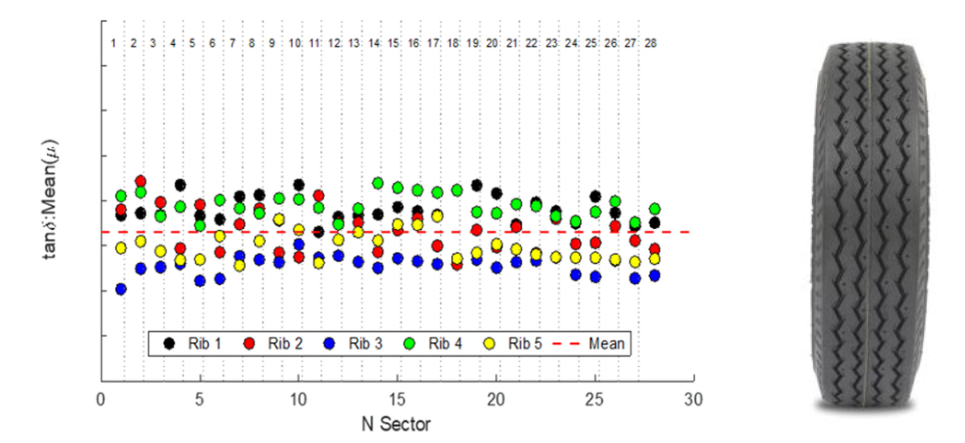
VESevo can support this type of analysis because it can perform localized nondestructive measurements on different zones of the tread. A tire can be divided into sectors along the circumferential direction and into ribs or zones along the lateral direction. By measuring multiple points, it becomes possible to map variations in loss factor or other viscoelastic indexes.
This approach is particularly useful for production quality control because it can reveal tires’ local nonuniformity that may not be obvious through visual inspection. If one rib of the tread shows a different viscoelastic response compared with others, this may indicate a material or process-related variation. If different tires from the same batch show inconsistent behavior, the data can support further investigation of the production process.
The concept of tire uniformity should therefore not be understood only as dimensional uniformity. It also includes the uniformity of the material response. A tire may appear geometrically correct but still show local differences in viscoelastic behavior. For modern tire manufacturing, this kind of information can contribute to more advanced quality control and improved consistency.
From an industrial point of view, the possibility of using a fast, portable and nondestructive system directly in quality control workflows is one of the most relevant aspects of this technology. It can help reduce waste, support repeatability and improve the ability to identify unexpected variations before tires reach the market or are used in demanding applications.
Tire Manufacturing: Measuring Viscoelastic Effects of Curing and Production Conditions
During tire manufacturing, several stages can influence the final viscoelastic properties of the rubber compound. One of the most important is vulcanization, where heat and pressure are used to transform the material into its final functional state. The conditions applied during production can affect stiffness, damping, durability and frictional behavior.
Rubber materials can also change after additional heating and cooling cycles. In motorsport, for example, teams often use tire thermal blankets, ovens or other controlled heating strategies to prepare racing tires. These thermal cycles can influence the viscoelastic response of the tread compound. However, without direct measurement, it is difficult to understand whether a specific cycle improves or worsens the desired behavior.
Nondestructive testing allows the same tire or rubber product to be measured before and after each thermal cycle. This is important because it creates a structured experimental approach. Instead of relying only on experience or routine, users can compare the effects of different cycle durations, temperature levels and numbers of cycles.
In the context of tire production, the same logic can be applied to evaluate curing conditions. If different vulcanization setups produce different viscoelastic responses, measurement data can support optimization. The objective is not simply to produce a tire that meets dimensional requirements, but to produce a tire whose material behavior is consistent with the expected performance targets.
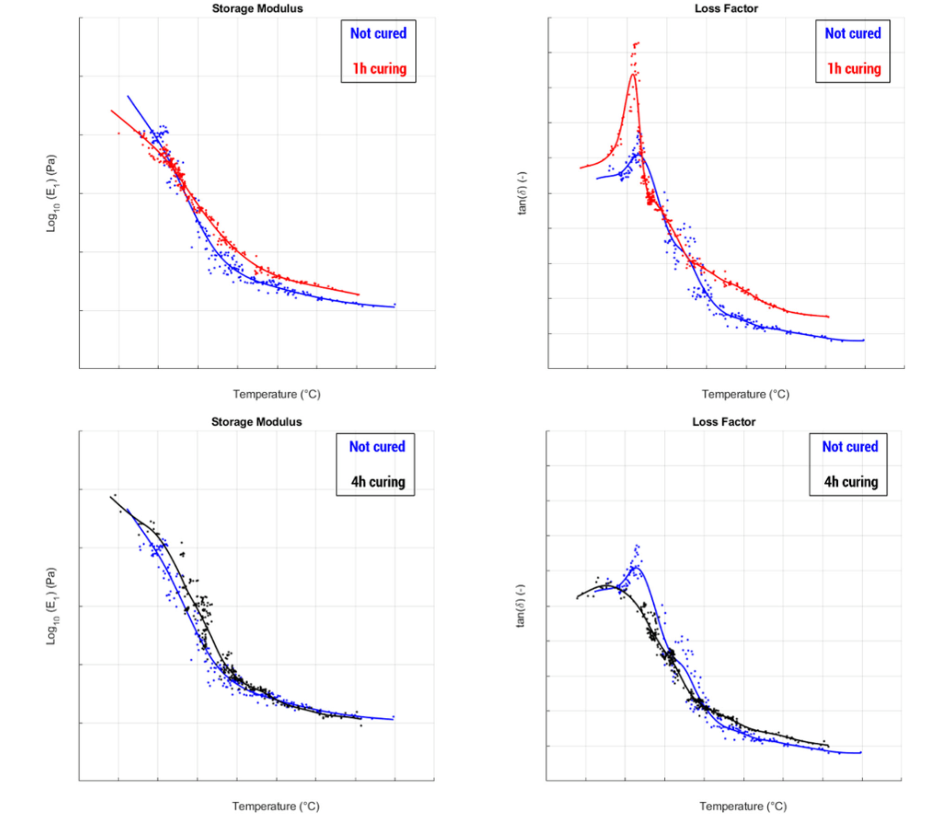
This makes nondestructive viscoelastic measurement useful both for R&D and for process validation. It can help tire producers better understand the relationship between production parameters, compound response and final tire performance.
Tire Compounds and Tire Formulations: Why Objective Data Improve Development
Tire compounds and tire formulations are designed to balance multiple targets. A compound may need to provide grip, durability, thermal stability, low rolling resistance, wet performance or resistance to aging. Improving one property can sometimes affect another. For this reason, compound development requires objective data that describe the material response under relevant conditions.
Viscoelastic characterization can help compare different formulations more clearly. Instead of relying only on final vehicle testing or destructive laboratory samples, developers can evaluate how compounds differ in terms of storage modulus, loss factor and temperature sensitivity. This supports a more informed development process.
For example, two tire tread compounds may show similar behavior at ambient temperature but differ significantly at higher temperatures. Another compound may provide stronger damping in a specific temperature window, making it more suitable for a certain application. A racing compound may be designed for a narrow operating range, while a passenger tire compound must work across broader environmental conditions.
Nondestructive testing can also support benchmarking. Tire manufacturers and research teams can compare multiple tire tread compounds without destroying the tested tires. This can be especially useful when the tire itself must remain intact, when samples are limited, or when the objective is to monitor how the same compound evolves over time.
In this sense, compound analysis becomes more than a laboratory activity. It becomes part of a broader workflow that connects material science, product development, tire performance, lifecycle behavior and quality control.
Bike Tires, Motorcycle Tires and Other Tire Segments
Although many examples of advanced tire testing come from automotive and motorsport environments, the same principles can be applied to other tire segments. Bike tires, motorcycle tires, truck tires and aircraft tires all rely on rubber compounds whose viscoelastic behavior affects performance and safety.
In bike tires, tread compound behavior can influence grip, rolling response and comfort. In motorcycle tires, temperature sensitivity and compound response are essential because the tire operates under combined longitudinal and lateral loads, often with significant lean angles. Truck tires require durability, load capacity and consistency over long mileage. Aircraft tires must operate under highly demanding load and speed conditions during landing and takeoff.
Each segment has different priorities, but the underlying need is similar: understanding how the tread compound behaves under deformation, temperature and use. Nondestructive viscoelastic measurement provides a way to compare these behaviors without damaging the tire.
This is why the concept of tire-centered analysis can be extended across multiple markets. The methodology does not depend only on one type of tire. It is connected to the physical behavior of viscoelastic rubber materials, which are common to many tire applications.
Beyond Tires: Viscoelastic Testing for Rubber and Polymer Products
Although the tire field is one of the most natural applications for VESevo, the same measurement concept can be extended to other rubber and polymer products. Many industrial goods are made of materials that exhibit viscoelastic behavior, and their performance depends on how they store and dissipate energy.
The research reports applications beyond tires, including sports equipment, running shoe soles, padel rackets, tennis resin playing surfaces, rubber cables, seals, rings, belts, coating sheets, artificial textiles and natural leather. These examples show that nondestructive viscoelastic testing can be useful wherever material response, damping, stiffness and uniformity matter.
For manufacturers of rubber goods, the ability to assess uniformity and quality without destroying the product can support production control. For sports equipment, it can help compare products and evaluate performance-related material properties. For research laboratories, it can provide a fast way to characterize viscoelastic goods under different conditions.

This broader perspective is important because it shows that tire analysis is part of a larger field: the characterization of viscoelastic materials. Tires remain one of the most demanding and valuable applications, but the same principles can help improve testing and quality control in several industries.
How Nondestructive Tire Analysis Supports Safety, Sustainability and Quality
Nondestructive tire analysis has implications that go beyond performance. When tire behavior is better understood, it becomes easier to design safer products, monitor degradation, reduce manufacturing waste and improve the consistency of production.
Safety is closely connected to the tire tread’s ability to generate friction under different conditions. If the viscoelastic properties of a tread compound change with wear, aging or temperature, the tire’s grip behavior may also change. Understanding these variations can support better product development and more informed evaluation of tire lifecycle performance.
Sustainability is also relevant. If quality control becomes more precise, manufacturers can reduce unexpected failures, minimize waste and improve repeatability. If tire degradation is better understood, products can be designed with more accurate lifecycle expectations. If testing can be performed without destroying tires, fewer products need to be sacrificed for analysis.
In production environments, nondestructive testing can support continuous improvement. Instead of limiting viscoelastic characterization to laboratory specimens, manufacturers can collect information directly from finished tires or production samples. This can make quality control more representative of the actual product.
For motorsport and high-performance applications, the benefit is more operational. Teams and engineers can obtain objective data on tires that cannot be destructively tested, improving the connection between material behavior, setup decisions, telemetry and driver feedback.
Frequently Asked Questions About Tire Testing and Tire Characterization
What is tire testing?
Tire testing is the process of evaluating how a tire behaves under specific conditions. It can include performance tests, material analysis, wear evaluation, temperature sensitivity, uniformity checks and measurements of tire tread compounds. In the context of viscoelastic analysis, tire testing focuses on how the rubber stores and dissipates energy during deformation.
What is nondestructive tire testing?
Nondestructive tire testing is a testing approach that allows the tire to be analyzed without cutting, damaging or making it unusable. This is useful when the same tire must be tested multiple times, when destructive analysis is not allowed, or when measurements need to be performed directly in the field or production environment.
Why are tire’s viscoelastic properties important?
The tire’s viscoelastic properties influence grip, damping, stiffness, heat generation, wear behavior and performance consistency. Since tire tread compounds respond differently depending on temperature and excitation frequency, viscoelastic characterization helps explain how a tire behaves in real operating conditions.
What is tire measurement with VESevo based on?
Tire measurement with VESevo is based on a controlled indentation principle. A small indenter interacts with the tire tread surface, and the device measures the resulting displacement signal and temperature. The acquired data are processed to estimate viscoelastic indexes related to storage modulus and loss factor.
What is tire characterization?
Tire characterization means describing the physical and mechanical behavior of a tire or tire compound through measurable parameters. In viscoelastic characterization, the main focus is often on storage modulus, loss factor, temperature sensitivity and the way these properties change with use, wear or aging.
How does tire behavior change with temperature?
Tire behavior changes with temperature because rubber compounds are viscoelastic. A compound can be stiffer, softer, more dissipative or less dissipative depending on its thermal state. This is why tire temperature affects grip, performance, wear and the operating window of tire tread compounds.
Why is tire performance connected to viscoelasticity?
Tire performance is connected to viscoelasticity because the tire tread must deform, recover and dissipate energy while interacting with the road. These mechanisms influence friction, grip, comfort, rolling behavior and degradation. Measuring viscoelastic properties helps explain why different compounds perform differently.
What is tire wear testing?
Tire wear testing evaluates how a tire changes during use. It can include tread thickness reduction, mechanical degradation, aging effects and changes in viscoelastic properties. Nondestructive tire wear testing is valuable because it allows the same tire to be monitored throughout its lifecycle.
Can nondestructive testing monitor tire mileage effects?
Yes. A nondestructive method can measure the same tire at different mileage levels, helping identify how storage modulus, loss factor and other viscoelastic indicators evolve with use. This is difficult to achieve with destructive methods because cutting a sample from the tire makes it unusable.
What is tire uniformity?
Tire uniformity refers to the consistency of a tire’s properties across its structure and tread. It can include geometric uniformity, but also material uniformity. Viscoelastic tire uniformity focuses on whether different tread zones or different tires from the same production batch show consistent material behavior.
Why is tire uniformity important in manufacturing?
Tire uniformity is important because local variations can affect comfort, ride quality, safety and performance. Measuring viscoelastic uniformity can help tire producers detect differences across tread ribs, circumferential sectors or production batches, supporting better quality control.
Can VESevo be used on bike tires and motorcycle tires?
The same nondestructive testing principles can be applied to several tire segments, including bike tires, motorcycle tires, passenger tires, truck tires and other rubber-based products. The usefulness depends on the specific application, tread geometry and measurement objectives.
Is VESevo only useful for tires?
No. Although tires are one of the main application fields, the same technology can be used to assess other viscoelastic goods such as running shoe soles, rubber cables, seals, belts, padel rackets, tennis surfaces and other polymer or rubber products where damping, stiffness and material uniformity are relevant.
Does nondestructive tire testing replace laboratory testing?
Nondestructive tire testing does not necessarily replace all laboratory methods. Instead, it can complement them. Laboratory methods such as DMA remain important for detailed material analysis, while nondestructive methods provide fast, repeatable and field-friendly measurements on the actual tire or product without destroying it.
Why is this technology relevant for sustainability?
Nondestructive testing can support sustainability because it reduces the need to destroy products for analysis, helps improve quality control and may contribute to fewer production rejects or unexpected failures. Better understanding of tire lifecycle behavior can also support more efficient product development and material use.
Scientific Source
This article is based on the scientific paper: Farroni, F.; Timpone, F.; Genovese, A. Analysis of the Scenarios of Use of an Innovative Technology for the Fast and Nondestructive Characterization of Viscoelastic Materials in the Tires Field. Sensors 2024, 24, 1136. DOI: 10.3390/s24041136.
The images from the paper are distributed under a Creative Commons Attribution license. If they are reused in the article, the original authors, publication and license should be clearly credited in the image captions.
Editorial note: The information provided in this article is general and technical in nature. It does not replace a customized engineering assessment, laboratory validation or product-specific quality control protocol. Any use of tire testing data for production, motorsport, safety or regulatory purposes should be evaluated by qualified technical professionals.