
In tire engineering, the behavior of a tire is never determined by a single parameter. The way a tire performs on the road, on track or in a controlled test environment depends on a complex relationship between rubber formulation, temperature, road roughness, contact pressure, tread deformation, aging and the viscoelastic response of the compound. This is why tire testing, tire measurement and tire characterization are essential activities for engineers, researchers, tire manufacturers and motorsport specialists.
The scientific work behind VESevo focuses precisely on this challenge: how to evaluate the tires viscoelastic properties and the tire tread viscoelastic properties without destroying the tire or cutting a specimen from the tread. Traditional laboratory procedures such as Dynamic Mechanical Analysis can provide valuable information, but they often require specific compound samples or specimens extracted from the tire. When the sample is taken directly from the tire tread, the tire is damaged and can no longer be monitored throughout its lifecycle.
VESevo was developed as a smart, compact and non-destructive technology for the viscoelastic characterization of rubber and polymer materials, with a specific focus on tires compounds and tire tread compounds. The device is designed to perform measurements directly on the tire tread surface or on rubber slabs, allowing the user to evaluate the material response in laboratory conditions and potentially in more practical field scenarios.
The core value of this approach is not only that the tire remains intact. The main advantage is that the same tire, compound or material sample can be measured repeatedly under different thermal conditions, after mileage accumulation, during aging or across different stages of product validation. This opens important possibilities for tire performance analysis, tire manufacturing, production repeatability, compound comparison and quality control.
The article below explains the principles behind VESevo in a clear and structured way, transforming the technical content of the scientific paper into a practical overview for professionals interested in non-destructive tire testing, tire materials, tire mechanics, tire tread-road interaction and smart viscoelastic characterization.
Tire Analysis: Why Viscoelastic Properties Matter
Tire analysis becomes truly useful when it helps explain how a tire behaves under real working conditions. In automotive and motorsport applications, tires are continuously exposed to changes in temperature, load, contact pressure, speed, road roughness and surface texture. The tread compound is deformed, compressed and released many times, and its response influences both vehicle performance and safety.
The paper highlights that tire mechanics and physics are central to the optimization of vehicle stability, performance and safety. Engineers and researchers need to understand the mechanical and viscoelastic properties of tires because these properties influence the phenomena occurring during tires tread-road interaction. In other words, the tire is not just a passive component: it is a complex material system that reacts dynamically to the road.
The behavior of tire materials is especially important because rubber is not purely elastic and not purely viscous. A tire tread compound behaves as a viscoelastic material, meaning that its response depends on time, temperature and excitation frequency. This is why a complete tire analysis cannot rely only on geometry, tread pattern or nominal compound category. It must also consider how the material stores energy, dissipates energy and changes across operating conditions.
VESevo addresses this need by enabling a non-destructive analysis of the tire tread compound. Instead of destroying the tire to obtain a specimen, the device can perform an indentation-based measurement and process the acquired signals to estimate key viscoelastic indicators. This approach is particularly relevant when the objective is to monitor tires properties, compare compounds, evaluate production consistency or observe changes caused by mileage and aging.
Tire Testing: From Destructive Laboratory Methods to Non-Destructive Evaluation
Tire testing has traditionally relied on laboratory methods capable of characterizing rubber materials under controlled conditions. Dynamic Mechanical Analysis is one of the most established procedures for identifying the viscoelastic properties of polymers and tire tread compounds. However, this procedure requires specimens with suitable geometry and is usually performed in laboratory conditions.
When a specimen is specifically produced for the test, it may not fully reproduce the actual tread properties obtained after the tire vulcanization process. The paper underlines that, due to the complexity of vulcanization and tire manufacturing, the properties of the tread compound in the final tire can be significantly different from those achieved in laboratory samples. This difference is a key point: the material tested in the lab may not always represent the actual tire tread in its finished state.
When the sample is extracted directly from the tire, another problem appears: the tire tread must be destroyed to obtain the specimen. This is not ideal when the same tire needs to be tested multiple times, when the available tires are limited, or when the application does not allow destructive procedures. In motorsport, for example, tires may be subject to restrictions that prevent classic laboratory testing.
A non-destructive and non-invasive method provides a different path. It allows measurements to be performed directly on the tire tread compound or on rubber slabs without compromising the sample. This is the scenario in which VESevo becomes relevant: it offers a smart testing approach designed to characterize viscoelastic behavior while preserving the tire for further analysis, comparison or use.
For tire manufacturers and tire producers, this type of non-destructive tire testing can support quality evaluation across a large number of final products. For researchers, it provides a practical way to investigate compound behavior. For motorsport applications, it can help analyze tire characteristics without violating the need to keep the tire intact.
Tire Measurement: How VESevo Acquires Data from the Tire Tread Surface
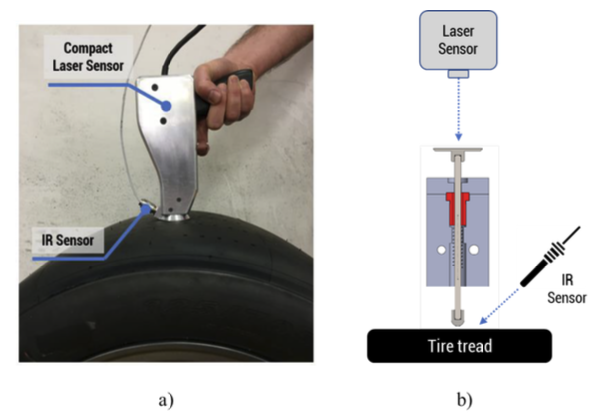
Tire measurement with VESevo is based on a controlled indentation principle. The device is positioned vertically on the tire tread compound or on a rubber slab. A steel rod equipped with a semi-spherical indenter is lifted to a repeatable starting position and then released. When the indenter contacts the rubber surface, its motion is acquired and transformed into useful information about the material response.
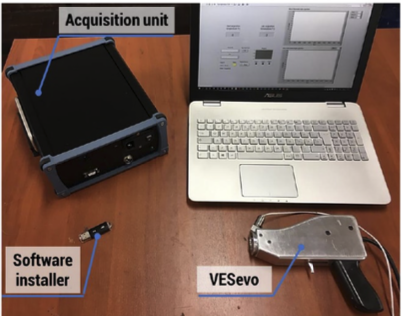
The VESevo system includes an indentation tool, an acquisition unit and dedicated software developed to manage raw data acquisition. The device is designed with an ergonomic gun-shaped handle to support stability and repeatability during the testing procedure. The internal structure includes a rod that slides inside a specific guide, a spring that ensures a minimum preload, a magnet-based mechanism that helps repeat the initial position and high-accuracy sensors for displacement and temperature measurement.
The optical sensor acquires the movement of the rod with high-frequency response and high resolution, while a compact infrared pyrometer measures the temperature of the compound during each individual test. This is essential because temperature directly affects the viscoelastic response of the tire tread surface. A compound tested at different temperatures can show different levels of stiffness, damping and indentation behavior.
The testing procedure is designed to be repeatable. The user positions the device on the sample, manually lifts the indenter until the mechanical lock is reached, then releases the rod through the semi-automatic system. The acquisition software displays both the displacement curve of the rod and the temperature of the compound. This makes the measurement process practical, fast and suitable for repeated acquisitions.
The result is not a simple hardness value. The acquired signal contains information about the interaction between the indenter and the viscoelastic material. By analyzing the shape of the displacement curve, the contact duration, the damping behavior and the temperature condition, VESevo can support a deeper characterization of the tire tread compound.
Tire Characterization: Storage Modulus, Loss Factor and Viscoelastic Response
Tire characterization requires connecting measured signals with physical properties. In viscoelastic materials, two of the most important quantities are the storage modulus and the loss factor. The storage modulus is related to the elastic part of the material response and describes the ability of the compound to store energy. The loss-related quantities describe the tendency of the material to dissipate energy, often in the form of heat.
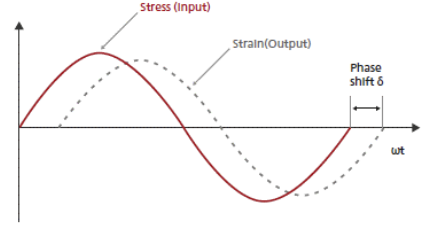
The paper introduces viscoelastic behavior by explaining that there is a time shift between stress and strain. This means that when a tire tread compound is deformed, its response does not occur in the same way as a purely elastic solid. Part of the response is elastic, while another part is viscous. This dual behavior is exactly what makes tires viscoelastic properties so important for understanding grip, deformation, damping and performance consistency.
The loss factor, often indicated as the ratio between loss modulus and storage modulus, is an indicator of the overall damping of the material. In practical tire applications, this is relevant because the tire tread is continuously excited by road roughness. As the tire rolls and interacts with the road, the compound is repeatedly deformed and energy is dissipated. This process contributes to the way the tire generates grip and reacts to different temperatures.
VESevo estimates the viscoelastic behavior of the compound by processing the indentation signal acquired during the test. The analysis focuses on the first contact phase between the indenter and the material, because this part of the signal contains direct information about how the compound responds when the rod impacts and penetrates the surface. From this interaction, the device and processing method estimate quantities connected to stiffness, damping, storage modulus and loss factor.
This makes the technology relevant for tire tread viscoelastic properties because the measurement is performed directly on the surface of interest. Instead of evaluating only an isolated laboratory specimen, the method can be applied to a tread compound, a slab or potentially a tire in practical conditions, depending on the testing objective.
Tire Behavior: Temperature, Frequency and Tread-Road Interaction
Tire behavior is strongly influenced by temperature and frequency. The paper explains that the mechanical behavior of a viscoelastic material is affected by both time and temperature. This is particularly important in tire applications because the tire tread compound can operate under very different thermal conditions depending on speed, load, road surface, ambient temperature and usage history.
At lower temperatures or higher excitation frequencies, the compound can behave closer to a glassy solid. At higher temperatures or lower excitation frequencies, the compound can move toward a rubbery behavior. Between these regions, the viscoelastic response changes significantly. This transition affects stiffness, damping and the way the tread compound interacts with road texture.
The tire tread-road interaction is one of the main reasons why viscoelastic characterization matters. The tread is continuously deformed by the roughness of the road. This deformation activates the material’s damping behavior and contributes to friction. At the same time, the material’s ability to store and release energy affects how the tread adapts to the surface and how the tire responds dynamically.
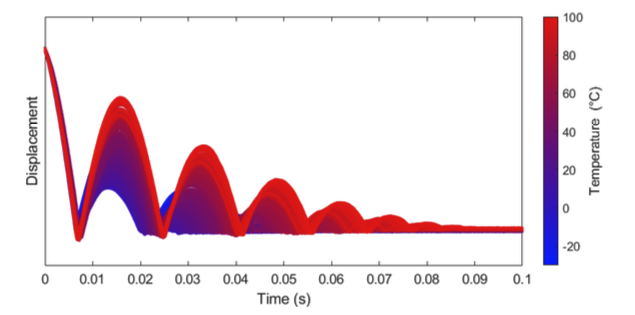
VESevo measurements performed at different tread temperatures show that the displacement signal changes as temperature varies. According to the paper, at lower temperatures the transient phase becomes shorter and bounce amplitudes decrease, while at higher temperatures the displacement reaches higher values at each bounce. These differences reflect the temperature-dependent behavior of the compound.
This is why temperature acquisition is not secondary in the VESevo procedure. Measuring the tire tread surface temperature during each acquisition allows the signal to be interpreted in relation to the thermal state of the material. For tire mechanics, this connection is fundamental because performance, safety and compound response cannot be separated from temperature conditions.
Tire Measurement Signal: Drop Phase, Indentation Phase and Transient Response
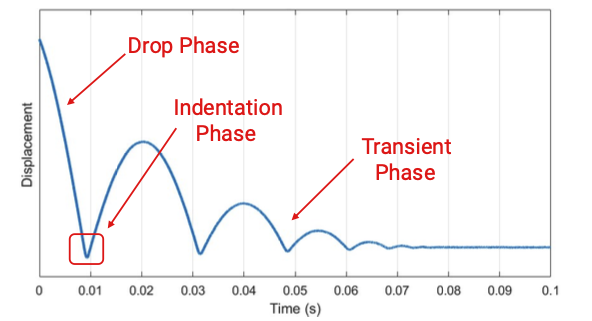
The raw signal acquired by VESevo contains several phases that help describe the interaction between the indenter and the tire tread compound. The first is the drop phase, where the rod moves from the initial position toward the material surface. This part of the signal does not depend strongly on the compound temperature because the rod has not yet contacted the material.
The second phase is the indentation phase, where the rod penetrates into the rubber thickness. This is the most important part of the signal for viscoelastic evaluation because it captures the direct contact between the indenter and the material. The shape of this part of the curve is influenced by the stiffness and damping behavior of the compound.
The third phase is the transient bounce response. After the first indentation, the rod bounces and the oscillations gradually decrease until contact with the tire tread surface is established. The duration and amplitude of this transient behavior provide information about how the material dissipates energy and how the compound response changes under different temperature conditions.
From an engineering perspective, this signal is valuable because it transforms a fast mechanical interaction into analyzable data. The device does not simply press the material and return a single number. Instead, it records the dynamic behavior of the indenter and uses this information to support the evaluation of viscoelastic properties.
This makes the VESevo approach especially useful for repeated tire measurement sessions. Since the procedure is non-destructive, the same tread compound, slab or tire can be measured multiple times at different temperatures, after different treatments or during different stages of its lifecycle.
Tire Mechanics: How Indentation Data Become Material Properties
Tire mechanics requires more than observing external behavior. To understand how the tire tread responds under load, engineers need information about the material properties that govern deformation and energy dissipation. VESevo contributes to this analysis by processing the acquired indentation signal and estimating contact-related parameters.
The paper describes a data processing workflow aimed at estimating the viscoelastic properties of the compounds from VESevo measurements. The procedure includes identification of the first contact duration between rod and compound, optimization for unknown parameter estimation and evaluation of viscoelastic properties from contact parameters.
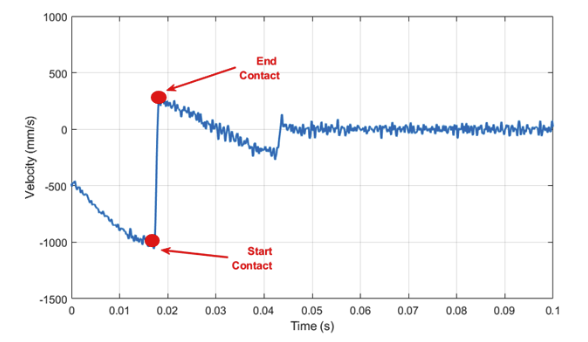
The first contact phase is identified by analyzing velocity curves obtained from the filtered displacement signal. The beginning of contact corresponds to the end of the drop phase, when the indenter hits the compound and the absolute value of its velocity starts to decrease. The maximum indentation occurs when the velocity reaches zero. Then the velocity changes sign until the compound stops exerting force on the indenter, marking the end of contact.
This contact duration depends on the temperature of the tested specimen. At lower temperatures, the contact duration is shorter. At higher temperatures, the compound behaves more like a viscous solid and the indentation phase becomes longer. This relationship between temperature and contact behavior is one of the reasons why the VESevo method can reveal the temperature-dependent viscoelastic response of tire materials.
Once the contact phase is identified, the shape of the displacement curve in that range can be analyzed. The paper models this indentation phase as the free evolution of a second-order non-conservative mass-spring system. From the identified parameters, contact stiffness and damping coefficients can be estimated, and these values are then used to evaluate storage modulus, loss modulus and loss factor.
Tire Materials and Tire Compounds: Why Formulation and Manufacturing Matter
Tire materials are designed to satisfy several requirements at the same time. A tread compound must contribute to grip, durability, thermal stability, energy dissipation, wear resistance and predictable behavior across different working conditions. This balance depends on formulation, processing, curing and the final state of the compound inside the finished tire.
The paper emphasizes that the properties of the tread compound obtained in tire manufacturing can differ from those obtained in laboratory conditions. This is particularly relevant because laboratory samples may not fully represent the final properties of the actual tire tread. The tire vulcanization process plays a central role here: heat, pressure and curing conditions help determine the final mechanical and viscoelastic behavior of the rubber.
For this reason, direct and non-destructive measurements on the tire tread compound can provide more representative information. They allow engineers to evaluate material response on the final product or on relevant samples without requiring destructive extraction. This is useful for tire manufacturers, research teams and industries involved in compound development.
The paper also refers to three different tire tread compounds, indicated as A, B and C, tested with VESevo and compared with standard laboratory data. The ability to distinguish the viscoelastic behavior of different compounds is important because tires characteristics and tires properties depend strongly on how the compound stores and dissipates energy across the temperature range.
In a product development context, this kind of analysis can support the comparison of tires compounds, the monitoring of material performance over time and the evaluation of production repeatability. In a quality control context, it can help identify whether the material behavior of a tire or batch is consistent with expected performance targets.
Tire Performance: From Viscoelastic Data to Vehicle Dynamics
Tire performance is directly connected to viscoelasticity because the tire tread compound influences grip, energy dissipation, deformation and interaction with the road. The paper states that the viscoelastic properties of tire compounds play a fundamental role in vehicle dynamics, affecting both vehicle performances and safety according to different working conditions.
For a vehicle, the tire is the only point of contact with the road. The tread compound must respond to roughness, temperature changes, load variations and sliding conditions. If the viscoelastic response of the material changes, the tire’s behavior can also change. This is why the knowledge of storage modulus, loss factor and temperature-dependent behavior can support a better understanding of performance.
In motorsport, this aspect becomes even more critical. Racing tires are often used in narrow operating windows, where temperature and compound behavior can strongly affect performance. A non-destructive system that can be used in laboratory conditions and potentially on track creates valuable opportunities for monitoring tire characteristics without damaging the tire.
VESevo does not replace complete vehicle testing or track evaluation. Instead, it adds a material-level layer of information. By identifying how the compound behaves across temperature and how the viscoelastic response differs among tire tread compounds, engineers can interpret performance differences with more objective data.
This is particularly useful when comparing compounds, studying aging, evaluating mileage effects or checking whether production processes lead to repeatable material behavior. In all these cases, the performance of the tire is connected to measurable tire properties rather than only subjective feedback.
Tire Wear Testing: Monitoring Mileage, Aging and Material Evolution
Tire wear testing is one of the areas where non-destructive viscoelastic characterization can become especially valuable. A tire changes during its lifecycle. The tread wears, the compound experiences repeated mechanical cycles, thermal history accumulates and aging can modify the material response. These changes can affect stiffness, damping, grip potential and performance consistency.
The paper highlights the possibility of monitoring material performance during its whole lifecycle. Because VESevo does not destroy the tire, it can support repeated measurements on the same product. This is important because it reduces the uncertainty that would arise from comparing different nominally identical tires at different aging or mileage stages.
Progressive mileage is specifically mentioned as one of the scenarios in which the device can help monitor performance changes. As mileage increases, the tread compound may show different viscoelastic behavior due to wear, thermal exposure and mechanical history. With repeated measurements, these changes can be observed more directly.
Aging is another important aspect. Even without intensive use, rubber compounds can change over time due to environmental exposure, oxidation, storage conditions or thermal history. Non-destructive testing makes it possible to observe how the same compound or tire evolves, helping engineers understand whether the material response remains consistent or changes significantly.
For tire producers, fleets, laboratories and motorsport teams, this creates an opportunity to connect lifecycle monitoring with objective material data. Instead of relying only on visual inspection or final performance feedback, the tire can be evaluated through measurable viscoelastic indicators.
Tire Manufacturing and Tires’ Production: Quality, Repeatability and Process Control
Tire manufacturing is a complex process in which compound formulation, processing conditions and vulcanization all influence the final product. The paper points out that the properties of the tread compound obtained in tire manufacturing can be significantly different from those achieved in laboratory conditions. This is a key reason why direct measurement on the final product can be valuable.
In tires’ production, quality and repeatability are essential. A large number of final products must meet expected standards, and traditional test benches or laboratory procedures can require time, dedicated equipment and sample preparation. VESevo is presented as a compact and smart technology that could support the monitoring of product quality in a shorter time compared with standardized procedures requiring specific and expensive benches.
For tire manufacturers, this can be relevant in several ways. First, it can help evaluate whether a compound behaves consistently across products or batches. Second, it can support the analysis of production repeatability. Third, it can contribute to identifying deviations in material response that may not be immediately visible through geometric or visual checks.
The non-invasive nature of the method is also important. Since the test does not require destroying the tire, it can potentially be performed on many samples and repeated multiple times. This opens possible scenarios in quality analysis, production control and process validation.
In this sense, VESevo can support a more direct connection between production conditions and tire characteristics. Instead of evaluating only laboratory samples, engineers can work closer to the final product and better understand how manufacturing choices influence the viscoelastic response of the tire tread compound.
Tire Vulcanization Process: Why Final Tread Properties Can Differ from Laboratory Samples
The tire vulcanization process is one of the most important phases in defining the final properties of rubber materials. Through heat and pressure, the compound reaches its functional state and develops the mechanical and viscoelastic behavior required for real tire applications. However, this process can also make the final tread properties different from those measured on simplified laboratory specimens.
The paper explicitly notes that, because of the complexity of the tire vulcanization process, the tread compound properties obtained in tire manufacturing may differ significantly from the ones achieved in the laboratory. This explains why it can be difficult to know the actual mechanical properties of the tire tread unless the tread is destroyed to obtain a specimen for standard testing.
A non-destructive technology addresses this limitation by allowing measurements on the tire tread compound without removing material. This helps keep the tested tire intact while still providing access to information about its viscoelastic response. For process evaluation and production quality, this is a relevant advantage.
Understanding the role of vulcanization also helps explain why tire materials should not be evaluated only in their generic formulation state. The final behavior of the tread compound depends on the complete production history, and direct measurement on the finished or representative material can provide more practical insight.
Results: Comparing VESevo Data with Standard Laboratory Characterization
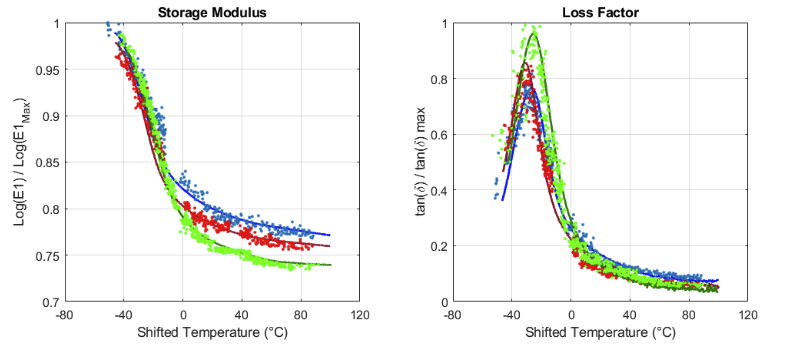
The paper validates the VESevo approach by comparing the processed non-destructive measurements with standard Dynamic Mechanical Analysis results. Three different tire tread compounds were tested with VESevo across a wide temperature range, and the acquired data were processed to obtain viscoelastic master curves at a reference frequency.
The results show that the VESevo processing algorithm was able to identify the main trends and values of the tested compounds. The comparison highlighted that the glass transition temperatures observed through loss factor master curves were almost similar to the ones obtained through the standard method. The VESevo results also reproduced the main viscoelastic behavior of the materials in low and high temperature ranges.
Another important outcome is that the relative ranking among the compounds remained unchanged between the two testing techniques for both storage modulus and loss factor. This means that VESevo was able to distinguish the different compounds in a way that remained consistent with laboratory characterization.
The paper also reports that one of the compounds, identified as compound C, showed the highest value of loss factor and the lowest storage modulus plateau at high temperatures. These kinds of differences are important because they show how non-destructive tire characterization can help compare compounds and identify material behavior trends.
For practical applications, this result supports the idea that VESevo can be used as a smart tool for identifying viscoelastic behavior as a function of temperature, while keeping the tested sample intact. The method should be understood as a non-destructive characterization approach that complements laboratory testing and supports practical tire analysis scenarios.
Beyond Tires: Polymers, Rubber Products and Other Viscoelastic Materials
Although the main focus of the paper is tire tread compounds, the underlying principle is connected to a broader class of viscoelastic materials. Polymers and rubber-like materials are used in many industrial products where stiffness, damping, temperature sensitivity and lifecycle behavior matter. The ability to characterize these properties without destroying the sample can be valuable beyond the tire industry.
The paper keywords include polymers and viscoelasticity, confirming that the VESevo concept belongs to a broader field of material characterization. The tire field is one of the most demanding and meaningful applications because the tire tread compound plays a critical role in vehicle dynamics, safety and performance. However, the same measurement philosophy can support the analysis of other viscoelastic goods where non-invasive testing is useful.
For industries dealing with rubber products, quality control and material development, this kind of technology can provide a faster way to compare materials, monitor production repeatability and study aging or thermal effects. The specific application depends on geometry, material type and measurement objectives, but the principle remains the same: use a controlled indentation interaction to obtain information about the viscoelastic response of the material.
How VESevo Supports Safety, Performance and Smart Quality Control
VESevo is relevant because it connects material science with practical tire applications. By providing non-destructive access to viscoelastic data, it can support several scenarios: vehicle performance optimization, motorsport tire analysis, compound comparison, production quality control, process repeatability and lifecycle monitoring.
From a safety perspective, the tire tread compound influences the ability of the tire to interact with the road under different conditions. If the compound response changes with temperature, aging or wear, the tire behavior can also change. Understanding these variations helps engineers interpret performance and safety-related behavior more clearly.
From a production perspective, non-destructive testing can help tire manufacturers evaluate a large number of products more efficiently. The paper specifically notes the potential advantage of monitoring product quality in a shorter time compared to standardized procedures requiring expensive test benches or specific equipment.
From a research perspective, VESevo provides a way to study tire tread compounds without destroying the tested sample. This enables repeated measurements, temperature-dependent analysis and comparison among different compounds. It also supports a more practical understanding of how tires characteristics and tires properties evolve under different environmental and usage conditions.
The main value of VESevo is therefore not limited to a single measurement. Its importance lies in the possibility of building a smarter workflow for tire analysis, where material behavior can be measured directly, repeatedly and without damaging the product.
Frequently Asked Questions About VESevo and Non-Destructive Tire Testing
What is VESevo?
VESevo is an innovative device developed for the non-destructive and smart viscoelastic characterization of tire tread compounds and other viscoelastic materials. It uses a controlled indentation principle and high-accuracy sensors to acquire displacement and temperature data from the tested material.
What is non-destructive tire testing?
Non-destructive tire testing is a testing approach that allows the tire or tread compound to be analyzed without cutting, damaging or destroying it. This is useful when the same tire must be measured multiple times or when destructive laboratory procedures are not practical.
Why are tires viscoelastic properties important?
Tires viscoelastic properties influence grip, damping, stiffness, heat generation, wear behavior, vehicle dynamics and safety. Since the tire tread compound changes its response with temperature and frequency, viscoelastic characterization helps explain how the tire behaves in different working conditions.
How does VESevo measure tire tread viscoelastic properties?
VESevo measures tire tread viscoelastic properties through a controlled indentation test. A semi-spherical indenter contacts the tire tread surface, and the device records the rod displacement and compound temperature. The acquired signal is processed to estimate parameters related to storage modulus, loss modulus and loss factor.
What is the role of tire temperature in VESevo measurements?
Tire temperature is essential because rubber compounds are temperature-dependent viscoelastic materials. The displacement signal, contact duration, stiffness and damping behavior can change significantly depending on the thermal condition of the tread surface.
What is the difference between tire measurement and tire characterization?
Tire measurement refers to the acquisition of data from the tire or compound, such as displacement and temperature signals. Tire characterization is the interpretation of those data in terms of material properties, including storage modulus, loss factor and temperature-dependent viscoelastic behavior.
Why is tire tread-road interaction important?
Tire tread-road interaction is important because the tread compound continuously deforms against road roughness. This interaction affects friction, energy dissipation, grip and tire behavior. Understanding viscoelastic properties helps explain how the tread reacts to different surfaces and temperatures.
Can VESevo help compare different tire compounds?
Yes. The paper reports tests on three different tire tread compounds and shows that VESevo data can identify trends and differences in storage modulus and loss factor. This makes the device useful for compound comparison and material behavior analysis.
How can VESevo support tire manufacturing?
VESevo can support tire manufacturing by helping evaluate the viscoelastic consistency of final products without destroying them. This can be useful for quality control, production repeatability, process validation and the monitoring of tire properties across different production conditions.
Why does the tire vulcanization process matter?
The tire vulcanization process affects the final mechanical and viscoelastic properties of the tread compound. The paper notes that the properties obtained in tire manufacturing can differ from laboratory samples, making direct non-destructive measurement on the final product especially valuable.
What is tire wear testing in this context?
Tire wear testing refers to the evaluation of how tire properties change with mileage, aging and use. A non-destructive method like VESevo can support repeated measurements on the same tire or compound, helping monitor material evolution over time.
Does VESevo replace Dynamic Mechanical Analysis?
VESevo should be considered a complementary non-destructive approach rather than a complete replacement for laboratory testing. The paper compares VESevo results with standard Dynamic Mechanical Analysis and shows that the device can identify relevant viscoelastic trends while preserving the tested sample.
Can VESevo be used outside the tire industry?
The principle behind VESevo can be relevant for other polymers and viscoelastic materials. Although the paper focuses on tire tread compounds, the same non-destructive characterization approach can be useful wherever stiffness, damping, temperature sensitivity and material repeatability matter.
Why is non-destructive characterization useful for sustainability?
Non-destructive characterization can support sustainability because it reduces the need to destroy tires or samples for analysis. It also helps improve production quality, reduce waste and monitor material behavior throughout the product lifecycle.
Scientific Source
This article is based on the scientific paper: Carputo, F.; Genovese, A.; Farroni, F.; Sakhnevych, A.; Timpone, F. VESevo, an Innovative Device for Non-Destructive and Smart Viscoelastic Characterization of Tires Compounds. AIP Conference Proceedings 2872, 120007, 2023. DOI: 10.1063/5.0164060.
Editorial note: The information provided in this article is general and technical in nature. It does not replace a customized engineering assessment, laboratory validation or product-specific quality control protocol. Any use of tire testing data for production, motorsport, safety or regulatory purposes should be evaluated by qualified technical professionals.