
In vehicle dynamics, the interaction between tire and road is one of the most important factors affecting handling, safety and performance. The tire is the only physical interface between the vehicle and the ground, and its behavior depends on a complex combination of rubber properties, temperature, surface conditions, deformation rate and compound formulation. For this reason, tire adhesion cannot be understood only through tread geometry or nominal compound hardness. It requires a deeper analysis of the viscoelastic behavior of the tire tread material.
The scientific study discussed here investigates how the VESevo device can be used to support the analysis of adhesion phenomena through non-destructive tire viscoelasticity characterization. The research focuses on three different tire compounds, classified as hard, medium and soft, tested under different temperature conditions and compared with and without the use of talc on the tested surface.
This approach is relevant because adhesion is strongly influenced by the material state of the tire tread. Rubber compounds behave differently as temperature changes: at lower temperatures they tend to become stiffer, while at higher temperatures they move toward a softer and more rubbery response. At the same time, surface interaction conditions can modify the rebound response acquired during the test. By comparing rebound curves with and without talc, the study provides a practical way to observe how adhesion-related effects appear in VESevo measurements.
The goal is not to replace complete vehicle testing or full tire-road friction analysis. Instead, the study shows how a portable, non-destructive measurement technology can provide useful material-level information for engineers, researchers, laboratories and tire specialists interested in tire testing, tire analysis, tire measurement, tire characterization, tire behavior and tire performance.
This overview explains the technical meaning of the study in a structured way, focusing on the role of VESevo, the comparison between talc and no-talc conditions, the thermal effect on rebound curves and the interpretation of adhesion differences among hard, medium and soft compounds.
Tire Analysis: How Viscoelastic Behavior Influences Adhesion
Tire analysis becomes meaningful when it connects material properties with what happens during tire-road interaction. Adhesion is one of the components involved in friction generation, and it depends on the way the rubber surface interacts with the road or with another contact surface. Since tire compounds are viscoelastic materials, their adhesive response cannot be separated from temperature, excitation frequency and deformation history.
A viscoelastic material behaves between an elastic solid and a viscous liquid. When stress or deformation is applied, the material response is not instantaneous and purely elastic. Part of the energy is stored, while another part is dissipated. This is why quantities such as storage modulus, loss factor and rebound response are relevant for understanding the behavior of tire tread compounds.
In tire applications, this behavior has direct consequences. A tread compound that appears stiff under one condition may become softer at a different temperature. A compound that shows a certain rebound response without surface treatment may behave differently when the adhesive interaction is modified. The study uses this principle to investigate how adhesion-related effects appear in the rebound curves acquired by the VESevo device.
The analysis is based on three compounds: a hard compound, a medium compound and a soft compound. This choice is important because the adhesive and viscoelastic response is expected to vary according to the formulation and mechanical behavior of the material. By comparing different compounds across temperature windows, the study provides a clearer view of how tire adhesion changes with both material type and thermal condition.
Tire Testing: Non-Destructive Characterization with VESevo
Tire testing has traditionally relied on laboratory procedures that can be expensive, time-consuming or destructive. Dynamic Mechanical Analysis is widely used to define the hysteretic behavior of polymeric and rubber materials, but it usually requires specific specimens and laboratory conditions. When the objective is to evaluate the tire tread material directly or repeatedly, destructive testing can become a limitation.
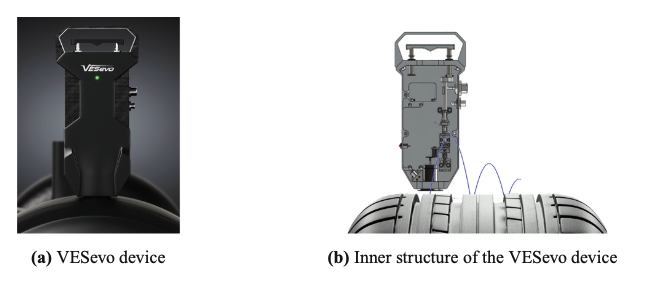
The VESevo technology addresses this problem by enabling a non-destructive characterization of tire tread viscoelastic properties. The device, whose name stands for Viscoelasticity Evaluation System Evolved, was developed by the Vehicle Dynamics research group of the University of Naples Federico II. Its purpose is to acquire useful information about the compound response without cutting or destroying the tire material.
The device is based on a steel rod with a semi-spherical indenter. The rod is free to bounce on the surface of the tested tire tread or rubber specimen while sliding inside a guide. During the test, the displacement signal of the rod is acquired by a compact optical sensor with high frequency response. Since the starting position of the rod is kept constant for each condition, the test can be repeated many times with good repeatability.
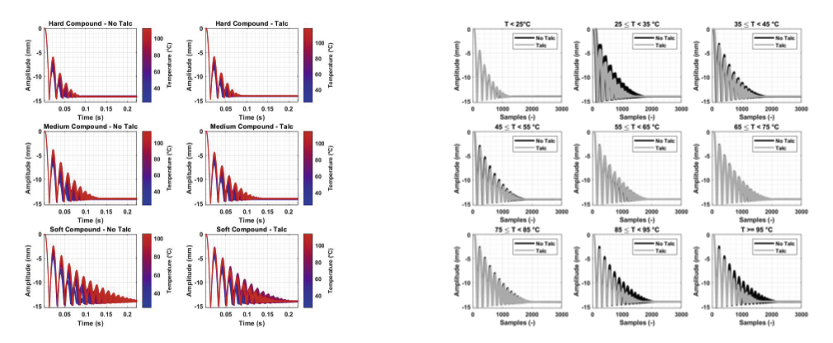
In this study, the testing campaign was designed to acquire rebound curves while varying three main conditions: compound type, temperature and surface treatment. The compounds were tested from approximately ambient temperature, around 20 °C, up to 100 °C. For each compound and temperature condition, the rebound response was compared with and without talc applied on the tested area.
This testing strategy is valuable because it allows the same measurement principle to be used not only for general viscoelastic characterization, but also for adhesion-related analysis. The difference between talc and no-talc conditions becomes a way to observe how surface adhesion influences the rebound behavior of the VESevo rod.
Tire Measurement: Rebound Curves as a Window into Adhesion
Tire measurement in this study is centered on the acquisition and interpretation of rebound curves. A rebound curve describes how the VESevo rod moves after interacting with the rubber specimen. The shape of this curve contains information about the material response, including damping, stiffness and the effect of surface interaction during indentation and rebound.
The key idea is that the adhesion component of friction influences the rebound curves acquired by VESevo. If the rod interacts with the rubber surface under a no-talc condition, the surface adhesion contributes to the measured response. When a thin layer of talc is applied to the tested area, the adhesive interaction is modified. Comparing these two conditions helps isolate adhesion-related differences in the acquired signal.
The paper shows that temperature has a strong influence on rebound curves. Because of this, the authors divided the analysis into nine thermal windows. This allows the comparison between talc and no-talc conditions to be performed in a more controlled way, avoiding the risk of mixing different thermal states into a single interpretation.
This is particularly important because tire compounds are strongly temperature-dependent. At a given frequency, heating the material generally makes the rubber softer and changes its rebound behavior. Therefore, an adhesion analysis that ignores temperature would be incomplete. The thermal-window approach gives engineers a more structured way to evaluate how compound type and temperature affect the measured response.
From a practical point of view, rebound curves provide a compact but informative measurement. They do not describe the full tire-road interaction by themselves, but they offer a repeatable signal that can be used to compare materials, temperatures and surface conditions in a non-destructive way.
Tire Characterization: Hard, Medium and Soft Compound Response
Tire characterization requires understanding how different compounds respond under the same testing method. The study compares three compounds representing different material behaviors: hard, medium and soft. Each compound was tested across the selected temperature range, with and without talc, so that both compound effects and thermal effects could be observed.
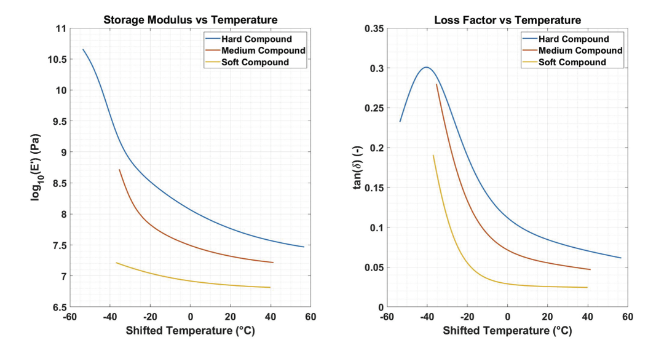
The hard compound, the medium compound and the soft compound show different viscoelastic master curves. These differences are important because the compound formulation affects storage modulus, loss factor and temperature sensitivity. A soft compound is expected to respond differently from a hard one when heated, deformed or placed under different surface interaction conditions.
The use of talc is central to the characterization approach. Talc changes the interaction between the VESevo indenter and the rubber surface, reducing the adhesive contribution during contact. By comparing the same compound under talc and no-talc conditions, the study provides a way to observe how much the adhesive behavior contributes to the rebound response.
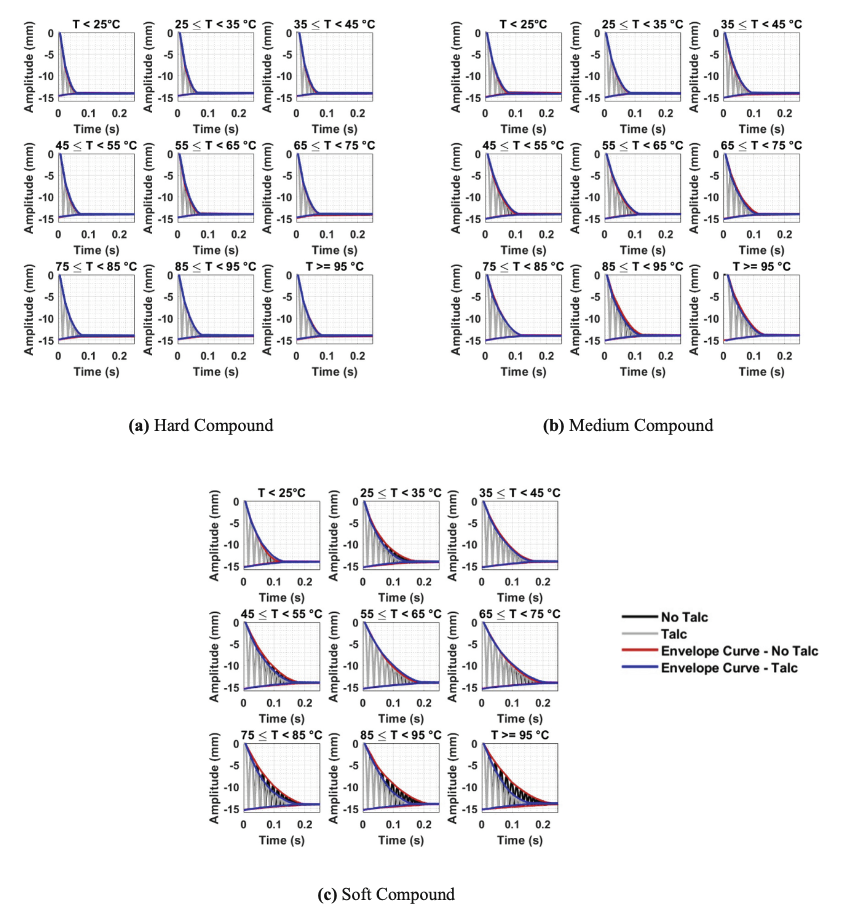
This is not a generic hardness comparison. The analysis focuses on the dynamic rebound response and on how the envelope of the peaks and valleys changes across thermal windows. For each testing condition, the authors identify an average rebound curve and then evaluate the envelope curves that interpolate peaks and valleys. This method makes the comparison more robust and easier to interpret.
For technical users, this is a useful approach because it connects measurement signals to compound behavior. It allows the response of hard, medium and soft compounds to be compared not only at one temperature, but across a structured thermal range where the adhesion effect changes progressively.
Tire Behavior: Temperature Effect on Adhesion and Rebound Response
Tire behavior is highly dependent on temperature because rubber materials change their mechanical response as their thermal state changes. The study confirms that temperature has a strong influence on the rebound curves acquired by VESevo. This influence is visible when comparing the curves at different thermal windows and when observing how the difference between talc and no-talc conditions evolves.
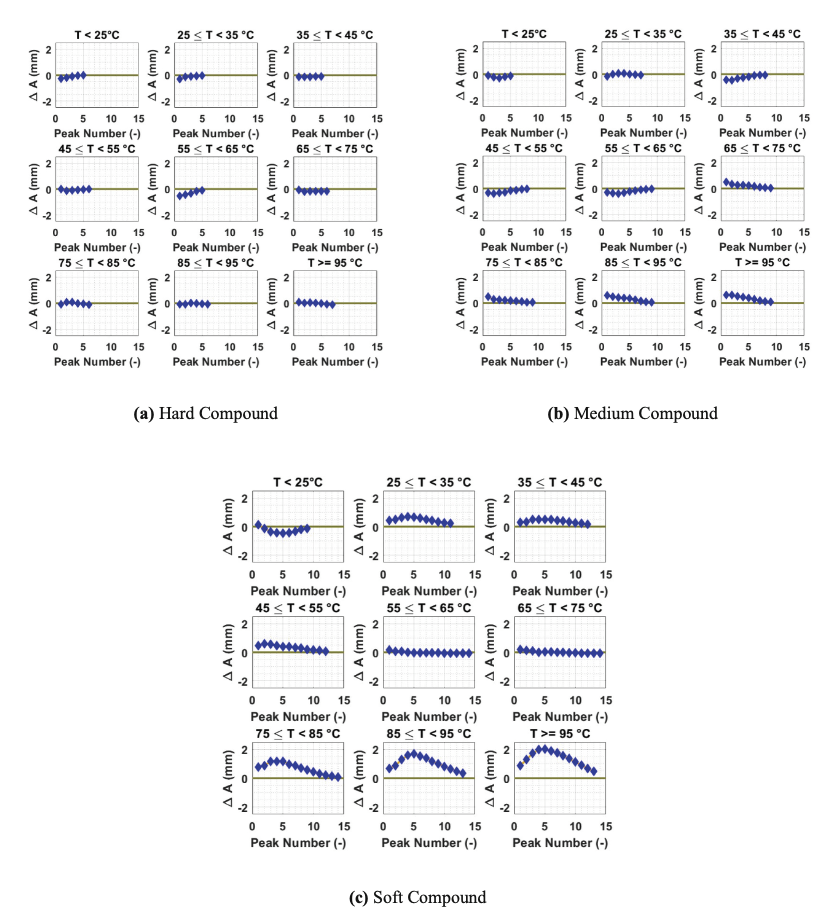
At lower temperatures, the difference between curves acquired with and without talc is generally smaller. As temperature increases, the difference tends to become more visible. This suggests that the adhesive behavior becomes more influential in the measured rebound response as the compound reaches higher thermal ranges.
The study also highlights that this behavior is not identical for every compound. The inversion in the curve behavior occurs at different thermal ranges depending on whether the compound is hard, medium or soft. In particular, the inversion appears at a very high thermal range for the hard compound, at a medium range for the medium compound and at a lower range for the soft compound.
This is a key result because it shows that adhesion-related behavior cannot be evaluated without considering compound type. A soft compound may reach a critical change in rebound behavior earlier than a hard compound. This kind of information is valuable for engineers who need to interpret tire performance under different operating temperatures.
Temperature therefore acts as both a physical variable and an interpretive filter. It changes the material response and also determines when the difference between talc and no-talc conditions becomes more meaningful.
Tire Performance: Why Adhesion Analysis Matters for Vehicle Dynamics
Tire performance is influenced by the ability of the tread compound to generate and maintain interaction with the road surface. Adhesion is one of the phenomena contributing to this interaction, together with other mechanisms linked to deformation, hysteresis, roughness and operating conditions. Understanding adhesion-related behavior can therefore support a more complete interpretation of vehicle dynamics.
The study is relevant because it uses a material-level measurement to investigate a phenomenon that has consequences at vehicle level. The rebound curves acquired with VESevo do not directly reproduce every aspect of real tire-road contact, but they provide useful information about how the compound behaves when the surface interaction is modified. This helps connect viscoelastic characterization with performance-oriented analysis.
For vehicle dynamics engineers, the value lies in the possibility of observing how different compounds react under changing thermal and surface conditions. A tire compound may offer different adhesion-related behavior depending on its softness, its temperature and its viscoelastic state. These differences can influence the way tire performance is interpreted in testing, modeling and development activities.
In motorsport and high-performance applications, this type of information can be especially important because tire operating temperature strongly affects available grip and consistency. In industrial tire development, it can support compound comparison and the study of surface interaction mechanisms. In research, it provides a non-destructive path to investigate adhesion-related phenomena without relying only on destructive characterization methods.
Envelope Curves and Peak Amplitude Difference: How the Adhesion Effect Is Quantified
The study does not stop at visual comparison of rebound curves. For each thermal window, the peaks and valleys of the acquired curves are detected. Then, for each compound and testing condition, an average rebound curve is identified. On this average curve, envelope curves are reconstructed by interpolating peaks and valleys.
This procedure makes it possible to compare the rebound behavior more clearly. The envelope curves show how the rebound amplitude evolves over time and how the response changes between talc and no-talc conditions. According to the paper, at lower temperatures the difference between the two conditions is small, while at higher temperatures the no-talc condition tends to present higher values than the talc condition.
The vertical distance between peaks is then used as a quantitative indicator. This quantity is indicated as ΔA and is calculated as the difference between the peak amplitude in the no-talc condition and the peak amplitude in the talc condition. A positive ΔA means that the no-talc curve is above the talc curve, while a negative value indicates the opposite behavior.
This is useful because it transforms the talc/no-talc comparison into a measurable parameter. Instead of relying only on curve inspection, engineers can evaluate how the adhesion-related difference evolves across compounds, thermal windows and rebound peaks.
For a technical audience, ΔA is one of the most important parts of the analysis because it provides a simple and interpretable way to quantify the difference between the two testing conditions. It also makes the comparison among hard, medium and soft compounds more structured.
Tire Wear Analysis: Potential Contributions of Non-Destructive Material Testing
Tire wear testing is not directly performed in this paper. The study does not measure tread wear, material removal or wear rate. However, the analysis is still relevant for broader lifecycle and performance studies because adhesion, temperature and viscoelastic properties are connected to how tire compounds behave during use.
As tires operate, their tread compounds are exposed to repeated deformation, thermal cycles and surface interaction. These conditions can modify the way the rubber responds over time. A non-destructive method such as VESevo can support repeated measurements and may therefore become useful in future studies focused on how adhesion-related behavior evolves with aging, usage or progressive material changes.
The paper itself identifies further developments related to the investigation of key performance indicators correlated with material viscoelastic properties while considering the adhesion effect. It also suggests that extending the procedure to other compounds would improve the statistical significance of the database.
For this reason, the connection with tire wear testing should be understood carefully. VESevo-based adhesion analysis does not replace direct wear testing, but it can provide complementary material information that may help interpret tire behavior during lifecycle studies, compound comparison and performance evaluation.
Why VESevo Is Relevant for Tire Adhesion Research
VESevo is relevant for tire adhesion research because it allows engineers to observe differences in rubber behavior through a repeatable, non-destructive measurement procedure. Instead of requiring destructive specimen preparation, the device acquires rebound curves directly from the tested rubber surface. This makes it suitable for comparing compounds and thermal conditions in a practical way.
The comparison between talc and no-talc conditions is particularly useful because it introduces a controlled change in the surface interaction. The presence of talc modifies the adhesive contribution during indentation, producing measurable changes in the rebound curves. These changes become especially meaningful when analyzed across different temperatures and compounds.
The study shows that the effect is not uniform. It depends on temperature and compound type. This is exactly why a structured testing campaign is necessary. A single measurement at one temperature would not be sufficient to describe the phenomenon. The thermal-window approach and the comparison among hard, medium and soft compounds provide a more complete view.
For tire engineers, this kind of analysis can support a deeper understanding of material behavior. For researchers, it provides a framework for studying adhesion through rebound response. For laboratories, it offers a non-destructive testing route that can be repeated under different conditions. For performance-oriented applications, it can help interpret how compound state and temperature influence adhesion-related response.
Frequently Asked Questions About Tire Adhesion and VESevo
What is the main focus of this study?
The study investigates adhesion-related effects in tire compounds through non-destructive viscoelastic characterization performed with the VESevo device. It compares rebound curves acquired on hard, medium and soft compounds, with and without talc, across different temperature windows.
Why is tire adhesion important?
Tire adhesion is important because it contributes to tire-road friction and therefore plays a role in grip and vehicle performance. It is influenced by the viscoelastic state of the rubber and by the contact conditions between the compound and the surface.
What does VESevo measure in this context?
In this study, VESevo measures rebound curves generated by a rod interacting with the rubber specimen. These curves are then analyzed to understand how compound type, temperature and talc/no-talc surface conditions influence the measured response.
Why is talc used during the test?
Talc is used to modify the adhesive interaction between the indenter and the rubber surface. By comparing measurements with and without talc, the study highlights differences related to the adhesion component of the rebound response.
How does temperature affect tire adhesion analysis?
Temperature affects rubber viscoelastic behavior. As the compound heats up, its response changes, and the difference between talc and no-talc rebound curves can become more evident. This is why the study divides the analysis into several thermal windows.
Which compounds were tested?
The study tested three different compounds: a hard compound, a medium compound and a soft compound. This allowed the authors to compare how the adhesion-related rebound response varies according to compound behavior.
What are rebound curves?
Rebound curves describe the displacement response of the VESevo rod after interaction with the rubber specimen. Their shape, peaks, valleys and envelope curves provide information about the dynamic response of the compound.
What is ΔA in the analysis?
ΔA is the difference between the peak amplitude of the no-talc rebound curve and the corresponding peak amplitude of the talc rebound curve. It is used to quantify the difference between the two testing conditions.
Does this study perform direct tire wear testing?
No. The study does not directly measure tire wear. However, the analysis is relevant for broader lifecycle and performance studies because adhesion, temperature and viscoelasticity are connected to how tire compounds behave during use.
Can VESevo replace full tire-road friction testing?
No. VESevo does not replace complete tire-road friction testing or vehicle-level validation. It provides complementary, non-destructive material-level information that can support adhesion analysis, compound comparison and tire performance interpretation.
Why is this approach useful for tire engineers?
It is useful because it provides a repeatable and non-destructive way to compare the adhesion-related behavior of different compounds under different thermal conditions. This can support material characterization, research activity and performance-oriented analysis.
What future developments does the study suggest?
The study suggests future developments related to key performance indicators correlated with viscoelastic properties and adhesion effects. It also highlights the value of extending the procedure to additional compounds to increase the statistical significance of the database.
Scientific Source
This article is based on the scientific paper: Stefanelli, R.; Suero, R.; Aprea, M.; Timpone, F.; Farroni, F. Tire Viscoelasticity Characterization for Adhesion Phenomena Analysis by Using the VESevo Innovative Technology. In: Quaglia, G. et al. (eds) Advances in Italian Mechanism Science, IFToMM Italy 2024, Mechanisms and Machine Science, vol. 164, Springer, 2024. DOI: 10.1007/978-3-031-64569-3_46.
Editorial note: The information provided in this article is technical and general in nature. It does not replace customized engineering analysis, laboratory validation, vehicle-level tire testing or product-specific performance assessment. Any use of tire adhesion, viscoelasticity or rebound-curve data for design, safety, motorsport or production purposes should be evaluated by qualified technical professionals.