
Underwater Deflectors
Defect detection through property
In industrial and infrastructural applications, the ability to identify potential critical issues before the installation of components plays a fundamental role in preventing damage, reducing operational risks and improving the overall reliability of systems. In this context, the use of non-destructive and repeatable measurement techniques represents a key element for the preliminary evaluation of the performance of manufactured components.
One of the most recent applications of VESevo technology concerns the characterization of marine cable cover, with the objective of supporting pre-installation assessment activities through the measurement of the material viscoelastic properties.
The study focused in particular on two parameters representative of local mechanical behavior:
- the AVI (Adhesion Viscoelastic Index), which provides indications of the softness of the material
- the HVI (Hysteretic Viscoelastic Index), which describes the ability of the material to dissipate energy during impact.
For both parameters, higher values are associated with softer materials and a greater hysteretic response, respectively.
Evaluating the AVI and HVI values across the entire surface of the cable cover allows the generation of color maps that highlight local variations in mechanical properties, providing a clear visualization of potential inhomogeneities over the analyzed area.
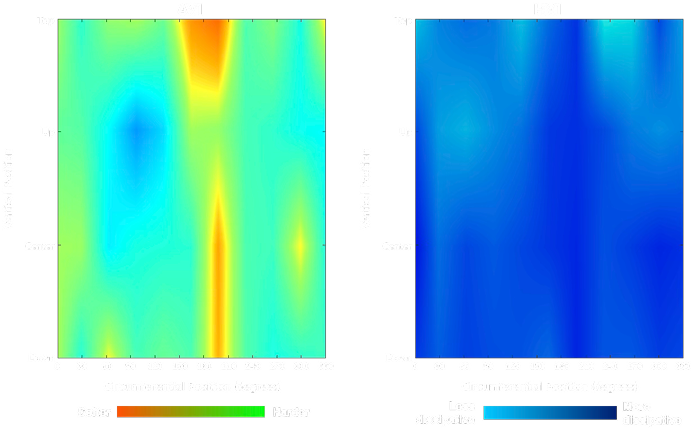
The variations, showed in the color maps, could be referred to material inhomogeneities related to the production process, which are not always detectable through traditional inspections.
Such defects could potentially cause breakage initiation points or damage after installation, especially under critical operating conditions.
The results obtained show how VESevo can be employed as a quality control and risk mitigation tool, helping to improve the reliability of marine cable deflectors prior to their installation and use in service.