
In modern vehicle engineering, tire behavior cannot be understood only through geometry, tread pattern or nominal compound category. The real response of a tire depends on how its rubber materials react to frequency, temperature, load, deformation, aging and operating conditions. This is why the mathematical modeling of viscoelastic materials has become a crucial topic for tire applications, especially when engineers need to predict performance, safety, durability and lifecycle behavior.
The scientific study behind this article focuses on the nonlinear mathematical modeling of frequency-temperature dependent viscoelastic materials. These materials are especially relevant in the mobility sector because tires represent the only interface between vehicle and road. Their properties influence handling, safety, energy efficiency and environmental impact. For this reason, a reliable tire mechanical model must be able to reproduce the realistic behavior of rubber compounds across a wide range of frequencies and temperatures.
The paper proposes an innovative nonlinear fractional derivative generalized Maxwell model, referred to as NLGFMW. The goal is to overcome some limitations of conventional fractional models and improve the reproduction of complex viscoelastic behavior, especially when materials show marked nonlinear variations in storage modulus and loss factor. This is particularly important for tire compound analysis, tire polymer behavior and advanced simulation workflows.
For engineers, researchers, laboratories and tire makers, this type of model can support more accurate material characterization, more reliable finite element analysis, better performance forecasting and more efficient experimental testing strategies. Instead of relying only on extensive experimental campaigns, the model aims to reproduce the dynamic behavior of viscoelastic materials even when only a reduced amount of experimental data is available.
This overview explains the technical meaning of the study in a clear and structured way, focusing on tire testing, tire analysis, tire measurement, tire performance, tire characterization, tire behavior and tire wear testing, while remaining faithful to the scientific content of the original research.
Tire Analysis: Why Viscoelastic Modeling Matters
Tire analysis becomes meaningful when it helps explain how rubber materials behave under real working conditions. A tire tread is not a simple elastic component. It is made of polymeric and rubber-based materials that combine elastic and viscous behavior. This means that the response of the material depends not only on the applied load, but also on the excitation frequency, temperature and time history.
In the context of tire applications, this is especially important because the tire is continuously excited by the road. During rolling, braking, cornering and interaction with surface roughness, tire treads experience repeated deformation over many frequency ranges. At the same time, temperature changes can shift the material response, modifying stiffness, damping and energy dissipation.
A mathematical model is useful because it transforms experimental material behavior into a structured representation that can be used in simulation, design and prediction. If the model is too simple, it may fail to describe the real response of the material. If it requires too many parameters, it may become difficult to calibrate and impractical for industrial workflows. The study addresses this balance by proposing a nonlinear fractional model designed to reproduce the dynamic moduli of viscoelastic materials with improved flexibility.
For professionals working with tires, this has direct implications. A better model can support product design, simulation analysis, lifecycle prediction and performance assessment. It can also help engineers understand how a tire polymer or compound may behave when temperature, frequency or aging conditions change.
Tire Testing: From Experimental Data to Predictive Models
Tire testing and material testing provide the experimental foundation needed to build reliable viscoelastic models. The paper explains that rubber materials can be characterized through different procedures, including static tests, quasi-static tests, transient tests and dynamic tests. Among these, Dynamic Mechanical Analysis, commonly known as DMA, is one of the most established approaches for measuring frequency-dependent and temperature-dependent material properties.
DMA makes it possible to measure storage modulus and loss factor by applying controlled stress or strain to a material specimen and analyzing its response. These quantities are essential for understanding how the compound stores energy, dissipates energy and changes behavior across temperature and frequency. However, experimental testing can require time, equipment, material preparation and a wide acquisition range if the goal is to reconstruct the complete viscoelastic response.
The study is relevant because it does not simply discuss experimental testing. It focuses on how experimental data can be used to calibrate a mathematical model capable of reproducing the material behavior over an extended frequency range. This is important for tire makers and research teams because the model may reduce the need for very large experimental datasets when the most informative regions of the material response are properly selected.
The paper also refers to the emergence of innovative non-destructive dynamic testing tools, such as VESevo, which can evaluate the viscoelastic characteristics of finished products like tires by studying the dynamics of a free bouncing rod. This connection is important because future tire testing workflows may combine smart measurement devices with robust mathematical models to improve characterization, simulation and lifecycle monitoring.
In this perspective, tire testing is not only about collecting data. It is about collecting the right data, identifying meaningful regions of the frequency-temperature response and using those data to build models that remain physically coherent and practically useful.
Tire Measurement: Storage Modulus, Loss Factor and Frequency-Temperature Dependence
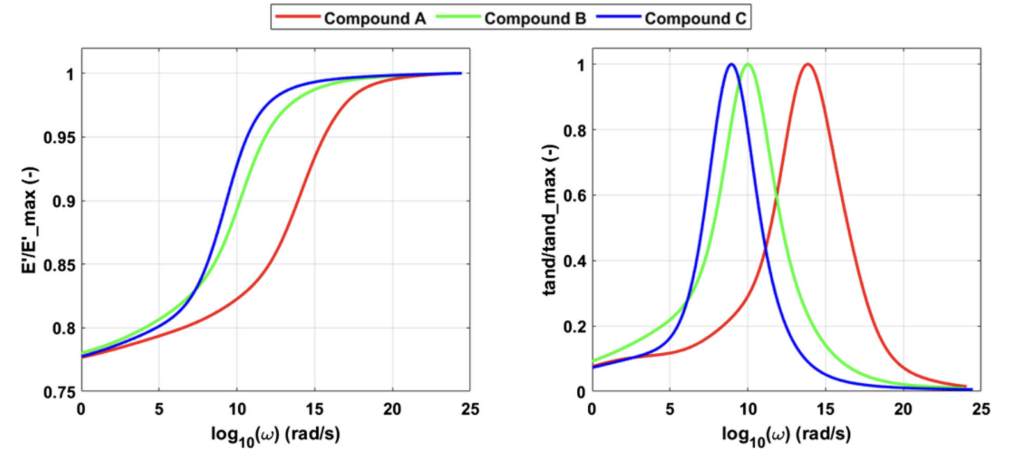
Tire measurement, in the context of viscoelastic material modeling, is closely connected to the measurement of storage modulus and loss factor. The storage modulus describes the elastic part of the response: it indicates how much energy the material can store during deformation. The loss factor describes the damping behavior: it indicates how much energy is dissipated inside the material.
When a sinusoidal stress is applied to a viscoelastic material, the resulting strain does not occur perfectly in phase with the input. There is a phase lag caused by internal energy dissipation. This is one of the key reasons why a tire compound cannot be described as a purely elastic material. The rubber response changes with frequency, and the temperature modifies the molecular mobility of the polymer chains.
At low frequencies, polymer chains have more time to reorganize, and the material tends to show rubbery behavior. At high frequencies, the chains cannot reorganize quickly enough, and the material approaches a glassy response. Temperature acts in a similar way through the time-temperature superposition principle: by increasing temperature, molecular mobility increases and the material response can shift along the frequency axis.
This relationship is fundamental for tire applications. A tire tread compound may behave differently during slow deformation, high-speed excitation, cold operation, hot operation or repeated thermal cycles. A realistic tire mechanical model must therefore reproduce both frequency and temperature effects in order to be useful for simulation and prediction.
The proposed nonlinear model uses these measured dynamic properties to reproduce the trends of storage modulus and loss factor over a broad range. This makes tire measurement more valuable because the measured data become the basis for a predictive representation of the material.
Tire Characterization: From Viscoelastic Materials to Mathematical Models
Tire characterization requires more than measuring a single property. It means describing how the tire compound behaves under a range of conditions and translating that behavior into parameters that can be used in engineering models. In the paper, this process is addressed through a fractional derivative modeling framework.
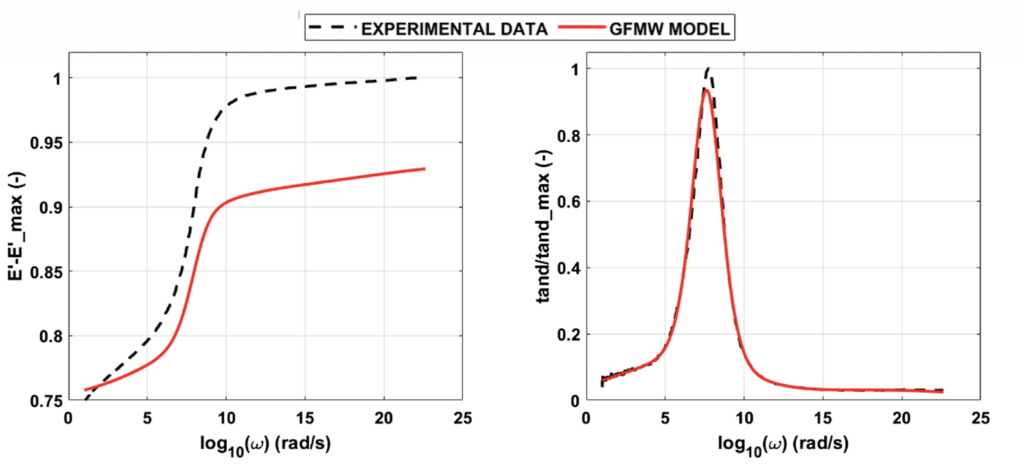
Classical viscoelastic models often rely on mechanical analogies such as springs and dashpots. A spring represents the elastic component, while a dashpot represents viscous damping. Simple models, such as Maxwell or Kelvin-Voigt models, can be useful in limited ranges, but they are not sufficient to describe complex rubber behavior over broad frequency and temperature domains.
Generalized Maxwell models improve this description by combining multiple elements, but they may require many parameters and lead to computational complexity. Fractional models introduce spring-pot elements, which are able to reproduce viscoelastic behavior with fewer parameters and better flexibility. The paper builds on this approach by proposing a nonlinear generalized fractional Maxwell model.
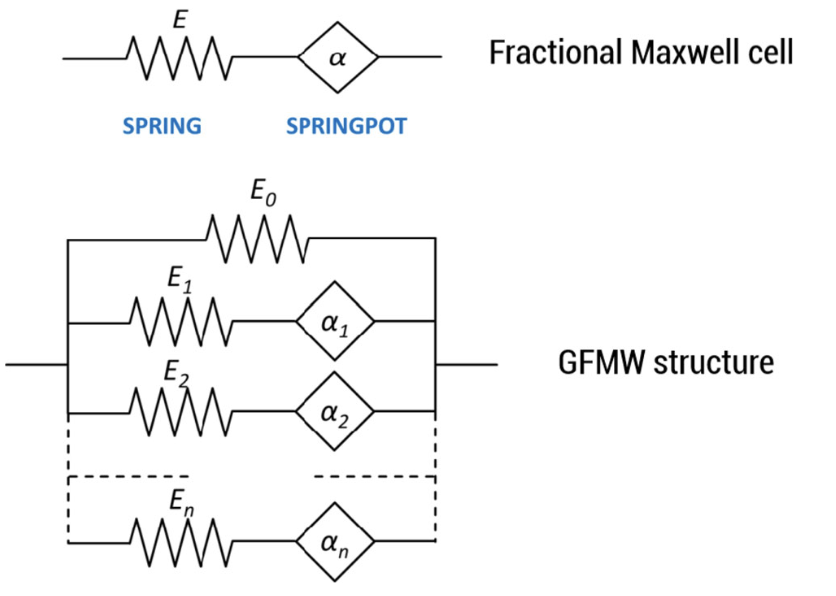
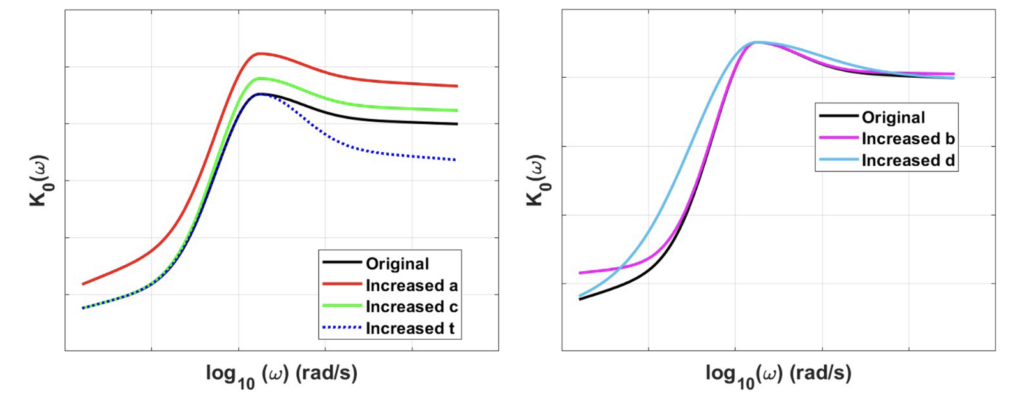
The key innovation is the introduction of a frequency-dependent stiffness term, indicated as K0(ω), into the model structure. This nonlinear element improves the ability to reproduce slope variations in the storage modulus, especially for materials whose behavior cannot be captured accurately by classical linear fractional models.
This is particularly important for tire compound characterization because tire materials can show complex internal dissipative phenomena. Their response depends on polymer composition, resins, additives, curing and technological treatments. A model that adapts better to these variations can provide a more realistic representation of tire materials.
Tire Behavior: Why Nonlinear Modeling Improves Realistic Prediction
Tire behavior is nonlinear in many practical conditions. Rubber compounds may respond differently depending on frequency, temperature, strain history, aging and material composition. While the loss factor often maintains a bell-shaped trend, the storage modulus can show slope changes that are difficult to reproduce with a purely linear formulation.
The paper explains that real materials can show transition phases that are less clear than idealized curves. This happens because compounds are mixtures of polymers, oils, resins and additives. Each component can influence the material response at different temperatures and frequencies. As a result, the storage modulus may not follow a simple smooth sigmoidal trend.
This is where the nonlinear model becomes useful. By introducing a frequency-dependent stiffness contribution, the NLGFMW model increases flexibility in following slope variations. The additional nonlinear component mainly affects the storage modulus without changing the phase prediction in a physically inconsistent way. This is important because the model remains coherent with the expected physics of viscoelastic behavior.
For tire engineering, this means that the model can better represent the behavior of different materials, including those with less regular or more complex viscoelastic trends. A better representation of tire behavior supports more reliable simulations, more accurate prediction of performance changes and more meaningful interpretation of experimental data.
In practical terms, nonlinear modeling helps bridge the gap between laboratory material characterization and real tire applications, where rubber behavior is rarely ideal and often depends on multiple interacting factors.
Tire Performance: Modeling Rubber Response for Simulation and Design
Tire performance depends on the interaction between material properties, geometry, load conditions and road excitation. A tire compound that behaves well in one temperature or frequency range may respond differently in another. This is why a realistic material model is valuable for design, simulation and performance prediction.
The paper emphasizes that reliable models can help in simulation analysis and in predicting how a product made with a specific material will behave under certain solicitation and temperature conditions. This is relevant for finite element analysis, complex eigenvalue analysis and other simulation workflows where a purely elastic model may be insufficient.
For tire performance studies, a viscoelastic model can support the evaluation of how the tread compound contributes to stiffness, damping, vibration response, grip-related behavior and lifecycle evolution. It can also help predict how performance may change due to aging or other factors affecting the material.
The NLGFMW model was validated on ten different viscoelastic materials, including compounds and slabs with different glass transition frequencies, loss factor values and storage modulus plateaus. This broad validation is important because it shows that the model is not tuned only for one ideal material, but can adapt to different material behaviors.
For tire makers, the practical value lies in better decision-making. A more accurate model can support compound comparison, design optimization and the interpretation of experimental data. It can also contribute to reducing the amount of testing needed when the model can be calibrated using selected portions of the experimental response.
Tire Mechanical Model: NLGFMW and the Role of Frequency-Dependent Stiffness
A tire mechanical model must be able to describe how the material behaves when exposed to dynamic solicitation. The NLGFMW model proposed in the paper extends the classical generalized fractional Maxwell approach by introducing a nonlinear stiffness function. This function changes with frequency and improves the description of complex storage modulus trends.
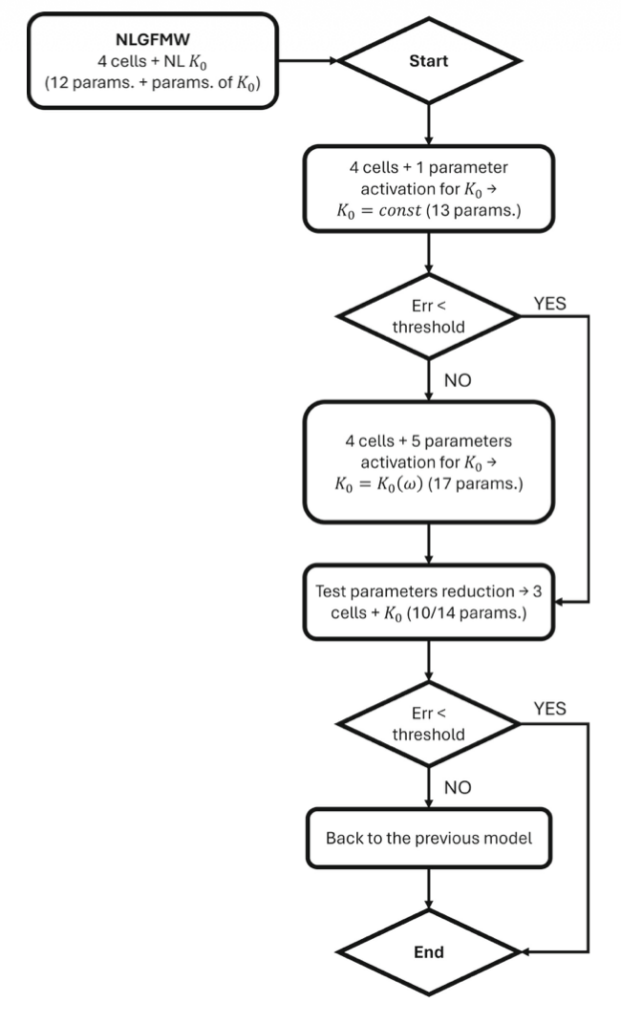
The model relies on a pole-zero formulation, which helps reduce computational complexity and improves the robustness of the parameter identification procedure. Instead of calibrating the model directly through a large and difficult parameter space, the pole-zero formulation constrains the identification process and supports more stable optimization.
The optimization procedure uses a multi-objective approach because the model must reproduce two different quantities at the same time: storage modulus and loss factor. These quantities can present conflicting fitting requirements, meaning that a model may fit one curve well while failing on the other. The study addresses this problem by using MAPE-based metrics and a structured calibration logic.
The result is a model that can work with different numbers of fractional elements. The paper analyzes models with three, four and five elements, comparing their performance and computational cost. A four-element configuration is presented as a strong trade-off between accuracy and complexity, while a three-element version can still provide useful results with shorter computation time.
This balance is important for practical tire applications because engineering models must not only be accurate. They must also be efficient enough to be used in real workflows, simulation environments and potentially monitoring-oriented applications.
Tire Applications: What the Results Show for Rubber Materials
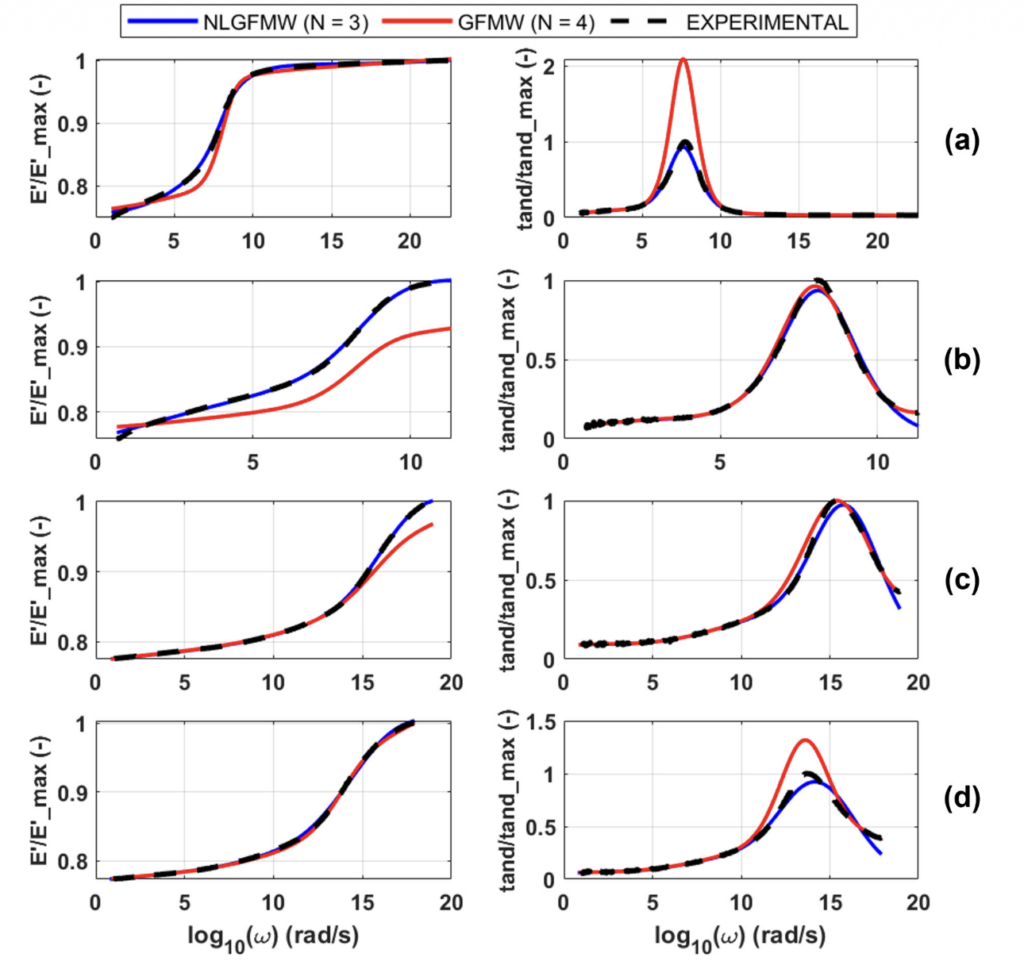
The results of the paper show that the NLGFMW model can reproduce the viscoelastic behavior of different materials with high accuracy. The model was applied to ten materials selected to cover a wide range of viscoelastic responses. These included compounds with marked transition zones and slabs characterized by different glass transition frequencies and dynamic properties.
The comparison between models with three, four and five fractional elements showed that all three configurations achieved satisfactory results, with errors generally remaining within acceptable ranges. Increasing the number of elements can reduce error in some cases, but it also increases the number of parameters and the computational cost. This is why the study identifies the four-element NLGFMW model as a practical compromise.
The paper also compares the nonlinear NLGFMW model with the traditional GFMW model. The nonlinear model performs better for most materials, especially those with less regular viscoelastic trends. For materials with very regular transition behavior, the classical fractional model can already perform well, making the nonlinear component less essential. This is why the proposed calibration logic activates the nonlinear stiffness function only when needed.
This is particularly useful for tire applications because tire materials are not all identical in their behavior. Some compounds may show smooth and regular trends, while others may have complex slope variations due to chemical composition, curing, resins, additives or technological treatment. A model that can adapt to these differences is more valuable for industrial and research use.
For tire makers, the key message is that nonlinear modeling can improve the ability to represent a wider range of compounds without abandoning physical coherence or requiring an excessive number of parameters.
Tire Wear Testing: How Material Modeling Supports Aging and Lifecycle Analysis
Tire wear testing is not addressed in the paper as a direct tread wear experiment, but the study has a clear connection with lifecycle analysis and material evolution. The introduction explains that realistic models of viscoelastic materials can be employed to monitor the behavior of existing products throughout their whole life cycle and to forecast performance changes caused by aging or other factors.
This is important because tires change during use. Their materials are exposed to repeated deformation, thermal cycles, mechanical stress and environmental aging. As these conditions accumulate, the viscoelastic response of the compound can change. A reliable model can help engineers interpret how those changes may influence stiffness, damping and performance over time.
In this sense, tire wear testing should not be understood only as measuring tread depth or visual degradation. For advanced engineering applications, it also includes understanding how the material response evolves with use. A mathematical model that reproduces frequency-temperature dependent behavior can support this broader interpretation of wear, aging and lifecycle performance.
The possibility of calibrating the model with limited experimental data is especially valuable here. If a reduced set of measurements can still reproduce the overall behavior of the material, then lifecycle monitoring can become more efficient. This may help reduce experimental effort while still providing useful information about how tire materials evolve.
For laboratories, manufacturers and research teams, this creates a bridge between material testing, mathematical modeling and long-term performance forecasting. The model does not replace physical tire wear testing, but it can support the interpretation of material-level changes that influence the behavior of tire treads over time.
Limited Experimental Data: Reducing Testing Time and Resources
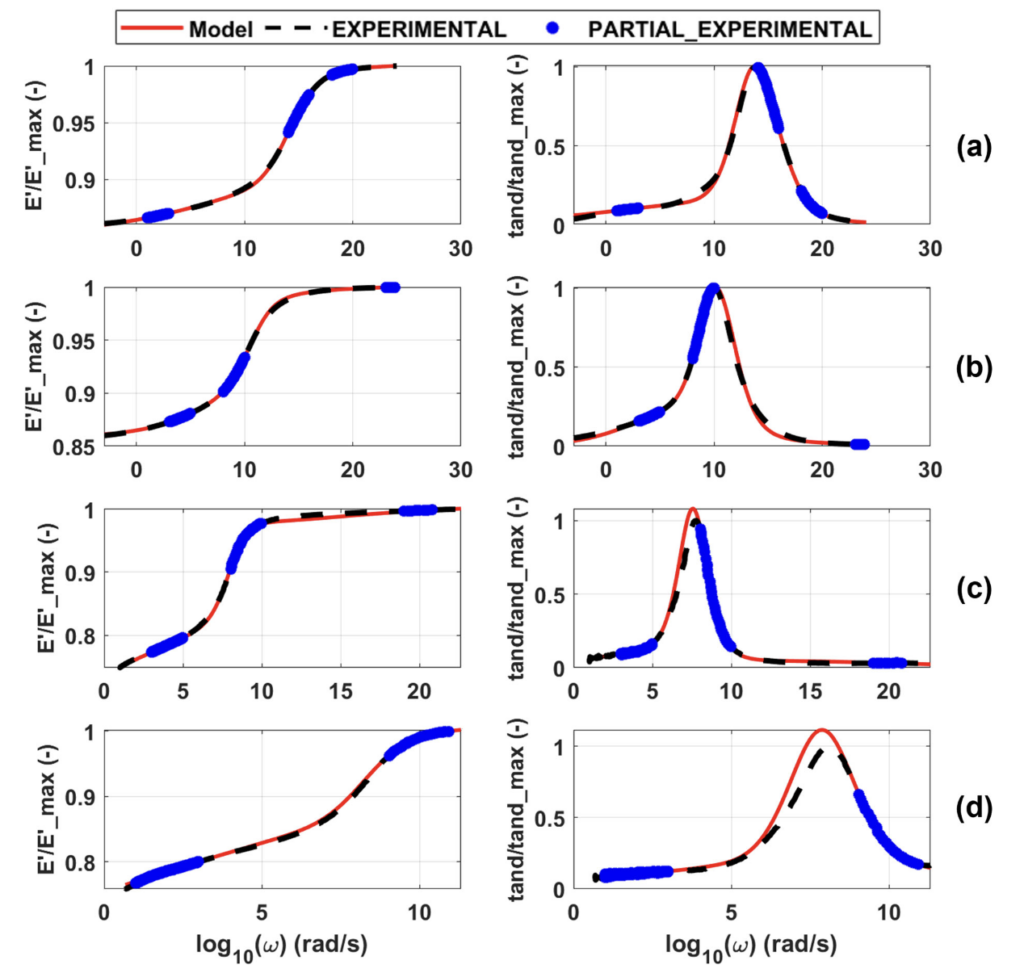
One of the most useful parts of the paper is the analysis of model calibration with limited experimental data. Full experimental characterization over a wide frequency range can require significant time, cost and resources. The study investigates whether the NLGFMW model can reproduce material behavior using only selected portions of the experimental data.
The authors focus on key zones: the lower-frequency plateau of the storage modulus, the upper-frequency plateau and the region around the glass transition temperature. These zones are important because they provide information about the material response far from and near the transition region. In some cases, when the complete upper plateau is not available, the model adapts using the available data.
The results are promising. The study shows that, by choosing the most relevant experimental zones, it is possible to reproduce the viscoelastic behavior over a wider frequency range while using only a fraction of the total experimental data. This has important practical implications because it can reduce the number of tests needed and make material characterization more efficient.
For tire makers, this approach could be particularly useful when the glass transition region can be estimated from compound formulation or known material components. If the most informative regions are selected correctly, the model can support faster material characterization and reduce experimental resource consumption.
Why This Model Is Useful for Engineers, Laboratories and Tire Makers
The value of the NLGFMW model is that it provides a more flexible and physically coherent way to represent frequency-temperature dependent viscoelastic behavior. For engineers, this means better material models for simulation. For laboratories, it means more effective use of experimental data. For tire makers, it means a possible route toward faster characterization, compound comparison and performance forecasting.
The model is especially useful because it addresses a real limitation of classical approaches. Traditional fractional models can work well for regular materials, but they may struggle when the storage modulus shows complex slope variations. The nonlinear stiffness function introduced in the study improves adaptability without making the model unnecessarily detached from physical interpretation.
Another strong point is computational efficiency. The study shows that reduced-parameter versions of the model can still provide valid results, and that the calibration logic can avoid unnecessary nonlinear complexity when a simpler configuration is already sufficient. This makes the approach more suitable for practical engineering use.
In the tire industry, where material behavior influences safety, performance, comfort, wear and environmental impact, models of this type can help transform experimental characterization into actionable engineering information. They support the transition from isolated test data to predictive tire mechanical models that can be used across design, validation and lifecycle analysis.
Frequently Asked Questions About Tire Modeling and Viscoelastic Materials
What is the main purpose of this study?
The study proposes a nonlinear fractional derivative generalized Maxwell model designed to reproduce the frequency-temperature dependent behavior of viscoelastic materials, especially for tire applications and rubber-based materials.
Why is viscoelastic modeling important for tire applications?
Viscoelastic modeling is important because tires are made of rubber materials whose behavior depends on frequency, temperature and time. A realistic model helps predict stiffness, damping, performance changes and material behavior in different working conditions.
What is a tire mechanical model?
A tire mechanical model is a mathematical representation used to describe how tire materials or tire structures respond to loads, deformation, frequency and temperature. In this article, the focus is on material-level modeling of viscoelastic tire compounds.
What are storage modulus and loss factor?
The storage modulus describes the elastic component of the material response, while the loss factor describes damping and energy dissipation. Together, they help explain how a tire compound behaves under dynamic solicitation.
What is the NLGFMW model?
The NLGFMW model is a nonlinear generalized fractional Maxwell model. It extends classical fractional Maxwell models by adding a frequency-dependent stiffness term that improves the reproduction of complex storage modulus trends.
Why is the nonlinear stiffness term important?
The nonlinear stiffness term helps the model follow slope variations in the storage modulus that classical linear fractional models may not reproduce accurately. This is useful for materials with complex chemical composition or irregular viscoelastic transitions.
How does temperature affect tire compounds?
Temperature affects molecular mobility in rubber materials. As temperature changes, the material response shifts, influencing stiffness, damping and the transition between rubbery and glassy behavior.
How does frequency affect tire behavior?
At low frequencies, polymer chains have more time to reorganize, producing rubbery behavior. At high frequencies, molecular motion is restricted, and the material tends toward a glassy response with higher stiffness.
Can this model support tire testing?
Yes. The model uses experimental data, such as DMA results, to reproduce the viscoelastic behavior of tire materials. It can support more efficient testing strategies by reducing the amount of data needed when key frequency-temperature zones are selected correctly.
Can the model help with tire performance prediction?
Yes. By reproducing the viscoelastic response of tire compounds, the model can support simulations and forecasts related to stiffness, damping, material behavior, lifecycle evolution and performance under different operating conditions.
Is tire wear testing directly performed in the paper?
No. The paper does not present a direct tire wear test. However, it discusses lifecycle monitoring and performance forecasting, which are connected to tire wear testing, aging and the evolution of material behavior over time.
Why is limited experimental data important?
Limited experimental data can reduce testing time and cost. The study shows that selected data around low and high-frequency plateaus and the glass transition region can still be sufficient to reproduce the broader viscoelastic behavior of materials.
Who can benefit from this modeling approach?
Engineers, research laboratories, simulation specialists and tire makers can benefit from this approach because it supports material characterization, model calibration, compound comparison, performance forecasting and more efficient experimental workflows.
Scientific Source
This article is based on the scientific paper: Sakhnevych, A.; Maglione, R.; Suero, R.; Mallozzi, L. Nonlinear mathematical modeling of frequency-temperature dependent viscoelastic materials for tire applications. Nonlinear Dynamics, 2024. DOI: 10.1007/s11071-024-10175-z.
Editorial note: The information provided in this article is general and technical in nature. It does not replace customized engineering analysis, laboratory validation or product-specific simulation work. Any use of material models for tire design, safety evaluation, production control or performance prediction should be assessed by qualified technical professionals.