
Understanding tire friction requires more than measuring grip at vehicle level. The friction generated during tire-road interaction depends on a complex combination of rubber viscoelasticity, road roughness, contact pressure, sliding velocity, temperature and the actual portion of tire tread that is effectively in contact with the road surface. For this reason, the study of the tire-road local contact area has become a central topic in tire performance analysis, road safety and racing applications.
The scientific study discussed here presents a physical-analytical approach to estimate the ratio between the real contact area and the nominal contact area, indicated as Ac/A0. This ratio is important because the real contact area is smaller than the nominal one: the tire tread does not perfectly conform to every road asperity, and only specific portions of the rubber actually interact with the surface texture.
The research combines three key elements: road roughness characterization, non-destructive tire tread viscoelasticity evaluation through the VESevo device, and an extended contact model based on Greenwood–Williamson theory. The resulting model is then validated through both indoor laboratory tests and outdoor high-performance vehicle testing on different tracks.
This is particularly relevant for engineers, researchers, laboratories, tire manufacturers and motorsport teams because it connects material-level characterization with measurable friction behavior. Instead of relying only on experimental friction tests after the fact, the model aims to provide a way to estimate relative friction potential by analyzing the surface, the compound and the operating conditions.
This overview explains the technical meaning of the study in a structured way, focusing on tire friction, tire testing, tire measurement, tire characterization, road roughness, tire-road contact modeling and the role of VESevo in non-destructive viscoelastic evaluation.
For a broader context on VESevo technology and tire material characterization, this article is connected to previous technical overviews on non-destructive tire testing and viscoelastic characterization, nonlinear modeling of viscoelastic materials for tire applications, tire adhesion analysis with VESevo technology and non-destructive testing for tire measurement, performance and characterization.
Tire Friction: Why Real Contact Area Matters
Tire friction is generated through the interaction between the rubber tread and the road surface. This interaction is not uniform across the entire apparent contact patch. Although the nominal contact area may look continuous at macroscopic scale, the real contact occurs locally at road asperities, where the rubber penetrates or conforms to the rough surface profile.
This difference between nominal contact area and real contact area is fundamental. The nominal area, A0, represents the apparent area that the rubber would cover if it perfectly followed the road profile. The real contact area, Ac, represents the effective portion of the tread that actually touches and interacts with the surface asperities. Since road surfaces are rough and irregular, Ac is generally much smaller than A0.
The ratio Ac/A0 therefore becomes a useful indicator for understanding how much of the nominal contact patch is effectively involved in the friction process. A higher real-to-nominal contact area ratio can be associated with a greater capacity of the rubber to interact with the surface, while a lower ratio indicates reduced local engagement between tread and road texture.
In practical terms, this ratio helps explain why two road surfaces can produce different friction levels even when the same tire compound and similar operating conditions are used. It also helps explain why tire-road interaction must be studied by considering both the mechanical behavior of the rubber and the morphology of the road surface.
The study demonstrates that the simulated Ac/A0 ranking is consistent with the experimental friction ranking in both indoor and outdoor environments. This makes the real contact area ratio a meaningful bridge between contact mechanics and tire performance analysis..
Tire-Road Contact Modeling: From Roughness to Friction Prediction
Tire-road contact modeling is one of the most complex parts of tire friction analysis because it requires the integration of several physical phenomena. A realistic model must consider the roughness of the road, the viscoelastic response of the tire tread compound and the operating conditions under which the tire interacts with the surface.
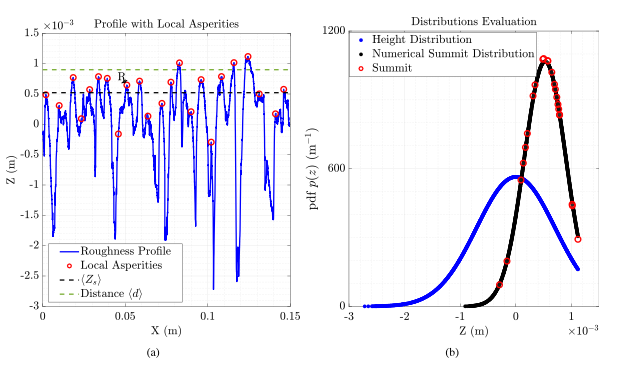
The paper develops an extended version of the Greenwood–Williamson contact model. The original Greenwood–Williamson framework describes a rough surface as a statistical distribution of asperities. Contact occurs when asperity heights exceed a separation distance, and each local contact region can be treated through Hertzian contact assumptions.
In this study, the Greenwood–Williamson approach is extended to account for tire-road interaction by including the viscoelastic properties of the rubber material and the statistical description of the road roughness. This makes the model suitable for evaluating the real-to-nominal contact area ratio between a viscoelastic tire compound and a rough surface.
The model receives several inputs: road roughness descriptors, tire tread viscoelastic properties, sliding velocity, contact pressure and tire surface temperature. These variables are necessary because the contact area depends not only on the geometry of the road, but also on how the rubber stiffness changes with frequency and temperature.
This is where the approach becomes especially relevant for practical tire applications. By combining surface scanning, non-destructive viscoelastic testing and operating condition data, the model can simulate how the local contact area changes across different road surfaces and tire states.
The result is a physical-analytical framework that can support friction prediction before complete experimental campaigns are performed. It does not eliminate the need for validation, but it offers a structured way to anticipate relative friction behavior among different surfaces.
Road Roughness Characterization: Macro and Micro Texture
Road roughness characterization is a key part of the study because the surface texture determines how the tire tread locally interacts with the road. Roughness is not only a visual or geometric property; it directly affects indentation, contact area, adhesion, hysteresis and the development of friction forces.
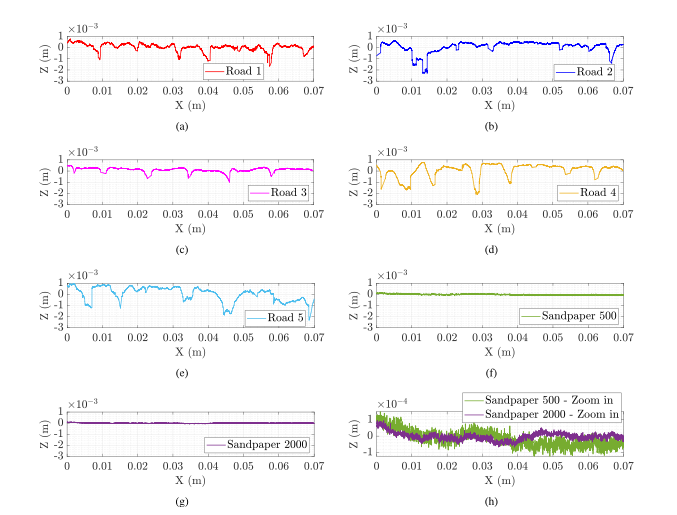
The research analyzes both indoor road specimens and outdoor tracks. Under controlled indoor conditions, several road specimens with different materials and surface characteristics are scanned. Sandpapers with different grit sizes are also included to challenge the model with unconventional surfaces and to evaluate whether the methodology remains consistent outside standard road textures.
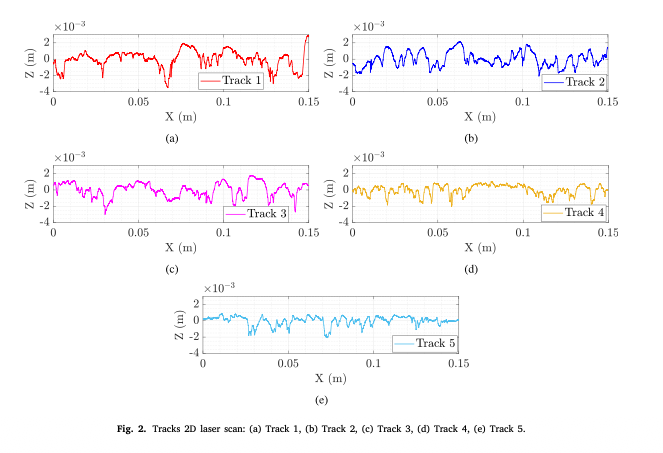
For the outdoor environment, five different tracks are scanned. This makes it possible to test the model not only under laboratory conditions, but also in real-world racing contexts where road texture, tire operating conditions and friction behavior are more complex.
The study distinguishes between macro-roughness and micro-roughness. Macro-roughness refers to larger-scale surface irregularities, while micro-roughness refers to smaller asperities and local peaks that directly participate in tire-road contact. Both scales are important because they influence different aspects of friction behavior.
Macro-roughness affects the overall contact geometry and load distribution. Micro-roughness influences local contact, adhesion and shear mechanisms. For this reason, a contact model that aims to predict friction behavior must include a physically meaningful description of both scales.
Innovative Roughness Data Processing for Tire Contact Analysis
One of the most important methodological contributions of the paper is the proposed approach for roughness data processing. Traditional spectral methods can be useful, but they may present limitations when the goal is to identify the micro-scale features that are physically involved in tire-road contact.
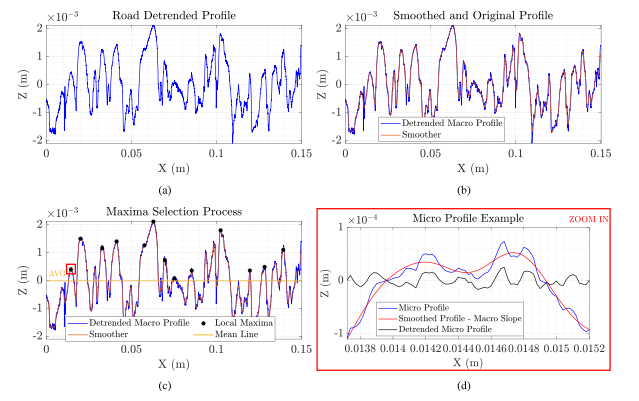
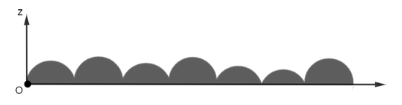
The study introduces a procedure based on geometric analysis of the surface profile. The idea is that tire-road contact primarily occurs on the peaks of the road profile. Therefore, the method isolates local maxima, removes the macro-slope effect and extracts micro-profiles that are representative of individual asperities.
The procedure begins with the acquisition of the macro roughness profile through a texture scanner. A smoothing operation is then applied to identify the summits of the profile. Peaks below the mean line are neglected because they are not expected to contribute significantly to tire-road contact. Once the relevant peaks are identified, local micro-profiles are extracted around each summit.
These micro-profiles are initially affected by the underlying macro-scale slope of the road profile. This effect is removed so that the final micro-profile represents the local asperity more accurately. The extracted profiles are then used to calculate micro-roughness indicators that serve as inputs to the contact model.
This approach is valuable because it links roughness characterization directly to the physical contact process. Instead of treating the whole surface profile as a generic signal, it focuses on the local maxima that are most relevant to the interaction between rubber and road.
Height Difference Correlation Function and Surface Texture Indicators
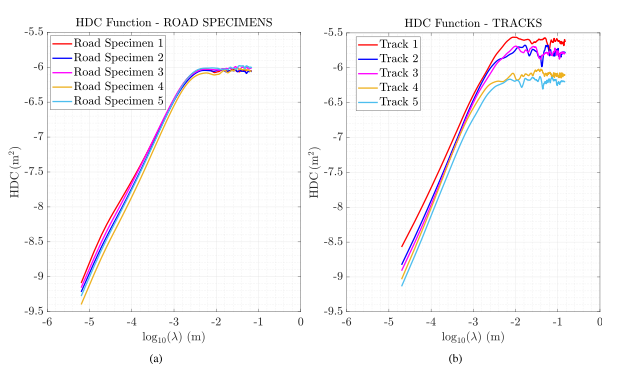
The Height Difference Correlation Function, often abbreviated as HDCF, is used in the study to evaluate surface roughness parameters that are relevant for contact modeling. It describes the mean square height fluctuations of a surface as a function of the horizontal length scale.
This is important because road surfaces show different scaling regimes. Macro-scale and micro-scale roughness do not behave in the same way, and both influence tire-road interaction. To capture this behavior, the study considers horizontal and vertical cut-off lengths together with Hurst exponents that describe the scaling behavior of the surface.
The HDCF analysis helps identify how surface morphology changes across length scales. These descriptors are then connected to the contact model, contributing to the estimation of the minimum contact length scale and the final Ac/A0 ratio.
For engineers, this means that roughness is not reduced to a single average parameter. The study uses a richer description of surface texture, combining macro indicators, micro indicators and correlation-based descriptors. This is essential when the objective is to predict friction-related behavior rather than only describe surface quality.
Tire Testing: Non-Destructive Viscoelastic Evaluation with VESevo
Tire testing is another fundamental part of the methodology. The tire tread compound must be characterized because its viscoelastic properties influence how the rubber deforms on road asperities. The same road texture can produce different contact behavior depending on the stiffness, damping and temperature-dependent response of the compound.
Traditional Dynamic Mechanical Analysis can provide viscoelastic properties, but it is a destructive laboratory method that requires specific polymer specimens. This is a limitation for tire tread analysis, especially in motorsport contexts where tires cannot be cut or destroyed due to regulations, supplier constraints or the need to preserve the product.
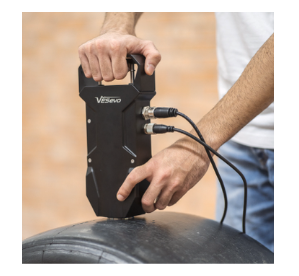
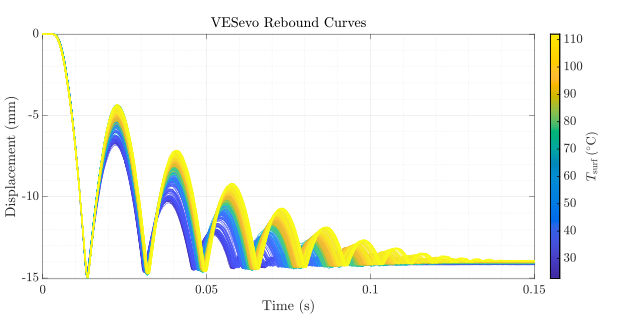
The VESevo device addresses this limitation by enabling non-destructive characterization of tire tread viscoelastic properties. It uses a steel rod with a semi-spherical indenter that bounces on the tire tread surface. The displacement of the rod is measured through a high-frequency optical sensor, allowing rebound curves to be acquired quickly and repeatedly.
In the study, VESevo is used to evaluate the viscoelastic properties of the reference compound adopted for both indoor and outdoor analyses. The rebound curves are processed to estimate material stiffness and damping characteristics, which are then used to generate viscoelastic master curves.
This point is crucial: the contact model is not based only on road geometry. It also includes the actual viscoelastic response of the tire compound, evaluated through a non-destructive procedure. This creates a direct connection between VESevo tire testing, material characterization and tire-road contact modeling.
Tire Measurement: Storage Modulus, Loss Factor and Shifted Temperature
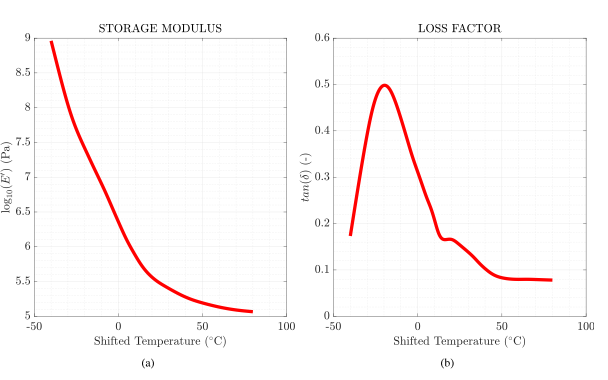
Tire measurement in this research is not limited to acquiring a single friction value. The model needs the viscoelastic behavior of the tread compound, including how storage modulus and loss factor change with frequency and temperature. These properties determine how the rubber responds when it interacts with road asperities at different sliding velocities.
The storage modulus describes the elastic part of the compound response, while the loss factor is related to energy dissipation and hysteresis. Both are affected by temperature and excitation frequency. At constant temperature, increasing frequency tends to move the polymer response toward a glassy state. At constant frequency, increasing temperature makes the material softer and more rubber-like.
To account for this behavior, the methodology uses the time-temperature superposition principle and a WLF-type approach. Instead of evaluating the material response only at the measured temperature, the model considers a shifted temperature equivalent to the frequency of interest. This allows the viscoelastic master curve to be used inside the contact model consistently.
This is essential because the frequencies involved in tire-road contact are related to sliding velocity and road texture wavelength. The rubber does not experience the road as a static surface; it interacts dynamically with asperities. Therefore, friction prediction requires a frequency-temperature dependent representation of the tire compound.
The use of VESevo data in this context makes the methodology especially valuable. It allows material properties to be integrated into the model without destructive preparation of tread specimens, supporting faster and more practical tire characterization workflows.
Greenwood–Williamson Theory Applied to Tire-Road Interaction
The Greenwood–Williamson theory is used as the foundation for the contact model. In its classical form, the theory describes the contact between a smooth plane and a nominally flat rough surface. The rough surface is represented by a large number of asperities with a statistical height distribution.
Contact occurs when asperities are high enough to exceed the separation distance between the surfaces. Each local contact is treated using Hertzian contact theory. By summing the contribution of the contacting asperities, it becomes possible to estimate the real contact area.
The study extends this framework to tire-road interaction by considering the road surface as the rough body and the tire tread as the viscoelastic material. This extension is necessary because rubber does not behave like a simple elastic solid. Its dynamic modulus changes with temperature and frequency, and those changes influence the local contact area.
The model evaluates the minimum contact length scale and then calculates the Ac/A0 ratio. The calculation depends on road roughness descriptors, viscoelastic modulus, sliding velocity, surface temperature and contact pressure. This makes the model sensitive to the same variables that influence real tire friction behavior.
From an engineering point of view, this is one of the strongest aspects of the study. The model is not a purely empirical correlation. It is built from contact mechanics, roughness characterization and tire viscoelasticity, then validated against experimental friction measurements.

Ac/A0 Simulation: Temperature, Pressure and Road Surface Effects
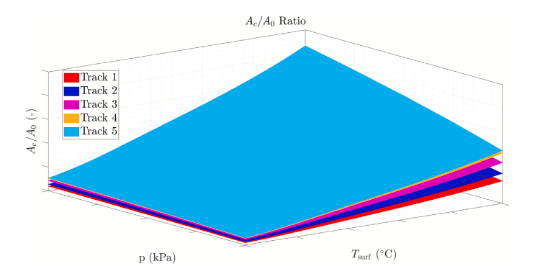
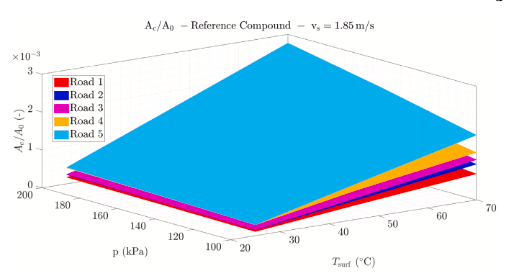
The simulated Ac/A0 ratio changes according to tire surface temperature, contact pressure and road roughness. The paper shows that the model responds consistently to these variables in both outdoor and indoor environments.
As temperature increases, the tire compound becomes softer. This allows a greater level of indentation into the rough surface and leads to a larger real contact area. As a result, the Ac/A0 ratio increases. A similar trend is observed when contact pressure increases: higher pressure produces greater indentation and therefore a larger effective contact area.
The model also differentiates among surfaces. In the outdoor analysis, tracks 5 and 4 show the highest Ac/A0 levels, track 3 shows an intermediate level and tracks 2 and 1 show the lowest levels. This ranking remains consistent across the analyzed conditions.
In the indoor analysis, the same kind of classification emerges. Road specimens 5 and 4 show the highest simulated contact area ratios, road specimen 3 shows an intermediate level and road specimens 2 and 1 show lower values. The sandpaper surfaces produce globally higher Ac/A0 ratios due to their distinctive texture.
This behavior is technically important because it shows that the model is sensitive to meaningful physical differences among surfaces. It does not simply produce a generic trend with temperature and pressure; it also captures the relative effect of road texture on real contact area.
Outdoor Tire Friction Testing in Racing Environments
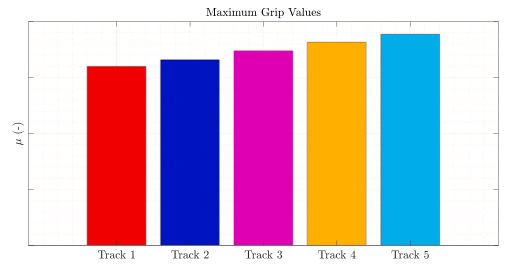
The outdoor validation campaign was performed using a high-performance vehicle equipped with sensors. Tests were carried out on five different tracks using the same tire compound. The objective was to evaluate experimental friction behavior and compare the ranking of maximum friction values with the simulated Ac/A0 ratio.
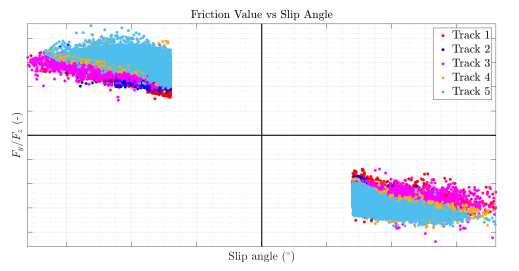
The analysis focuses mainly on pure lateral interaction in grip-limited zones. These zones correspond to conditions close to the limit of adherence, where the tire generates high friction values. This selection is useful because it focuses the analysis on the most relevant conditions for performance and road safety.
The lateral friction coefficient is evaluated from the ratio between lateral force and vertical load. By analyzing the relationship between lateral friction coefficient and slip angle, the study identifies the maximum attainable friction coefficient for each track.
An envelope curve is used to represent the experimental data and reduce the influence of noise and outliers. This allows the maximum friction level to be extracted more reliably from the measured point cloud. The same procedure is repeated for each track, providing a ranking of maximum grip values.
The results show that tracks 4 and 5 produce the highest friction values, track 3 shows an intermediate level and tracks 1 and 2 produce lower friction values. This ranking matches the simulated Ac/A0 ranking, supporting the physical relevance of the contact model.
Indoor Tire Friction Testing with the Evolved British Pendulum
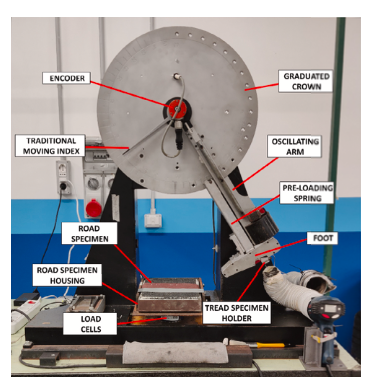
The indoor testing campaign was performed using an evolved version of the British Pendulum tester. This device is enhanced with additional sensors, including a triaxial load cell and an encoder. It measures tangential and normal forces during contact between the rubber specimen and the asphalt specimen, as well as the velocity of the pendulum arm.
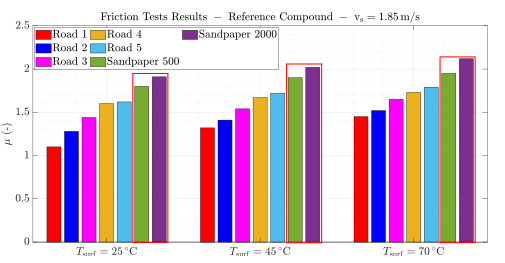
The indoor tests were conducted on five road specimens and two sandpapers with different grit sizes, using the same reference compound considered in the model simulations. The goal was to compare measured friction coefficients with the simulated Ac/A0 values under controlled conditions.
The results show a coherent ranking among the road specimens. Road specimens 5 and 4 behave as high-friction surfaces, road specimen 3 shows a medium friction level and road specimens 2 and 1 represent lower-friction surfaces. This ranking matches the simulated contact area ratio ranking.
The sandpapers provide an additional validation challenge because they represent unconventional surfaces with a very different texture from road specimens. The model still responds coherently: the sandpapers show higher friction levels and higher simulated Ac/A0 ratios than the road specimens.
This result is important because it shows that the methodology is not limited to one narrow class of surfaces. It can distinguish between standard road specimens and surfaces with much more distinctive texture, while maintaining consistency between simulated contact area and measured friction.
Tire Performance: Correlation Between Ac/A0 and Friction Coefficient
The central result of the study is the correlation between the simulated Ac/A0 ratio and the experimental friction coefficient. In both outdoor and indoor environments, surfaces with higher measured friction also show higher simulated real-to-nominal contact area ratios.
In the outdoor campaign, the ranking is clear: track 5 shows the highest friction and the highest Ac/A0 ratio, followed by track 4, track 3, track 2 and track 1. The paper reports that this relationship is valid across the analyzed combinations, even though some numerical values are presented for a specific operating condition.
In the indoor campaign, the same pattern appears for road specimens and sandpapers. Sandpaper 2000 shows the highest friction and the highest Ac/A0 ratio, followed by sandpaper 500 and then the road specimens in descending order. This further supports the model’s ability to classify surfaces according to expected friction behavior.
For tire performance analysis, this is highly relevant. It suggests that Ac/A0 can be used as an indicator of relative friction potential when the same compound and operating conditions are considered. A larger real contact area corresponds to greater interaction between rubber and surface, which is reflected in higher experimental friction values.
This does not mean that tire friction can be reduced to contact area alone. Friction is influenced by adhesion, hysteresis, temperature, roughness, load, sliding velocity and compound properties. However, the study shows that the local contact area ratio is a strong and physically meaningful descriptor for comparing friction behavior across surfaces.
Why This Approach Matters for Motorsport and Road Safety
The proposed approach has direct implications for both motorsport and road safety. In motorsport, grip prediction is essential for setup optimization, tire management and performance simulation. Being able to estimate how a tire compound may interact with different track surfaces before complete testing can save time and resources.
The study is particularly relevant for racing environments because it validates the model on outdoor tracks using a high-performance vehicle. This moves the methodology beyond laboratory-only analysis and demonstrates its applicability in realistic operating scenarios.
For road safety, the method can support the evaluation of expected friction levels on different surfaces. Since the contact area ratio is connected to friction behavior, it may help engineers understand how road texture, tire temperature and contact pressure affect grip potential.
The combination of VESevo testing and road roughness characterization is especially powerful because it brings together two critical aspects: the tire compound and the road surface. This integrated approach can support more reliable tire-road interaction models, better performance analysis and more informed development decisions.
The methodology also connects naturally with broader research on tire adhesion phenomena, viscoelastic material modeling and non-destructive tire measurement for performance characterization.
Future Friction Models and Wear-Related Perspectives
Tire wear testing is not the primary focus of this paper. The study does not directly measure tread wear or material removal. However, the connection with wear is technically relevant because friction, contact mechanics, local stresses and surface interaction are closely related to the mechanisms that can contribute to tread degradation over time.
The paper explains that energy dissipation in micro-contact regions can trigger micro-fractures and surface wear. This means that understanding local contact area and friction behavior can also support future studies on wear mechanisms, especially when combined with viscoelastic characterization and road roughness data.
The authors identify future developments focused on implementing a physical friction model that leverages the observed correlation between friction coefficient and Ac/A0. Such a model could support the prediction of friction maps for specific roads and tire compounds.
For tire engineers, this opens a broader perspective. The same framework used to estimate local contact area and friction potential could become part of more complete tire performance models, including thermal behavior, viscoelastic response, adhesion, hysteresis and eventually wear-related phenomena.
In this sense, the study contributes to the development of predictive tire-road interaction tools that can support both experimental testing and virtual simulation environments.
Frequently Asked Questions About Tire Friction and Contact Area Modeling
What is the main purpose of this study?
The study proposes and validates a physical-analytical contact model to estimate the real-to-nominal tire-road contact area ratio, Ac/A0, and correlate it with experimental friction values in both indoor and outdoor environments.
Why is the real contact area important for tire friction?
The real contact area represents the effective portion of the tire tread that interacts with the road asperities. Since this area is smaller than the nominal contact patch, it helps explain differences in friction behavior among surfaces.
What is Ac/A0?
Ac/A0 is the ratio between the real contact area and the nominal contact area. It indicates how much of the apparent contact area is effectively involved in the local tire-road interaction.
What role does road roughness play in tire friction?
Road roughness determines the distribution of asperities that interact with the tire tread. Macro-roughness affects the overall contact geometry, while micro-roughness influences local contact, adhesion and shear mechanisms.
How is VESevo used in this research?
VESevo is used to evaluate the viscoelastic properties of the tire tread compound in a non-destructive way. These properties are then used as inputs for the contact model.
Why is non-destructive tire testing important?
Non-destructive testing allows tire tread properties to be evaluated without cutting or damaging the tire. This is especially valuable in motorsport and high-performance contexts where tires cannot be destructively tested.
What is Greenwood–Williamson theory?
Greenwood–Williamson theory is a contact mechanics framework that models a rough surface as a statistical distribution of asperities. It is used to estimate the real contact area between rough and smooth surfaces.
How does temperature affect the contact area ratio?
As tire temperature increases, the rubber compound becomes softer. This generally increases indentation into the road asperities and produces a larger Ac/A0 ratio.
How does contact pressure affect Ac/A0?
Higher contact pressure increases rubber indentation into the rough surface, leading to a larger real contact area and therefore a higher Ac/A0 ratio.
Was the model validated experimentally?
Yes. The model was validated in outdoor racing environments using a high-performance vehicle on five tracks and in indoor laboratory conditions using an evolved British Pendulum tester on road specimens and sandpapers.
What is the relationship between Ac/A0 and friction coefficient?
The study shows that surfaces with higher simulated Ac/A0 ratios also show higher experimental friction coefficients. This relationship is observed in both indoor and outdoor testing campaigns.
Can this model replace tire testing?
No. The model does not replace experimental tire testing or vehicle validation. It provides a predictive and interpretive tool that can support testing, surface comparison, tire performance analysis and simulation workflows.
Is this approach useful for motorsport?
Yes. The approach is useful for motorsport because it can support grip prediction, compound comparison and virtual performance analysis across different track surfaces and tire operating conditions.
Does the study directly measure tire wear?
No. The study does not directly measure tire wear. However, the analysis is relevant for future wear-related research because local contact area, friction, roughness and viscoelasticity are connected to the mechanisms that influence tread degradation.
Scientific Source
This article is based on the scientific paper: Farroni, F.; Stefanelli, R.; Napolitano Dell’Annunziata, G.; Timpone, F. Impact of the tire/road local contact area on tire friction, with a novel approach based on Greenwood–Williamson theory and validation in both laboratory and outdoor racing environments. Tribology International, 210, 110772, 2025. DOI: 10.1016/j.triboint.2025.110772.
Editorial note: The information provided in this article is technical and general in nature. It does not replace customized engineering analysis, road safety assessment, laboratory validation, motorsport testing or product-specific tire development. Any use of tire-road friction models, contact area simulations or viscoelastic data for design, safety, racing or production purposes should be evaluated by qualified technical professionals.