
A tire wear model becomes truly useful only when its predictions remain meaningful outside the narrow conditions in which it was developed. Temperature, road roughness, compound viscoelasticity, load, sliding conditions and vehicle category can all influence tire wear, making experimental validation a fundamental step before a physical formulation can be considered useful for engineering applications.
The scientific study examined here validates a multidisciplinary physical wear model against experimental data collected from five substantially different tire and vehicle applications. The validation range includes motorsport single-seaters, a GT car, an ultra-high-performance racing application, a passenger sport car and a heavy-duty truck.
Instead of concentrating on the complete mathematical derivation of the tire wear formulation, this article focuses on a different engineering question: how closely do the simulated wear channels reproduce the measured tread loss, and how robust is the approach when thermal, dynamic, material and road conditions change?
For the complete physical description of the model — including viscoelasticity, thermodynamics, road roughness, contact mechanics and cumulative damage — see our dedicated analysis of the physical tire wear model combining viscoelasticity, road roughness and temperature.
Wear Testing Across Motorsport, Passenger and Heavy-Duty Tires
Wear testing is particularly valuable when a model must operate across more than one tire type or vehicle category. A formulation calibrated only on one compound, one temperature range or one road condition may reproduce that specific experiment without demonstrating broader applicability.
For this reason, the study uses five datasets intentionally selected to span very different operating conditions. They include three motorsport applications with moderate, high and ultra-high tire performance, one passenger sport-car application and one heavy-duty truck application.
| Spec | Vehicle type | Category | Tire performance | Temperature range | Excitation frequency |
|---|---|---|---|---|---|
| 1 | Single-seater | Motorsport | Moderate | 28–105 °C | 100–850 Hz |
| 2 | GT car | Motorsport | High | 33–125 °C | 150–1000 Hz |
| 3 | Single-seater | Motorsport | Ultra high | 60–130 °C | 250–1500 Hz |
| 4 | Sport car | Production car | Passenger | 40–90 °C | 50–800 Hz |
| 5 | Truck & trailer | Truck | Heavy duty | 30–95 °C | 50–550 Hz |
Validation datasets reported in the study. Temperature and frequency values represent the investigated operating ranges.
The spread is significant. Loads, operating temperatures, excitation frequencies, tire structures and compound characteristics all change from one dataset to another. This makes the validation much more informative than repeating the same test under only slightly modified conditions.
The objective of the campaign is therefore not simply to produce another wear level. It is to determine whether the same physical framework can reproduce material removal when the complete operating scenario changes.
Wear Mechanisms Behind the Validation Problem
Before considering prediction accuracy, it is important to understand what the model interprets as wear. Rubber degradation may involve several wear mechanisms, including abrasion, adhesive wear and surface fatigue wear.
The literature reviewed in the paper describes a close connection between friction and rubber wear. Adhesion can contribute to abrasion and roll formation, while cyclic deformation and hysteretic interaction can contribute to fatigue-related degradation.
In the proposed formulation, the authors do not attempt to separate adhesive and hysteretic contributions experimentally. Instead, the resulting tire-road forces are treated together as model inputs, while material damage is described through a fatigue-based approach.
The study therefore extends the concept of fatigue wear toward wear abrasion: repeated local stress cycles progressively damage an elementary volume of tread until it is considered detached from the material.
This distinction matters for validation because the observed wear phenomena emerge from multiple interacting physical processes rather than from one universal abrasion coefficient.
For a deeper material-level discussion of rubber wear, abrasion, fatigue and rough-surface interaction, see our article on rubber wear, viscoelasticity, abrasion and road contact.
Experimental Tread Wear Comparison: How the Reference Data Are Collected
An experimental tread wear comparison requires a physical reference against which the simulation can be evaluated. In the validation campaign, initial and final tread thickness values are measured during outdoor testing activities.
The measurements are acquired according to a defined lateral gauging scheme. Depending on the application, between one and three measurement locations per tire are available and are represented at corresponding lateral positions inside the wear model.
This is different from the statistical motorsport wear dataset discussed in our separate article on tire wear testing and tread-depth measurement. Here, the central objective is not constructing a regression target from a large motorsport database, but validating a physical simulation against measured material removal across different tire categories.
The measured tread thickness therefore acts as the experimental benchmark for the subsequent tire wear quantification.
Simulated Wear Channels vs Experimental Wear
The core validation compares the measured tread-depth variation with the simulated wear channels generated across the lateral direction of the tire.
Each simulation corresponds to a specific vehicle, compound, road profile and thermodynamic condition. The model therefore does not receive one generic wear coefficient and extrapolate it uniformly across all cases. Its inputs change according to the actual dataset under investigation.
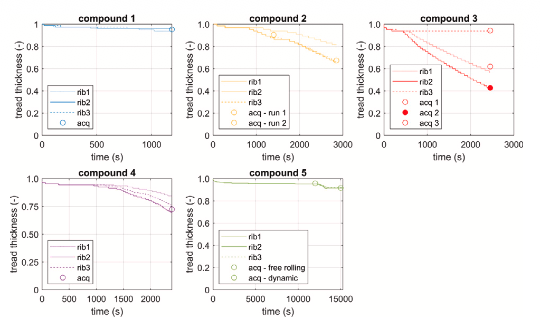
The comparison is particularly useful because the predicted profiles are evaluated under substantially different thermal and dynamic states. Agreement must therefore emerge not only from the mathematical form of the wear formulation, but also from the way material, road and operating conditions are passed through the complete modelling chain.
Final Tire Wear Prediction Accuracy and Validation Error
The final wear status is objectified using a normalized root-mean-square deviation between model predictions and experimental measurements.
The average error reported for each application category remains between 2% and 4%. It is important, however, to distinguish these averages from the individual vehicle-corner results: some individual corners reach errors of 6% or 7%.
| Tire performance | FL | FR | RL | RR | Average |
|---|---|---|---|---|---|
| Moderate | 1% | 2% | 3% | 2% | 2% |
| High | 1% | 1% | 4% | 6% | 3% |
| Ultra high | 2% | 2% | 6% | 7% | 4% |
| Passenger | 5% | 4% | 4% | 3% | 4% |
| Heavy duty | 5% | 5% | 3% | 3% | 4% |
Normalized wear-validation error percentages reported by vehicle corner. Average errors range from 2% to 4% across the five application categories.
This distinction is essential for a correct interpretation of the results. The validation indicates good overall agreement in terms of final wear, but it does not imply identical accuracy at every wheel position or operating condition.
For engineering users, the result is more valuable when expressed in this qualified form: the formulation reproduces the overall final material removal consistently across very different applications, while local prediction error still depends on the specific tire and vehicle corner.
Wear Rate Is Not Linear with Running Distance
The comparison also reveals an important feature of wear rate: tread removal is generally not linear with running distance.
This means that doubling mileage does not necessarily produce exactly twice the material removal. Temperature, frequency, stress state, compound properties and contact conditions evolve during operation and can change the rate at which damage accumulates.
For two compounds, the study includes additional experimental points between the initial and final states, allowing the wear trend with mileage to be evaluated rather than validating only the end point.
This is particularly important for tire wear prediction. A model may reproduce the final measured thickness while following an incorrect intermediate evolution. Additional measurements during the life of the tire provide a stronger test of the underlying physical description.
Wear Calculation Across Different Thermal States
The wear calculation is strongly connected to the instantaneous thermodynamic state of the tire. The five validation datasets span broad temperature ranges, and those temperatures modify the viscoelastic properties of the tread compound.
The material response is therefore not treated as a fixed nominal property. Storage modulus, dissipative behavior and fatigue characteristics vary with both temperature and road-induced excitation frequency.
This thermal dependence is one of the reasons the tire wear model is evaluated across applications with such different operating windows. A model that works for a racing slick around high tread temperatures must also respond correctly when applied to a passenger or heavy-duty tire operating under different thermal and loading conditions.
The complete thermodynamic and time-temperature-superposition methodology is described in our article on the viscoelastic and thermodynamic tire wear model.
Influence of Road Roughness and Compound Properties on Tire Wear
The wear influence of the operating environment cannot be separated from either the tire compound or the road profile.
Each validation dataset is associated with a specific road texture. Surface roughness defines representative wavelengths and therefore contributes to the frequency at which the tread is excited. That frequency, together with temperature, determines the instantaneous viscoelastic state used by the model.
The compounds are also substantially different. The study uses measured viscoelastic master curves rather than one generic rubber law, allowing each material to respond differently as operating conditions change.
This makes the validation more demanding: agreement cannot be obtained simply by applying one universal wear constant to every tire.
For more information about measuring these material properties non-destructively, see our article on compound testing and viscoelastic characterization with VESevo.
Physical Wear Models and Statistical Wear Prediction
A physical wear formulation and a statistical wear prediction approach address the same engineering target from different directions.
Statistical wear models learn relationships contained in experimental databases. A physical model instead attempts to reconstruct the mechanisms leading from operating conditions to stress, damage accumulation and material removal.
The present study belongs primarily to the second category. Its wear modelling strategy combines compound viscoelasticity, road roughness, tire thermodynamics, contact mechanics and fatigue damage.
Validation is therefore crucial. Without an experimental tread wear comparison, a sophisticated physical model could reproduce plausible internal quantities while still giving an incorrect final tread-loss prediction.
For comparison with a different methodology, our article on statistical tire wear prediction for high-performance vehicles examines neural networks, PCA and physically informed regression rather than the fatigue-based physical formulation used here.
Why Validation Matters More Than a Single Wear Level
A single measured wear level can indicate how much tread has been removed, but it cannot demonstrate whether a model is robust.
A meaningful validation should challenge the model with different compounds, structures, loads, temperatures, frequencies and surfaces. The five datasets used here provide that broader test.
This is particularly relevant when the model is expected to support applications such as virtual development, driver-in-the-loop simulation, advanced tire-state monitoring or vehicle control. In these environments, the formulation must continue to provide useful information when operating conditions move away from one original calibration point.
The result is not proof of universal validity for every tire in existence. It is evidence that the proposed tire wear formulation can reproduce experimental material removal across a comparatively broad set of tested applications.
Tire Wear Quantification for Simulation and Control
Tire wear quantification is useful beyond the prediction of remaining tread thickness. Changes in tread geometry can affect tire thermodynamics, stiffness and frictional performance.
The model can provide reduced tread thickness or removed rubber mass as outputs that may feed more advanced tire and vehicle models. This opens the possibility of connecting final wear and intermediate degradation states with simulation environments or monitoring systems.
The formulation is designed to operate at different levels of modelling detail, from approaches using global contact-patch quantities to more discretized numerical descriptions using local pressure, temperature and velocity distributions.
This flexibility is one of the practical reasons why cross-application validation matters: a useful wear model should not depend exclusively on one simulation architecture or one vehicle class.
Wear Particles, Performance and Environmental Relevance
The consequences of tire wear extend beyond vehicle performance. Material removal generates wear particles, making tire degradation relevant to durability, safety and non-exhaust emissions.
The relative importance of these consequences changes with application. In motorsport the emphasis is often on maintaining competitive performance; in passenger vehicles safety and mileage are central; in heavy-duty and high-mileage applications material consumption and environmental impact become increasingly important.
A validated physical model can therefore provide value in different contexts even when the engineering target is not the same.
Limits of the Tire Wear Validation
- The validation covers five selected datasets, not every possible tire, compound or road surface.
- Most experimental references are based primarily on initial and final tread-thickness measurements.
- Only two compounds include additional measurement points that allow the intermediate wear trend with mileage to be validated.
- Some individual vehicle-corner errors are higher than the 2–4% category averages.
- The complete geometry, compound and operating data are partly confidential.
- The model does not currently update every mechanical and contact-patch characteristic continuously as tread geometry changes.
- Thermomechanical and chemical degradation effects on the viscoelastic and diffusivity properties are not included in the current formulation.
- Different physical contributions to wear are not experimentally isolated during the validation campaign.
These limitations do not invalidate the comparison, but they define the range in which the reported wear prediction accuracy should be interpreted.
Frequently Asked Questions About Tire Wear Validation
What is being validated in this tire wear model?
The study validates the predicted tread-material removal generated by a physical wear formulation that combines compound viscoelasticity, tire thermal state, road roughness, contact mechanics and fatigue damage.
Which vehicle classes are included in the wear testing?
The five datasets include three motorsport applications (two single-seaters and one GT racing car), one passenger sport car and one heavy-duty truck.
How is experimental tire wear measured?
Initial and final tread thickness values are measured during outdoor testing according to a defined lateral gauging scheme. For two compounds, additional intermediate measurement points are also available.
What are simulated wear channels?
Simulated wear channels are the predicted tread-removal profiles produced by the model across the lateral direction of the tire. They can be compared directly with experimental tread-thickness observations at the corresponding measurement positions.
How accurate is the final wear prediction?
The reported average error by application category ranges from 2% to 4%. Individual vehicle corners can show larger deviations, reaching 6% or 7% in some of the high- and ultra-high-performance cases.
Is wear rate linear with mileage?
No. The study reports that tread-material removal is generally nonlinear with running distance because thermal, dynamic and material conditions evolve during operation.
Does the formulation model adhesive wear separately?
No. Although adhesive wear and other wear mechanisms are discussed in the scientific background, the proposed approach does not experimentally separate adhesive and hysteretic friction contributions. The tire-road forces are considered together as model inputs.
How does fatigue wear enter the model?
Repeated local stress cycles accumulate material damage. The fatigue formulation is made dependent on temperature and excitation frequency, and material is considered removed once the damage criterion reaches its ultimate condition.
Why are different compounds important for validation?
Different compounds have different viscoelastic responses. Testing the same formulation across multiple materials verifies whether its wear calculation remains useful when stiffness and dissipative behavior change with temperature and frequency.
Is this the same as statistical tire wear prediction?
No. This study validates a physics-based wear model. Statistical tire wear prediction instead learns relationships from experimental databases using regression or machine-learning techniques.
Scientific Source
This article is based on: Sakhnevych, A.; Genovese, A. Tire wear model: A fusion of rubber viscoelasticity, road roughness, and thermodynamic state. Wear, Volumes 542–543, 205291, 2024. DOI: 10.1016/j.wear.2024.205291.
The scientific publication is distributed under the Creative Commons Attribution 4.0 International license.
Editorial note: This article focuses specifically on experimental validation of the wear formulation across different vehicle and tire applications. The detailed mathematical formulation of viscoelasticity, thermodynamics, contact mechanics and fatigue damage is covered separately in the VESevo article dedicated to the physical tire wear model.