
Tire wear testing is essential when vehicle engineers need to transform physical tread degradation into reliable experimental data. In high-performance and motorsport applications, simply recording mileage is not enough: the final wear condition reflects the combined effects of tire-road interaction, frictional energy, temperature, road roughness, compound properties and vehicle operating conditions.
The scientific study examined here approaches tire wear through a large multidisciplinary experimental database collected during racing activity. Road profiles, vehicle telemetry, tire viscoelastic properties and direct wear measurements are processed to describe the degradation experienced by each tire after a run.
This article focuses specifically on how wear data are acquired, processed and converted into engineering indicators such as tread-depth loss, mean wear and mean wear percentage. The subsequent development and comparison of statistical predictive methods are discussed separately in our analysis of statistical tire wear prediction for high-performance vehicles.
The distinction is important. A reliable wear prediction model can only be developed when the experimental target is itself representative, consistently measured and connected with the real operating history of the tire.
Wear Testing: From Track Runs to Tread-Depth Data
Wear testing in the study begins with data collected during racing events involving a single-seater vehicle equipped with high-performance slick tires and different tread compounds.
For each event, the available information includes road roughness profiles, vehicle telemetry, compound properties and the final wear levels measured on the tires. These sources are combined because the wear phenomenon is influenced by several mechanisms acting simultaneously rather than by distance alone.
The direct experimental reference is the reduction in tread depth. After each run, inspection holes located across the tread are measured using a professional tread-depth instrument commonly employed in motorsport.
Several measurements are acquired at each available inspection spot and averaged to improve the reliability of the resulting wear value. This procedure provides the physical foundation of the complete dataset.
These tire wear acquisitions are especially important because the target variable used later by the statistical models is not an abstract estimate: it originates from direct experimental measurements performed on the tires after real track operation.
Tire Wear Measurements and Tread Interpolation
The physical measurement points available on a racing tire are not distributed uniformly across the entire tread width. Consequently, the raw wear measurements cannot be used directly as if every lateral portion of the tread were sampled equally.
The acquired values are therefore interpolated to create uniformly positioned virtual ribs. This processing step provides a more consistent representation of tread wear across the tire width and enables comparison between different tires and runs.
Once these virtual positions are generated, the resulting wear values can be interpreted as a representation of material loss distributed across the tread.
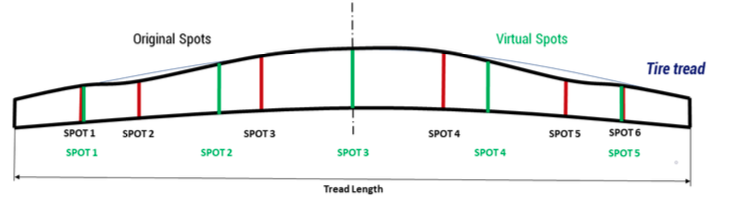
This transformation from discrete inspection points to a structured lateral tread representation is one of the most important steps in the wear evaluation procedure because it creates a consistent target quantity from measurements that are not originally equally spaced.
Mean Wear Percentage as an Experimental Wear Metric
After interpolation, the individual tread measurements are combined into an average wear value calculated across the entire tread width. The study identifies this quantity as WearMean.
The resulting mean wear is expressed as a percentage of the original tread thickness. This produces a normalized mean wear percentage that can be compared across different observations and used as the response variable in subsequent statistical analyses.
This normalization is useful because a predictive model requires a consistent numerical target. Instead of attempting to predict multiple individual tread-depth measurements, the methodology uses one representative quantity for each analyzed tire.
However, reducing tread degradation to one average number also introduces an important limitation: localized differences and complex wear pattern development can partially disappear when measurements are reduced to a mean value.
Wear Data: Building a Multidisciplinary Motorsport Database
The experimental wear data are not analyzed in isolation. They are associated with a much wider set of variables describing the conditions experienced by each tire during the corresponding run.
The database is organized around three principal technical areas:
- road roughness indicators, describing the surface interacting with the tire;
- telemetry indicators, describing forces, slips, temperatures, pressure, distance and vehicle operating conditions;
- tire viscoelastic indicators, describing the dynamic properties of the tread compound under representative working conditions.
The resulting dataset contains 200 observations for model training and validation and an additional 80 observations used for testing. This separation is important because predictive capability must be evaluated on data that were not used to construct the model.
Before the observations are used, the experimental dataset is also checked for outliers that may originate from sensor errors, incorrect classification or anomalous acquisition conditions.
For readers interested in how viscoelastic compound properties are obtained non-destructively, see our article on compound testing and viscoelastic characterization.
Tire Wear and Friction Power Analysis
The literature discussed in the study frequently connects wear rate with the frictional energy dissipated in the tire-road contact region. Local sliding velocity, contact pressure and friction forces all contribute to the mechanical and thermal conditions that can promote material degradation.
The telemetry processing therefore calculates longitudinal and lateral friction power from tire forces and sliding velocities. These quantities are combined into total friction power accumulated during the run.
The study then compares mean wear percentage with total friction power for the different circuits. To plot wear against friction power in this way makes it possible to investigate whether increasing dissipated energy corresponds to increasing tread degradation and whether the relationship changes from one road surface to another.
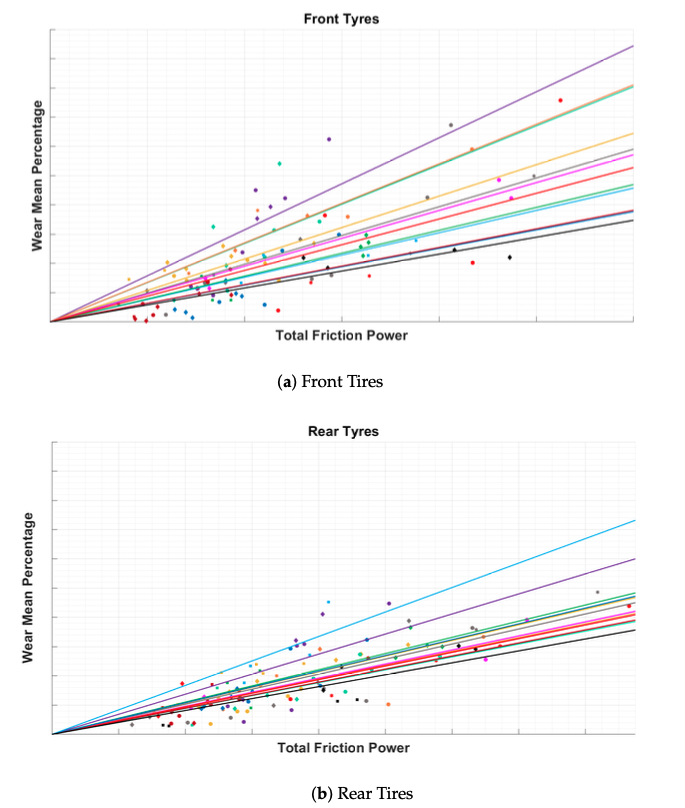
The comparison reveals that the relationship between frictional energy and tire wear is not identical for every track or axle. This is one reason why a simple universal wear formulation based only on dissipated energy can be insufficient for real motorsport applications.
Tire Temperature and Wear Evaluation
Temperature is another important variable in the experimental wear evaluation. Rubber is viscoelastic, meaning that its stiffness and dissipative behavior change with temperature and excitation frequency.
When the slopes obtained from the relationship between mean wear and friction power are compared across circuits, the study identifies a meaningful correlation with average tire surface temperature.
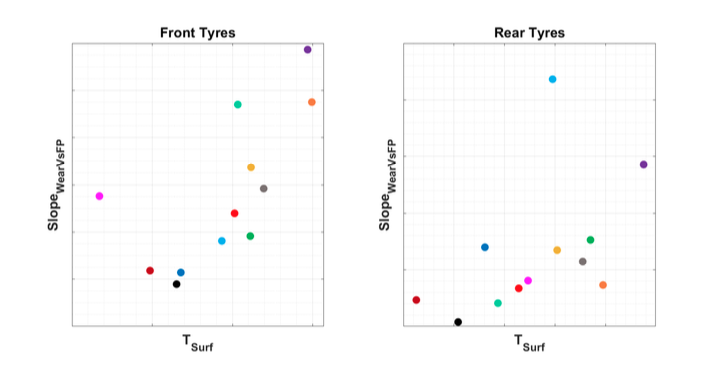
This finding reinforces the multidisciplinary nature of the wear phenomenon: frictional energy alone does not fully describe tread degradation because the material response itself changes with the thermal state of the tire.
A more physically detailed approach to temperature, viscoelasticity and material removal is discussed separately in our article on the physical tire wear model combining viscoelasticity, road roughness and thermodynamic state.
Irregular Wear and Why Mean Wear Is Not Always Enough
One of the most relevant limitations of an average tread metric is its difficulty in describing irregular wear.
The study observes that front tires can exhibit degradation phenomena that cannot be represented adequately by the same physical correlations used for rear tires. Examples include graining and blistering, which introduce localized or non-uniform degradation mechanisms.
These irregular wear conditions are important because two tires with a similar average material loss may display very different tread-surface states and therefore different performance consequences.
The broader literature reviewed by the paper also includes different forms of degradation such as polygonal wear, where repeated dynamic excitation can generate circumferentially non-uniform patterns, and wear abrasion mechanisms related to frictional energy and sliding.
This demonstrates why the definition of a single wear pattern or one universal wear metric is difficult. Different degradation mechanisms may require different indicators even when their final effect is a reduction in tread material.
Road Roughness and Tire Wear Correlations
Road texture also contributes to differences between measured and expected degradation. The study evaluates several roughness indicators including macro and micro wavelengths, center-line average roughness, Hurst coefficient, skewness, kurtosis and peak-related descriptors.
When residuals from the combined wear, friction-power and temperature relationship are compared with road parameters, road skewness shows a meaningful correlation for the rear tires.
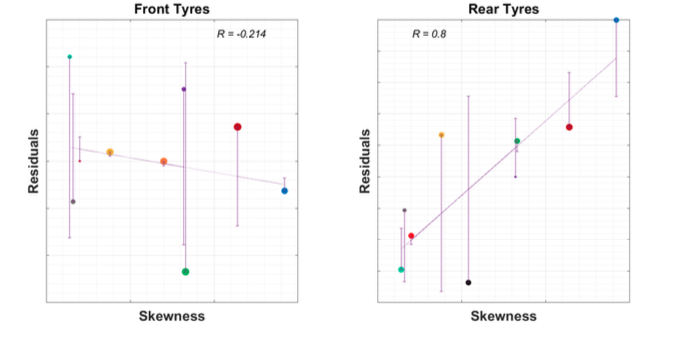
The front tires show a weaker relationship, supporting the interpretation that additional degradation mechanisms influence their measured wear values.
For a material-level analysis of rough-surface interaction, abrasion and viscoelastic degradation, see our article on rubber wear, abrasion and road contact.
From Wear Measurements to Tire Wear Models
Once the experimental target has been defined, the measured data can support the development of a tire wear model. The paper compares several wear models derived from machine learning and statistical regression.
This article intentionally does not reproduce the complete model comparison, because the key topic here is how the experimental data are constructed. However, understanding this transition is useful: every wear prediction ultimately depends on the quality of the measurements used to train and validate the model.
The study evaluates three approaches:
- Feed-Forward Neural Network;
- Principal Component Analysis combined with multiple linear regression;
- physical correlations combined with multiple linear regression.
The third approach provides the strongest performance in the investigated dataset, particularly for the rear tires, because the input selection incorporates physical knowledge about friction power, tire temperature, road characteristics, contact patch and compound behavior.
For the detailed comparison of these approaches, including prediction errors and model validation, see the dedicated article on tire wear prediction using statistical and physical correlations.
Wear Formulation and Physical Modeling Approaches
Historical wear formulation approaches have attempted to describe tire degradation through different physical mechanisms.
Early theories related material consumption to the work performed by friction forces. Schallamach connected abrasion with frictional energy dissipation, while Shepherd proposed a wear abrasion relationship associated with sliding length above a threshold lateral stress.
Other approaches investigated polygonal wear, irregular wear and the effect of vertical tire dynamics. Later experimental models introduced road roughness, contact-area effects and temperature-dependent wear constants.
The common limitation is that a specific wear formulation may work well inside the conditions in which its coefficients were identified but become less reliable when road, temperature, compound or vehicle operation changes.
This is one reason why the investigated study builds a large multidisciplinary database rather than attempting to describe every test condition through one fixed set of wear constants.
Wear Measurements as Inputs for Wear Prediction
A wear prediction model requires experimentally known outputs during its development phase. In supervised regression, the measured wear percentage acts as the target associated with each combination of road, telemetry and compound indicators.
This creates a direct chain:
- physical wear measurements establish the target;
- interpolation creates comparable tread-wide wear values;
- mean wear percentage provides a normalized response variable;
- telemetry, roughness and material KPIs describe the operating conditions;
- the resulting dataset can then support wear prediction.
The quality of the final prediction therefore depends not only on the regression algorithm but also on measurement repeatability, data coverage and the ability of the selected wear metric to describe the real tire condition.
Applications of Tire Wear Testing in Motorsport
Structured tire wear testing can support several areas of high-performance vehicle development.
- compound comparison, by associating tread degradation with measured material properties;
- track comparison, by connecting wear response with different road roughness characteristics;
- run analysis, by relating tread loss to telemetry and frictional energy;
- strategy evaluation, by understanding how different operating conditions influence wear levels;
- model validation, by providing physical targets for statistical or physical wear models;
- irregular wear detection, by identifying cases where mean wear does not describe the full degradation process.
The greatest value therefore comes from treating tire wear acquisitions as part of a complete engineering dataset rather than as isolated tread-depth readings.
Limits of Tire Wear Testing and Wear Data
- The physical tread inspection points are not equally spaced and require interpolation.
- Mean wear percentage reduces a spatially distributed degradation process to one representative value.
- Localized irregular wear may not be described accurately by the mean wear metric.
- Front and rear tires can exhibit different degradation mechanisms.
- The experimental database is based on specific motorsport operating ranges and should not be treated as universal.
- Wear prediction depends on the distribution and homogeneity of wear levels contained in the training data.
- Road roughness, temperature, frictional energy and viscoelasticity must be considered together when interpreting wear data.
Frequently Asked Questions About Tire Wear Testing
How is tire wear measured in this study?
Tire wear is measured through tread-depth inspection holes after each run. Multiple readings are taken at each spot using a professional tread-depth tool and averaged to improve measurement reliability.
Why are virtual tread ribs created?
The physical inspection points are not equally spaced across the tread width. Interpolation creates uniformly positioned virtual ribs, allowing the measured wear data to be processed and compared consistently.
What is mean wear percentage?
Mean wear percentage is the average tread wear calculated across the interpolated tread positions and expressed relative to the original tread thickness. In the study it is used as the principal experimental target for the statistical models.
What factors influence tire wear?
Tire wear rate can depend on frictional energy, sliding conditions, road roughness, temperature, tire dynamics and tread compound properties. The study therefore avoids treating wear as the result of one variable alone.
Why is friction power important for tread wear?
Friction power describes the rate of energy dissipation through tangential tire-road interaction. The study investigates the relationship between accumulated frictional energy and mean wear, considering thermal and road-surface indicators.
Can mean wear describe irregular wear?
Not completely. A mean value is useful for statistical modeling, but localized phenomena such as graining, blistering or other irregular wear conditions may require additional spatial indicators.
What is polygonal wear?
Polygonal wear is a non-uniform circumferential wear pattern associated in previous tire studies with tire vertical dynamics and repeated excitation. It is cited in the paper as one example of wear behavior that cannot be reduced to a simple uniform abrasion process.
How are wear measurements used for prediction?
The measured wear percentage provides the labeled output for supervised regression. Road, telemetry and viscoelastic indicators are then used as inputs from which the wear prediction model learns the relationship with the measured target.
Is tire wear testing the same as tire wear modeling?
No. Tire wear testing provides experimental measurements and reference data. Tire wear modeling uses these data together with physical or statistical relationships to estimate wear under defined operating conditions.
Scientific Source
This article is based on: Napolitano Dell’Annunziata, G.; Adiletta, G.; Farroni, F.; Sakhnevych, A.; Timpone, F. Tire Wear Sensitivity Analysis and Modeling Based on a Statistical Multidisciplinary Approach for High-Performance Vehicles. Lubricants 2023, 11, 269. DOI: 10.3390/lubricants11070269.
The scientific publication is distributed under the Creative Commons Attribution 4.0 International license.
Editorial note: This article focuses specifically on the experimental tire wear testing, tread-depth measurement and data-processing procedures described in the cited study. Predictive model performance is treated only as contextual information and is discussed in detail in the separate VESevo article dedicated to tire wear prediction.