
Tire wear is one of the most complex phenomena in tire-road interaction. It affects vehicle performance, safety, operating cost and environmental impact. In motorsport, tire wear can determine how long a compound maintains competitive grip. In passenger vehicles, it influences safety, mileage and maintenance. In heavy-duty applications, it affects durability, efficiency and particulate emissions. For this reason, a reliable tire wear model must account for much more than the distance travelled by a vehicle.
The scientific study discussed here presents a multidisciplinary tire wear formulation that combines rubber viscoelasticity, road roughness and the thermodynamic state of the tire. The model considers how the tread compound changes its behavior instant by instant according to excitation frequency and material temperature, while also including road texture and operating conditions inside the contact patch.
This approach is particularly relevant because tire tread wear is a local phenomenon. Material removal depends on local pressure, local sliding velocity, temperature distribution, road profile, compound viscoelastic properties and the stress-strain state generated at the tire-road interface. These quantities are difficult to measure directly in real driving scenarios, which is why predictive physical models are essential for advanced tire analysis.
The model described in the paper is validated on five different datasets collected from vehicles belonging to different categories: motorsport single-seaters, GT cars, passenger vehicles and heavy-duty trucks. This wide validation range is important because it shows that the formulation is not limited to one tire type, one vehicle class or one thermal condition.
This article explains the technical meaning of the study in a structured way, focusing on tire wear testing, tire analysis, tire measurement, tire characterization, tire performance, tire behavior, viscoelastic material modeling, road roughness and thermodynamic tire modeling.
For a broader technical context, this article is connected to previous VESevo research overviews on non-destructive tire testing and viscoelastic characterization, nonlinear modeling of viscoelastic materials for tire applications, tire adhesion analysis with VESevo technology, non-destructive testing for tire measurement, performance and characterization and tire friction and contact area modeling with VESevo.
Tire Wear Testing: Why Wear Cannot Be Treated as a Simple Mileage Effect
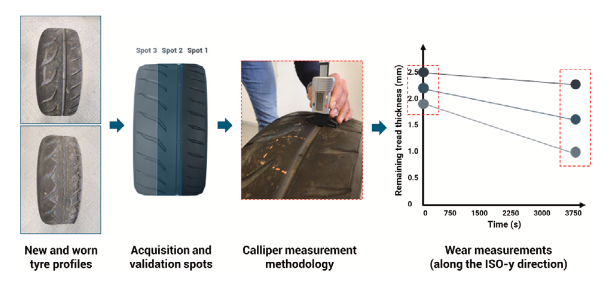
Tire wear testing is often associated with measuring tread thickness before and after a run. This is necessary, but it does not fully explain why the material has been removed or how the wear process evolved during use. Tire wear is not only the result of mileage. It is the consequence of repeated local interactions between rubber and road, where pressure, sliding velocity, temperature, friction and material properties act together.
In rubber compounds, wear is especially difficult to model because the material is viscoelastic. Its mechanical response changes with temperature and excitation frequency. A tread compound can behave differently at low temperature, high temperature, low sliding frequency or high-frequency road excitation. This means that the same compound may show different wear tendencies under different operating conditions.
The paper approaches tire wear as a fatigue-related material removal process. Local contacts between road asperities and the tire tread generate stress cycles inside the rubber. When these cycles accumulate damage, material can detach from the tread. This makes the wear phenomenon strongly dependent on the local stress state within the rubber, not only on global vehicle mileage.
For engineers, this distinction is important. A tire wear model based only on global quantities can be useful for rough estimation, but it may fail when conditions change significantly. A physically grounded model must consider the actual tire operating state, the road profile and the changing viscoelastic properties of the compound.
This is the reason why the study proposes a multidisciplinary model. It links tire thermodynamics, compound viscoelasticity, road roughness, contact mechanics and fatigue damage accumulation into a single predictive framework.
Tire Analysis: A Multidisciplinary View of Wear Mechanisms
Tire analysis becomes more accurate when wear is treated as the result of interacting physical mechanisms. The paper emphasizes that tire wear depends on several domains at the same time: the rubber compound, the road surface, the tire thermal state, the contact patch and the vehicle operating conditions.
Traditional tire wear approaches often rely on quantities such as frictional power, contact pressure and sliding speed. These are important, but they are not sufficient by themselves. The frictional power dissipated during contact is affected by the local friction coefficient, local pressure and local sliding velocity, but those quantities are in turn influenced by the tire structure, tread compound, road roughness and thermal condition.
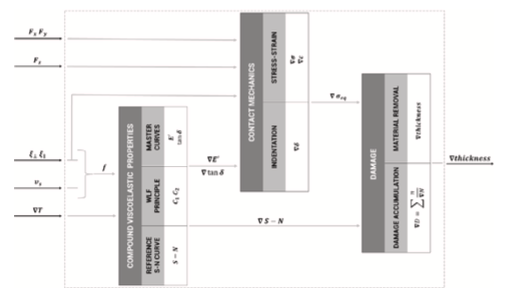
The paper therefore shifts the focus toward a more complete simulation framework. The model starts from the relative velocity in the contact patch and the road roughness characteristics. These quantities define the excitation frequency experienced by the rubber. Together with the temperature distribution inside the tread, this frequency is used to determine the instantaneous viscoelastic properties of the compound.
These viscoelastic properties are then used inside the contact mechanics block, where indentation levels and stress-strain distributions are computed. Finally, the local equivalent stress contributes to damage accumulation, which determines when a volume of rubber is considered detached from the tread.
This structure is particularly useful because it connects measurable or computable operating conditions with the physical process of material removal. It also allows the wear model to interact with other tire models, including thermodynamic models, adherence models and vehicle dynamics models.
Tire Characterization: Viscoelastic Properties and Time-Temperature Superposition
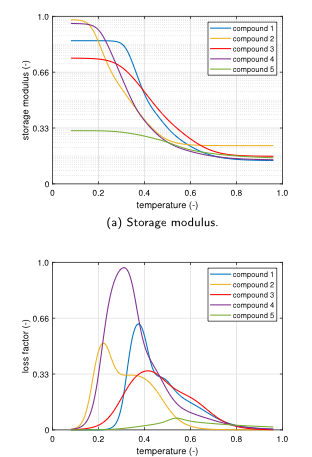
Tire characterization is central to the model because the tread compound is not a purely elastic material. Rubber has both elastic and viscous behavior. Its dynamic response is described through the complex modulus, which includes storage modulus and loss modulus. The loss factor, also known as tan δ, describes the hysteretic behavior of the compound.
The storage modulus is related to the elastic part of the response, while the loss factor is linked to energy dissipation. Both quantities depend on excitation frequency and material temperature. This is crucial for tire wear because the road profile excites the tread at frequencies that depend on sliding velocity and roughness wavelength, while the thermal state changes continuously during tire operation.
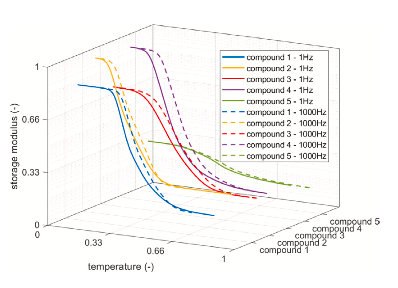
To represent this behavior over a wide operating range, the study uses the time-temperature superposition principle. This allows the material properties measured or modeled at one temperature and frequency condition to be shifted to another condition. The Williams-Landel-Ferry law is used to describe the horizontal shift related to temperature dependence.
The paper also adopts fractional viscoelastic modeling to describe the mechanical behavior of the compound over a wide frequency range using a limited number of parameters. This is important for simulation efficiency, especially when the wear model must operate across many nodes in a discretized tread volume.
In practical terms, the compound properties used in the wear model are not fixed nominal values. They change according to the instantaneous temperature and excitation frequency. This is one of the most important aspects of the formulation because it makes the model sensitive to the real operating state of the tire.
Tire Thermal Analysis: Temperature Gradients and Instantaneous Operating Conditions
Tire measurement in the context of this model is not limited to surface temperature or final tread depth. The formulation requires information about the thermodynamic state of the tire, including the temperature gradient inside the tread compound. This is important because the material properties vary across the tread thickness, not only at the surface.
The study uses a tire thermodynamic model based on heat transfer principles to reproduce the temperature distribution of the tire in different operating conditions. Heat generation comes mainly from two sources: hysteretic energy dissipation during loading-unloading cycles and heat generated by sliding friction at the tire-road interface.
Boundary conditions such as road temperature, air temperature, vehicle configuration, braking heat and cooling effects can influence the thermal state. The resulting three-dimensional temperature gradient is then used together with road-induced excitation frequency to evaluate the instantaneous viscoelastic properties of the tread compound.
This has a direct impact on wear prediction. If the temperature distribution is not properly considered, the model may use incorrect material properties and therefore incorrect stress, strain and damage values. A tire can appear similar from the outside while having very different internal thermal states, especially in motorsport or heavy-duty applications.
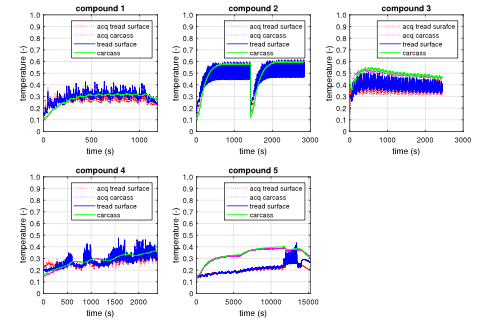
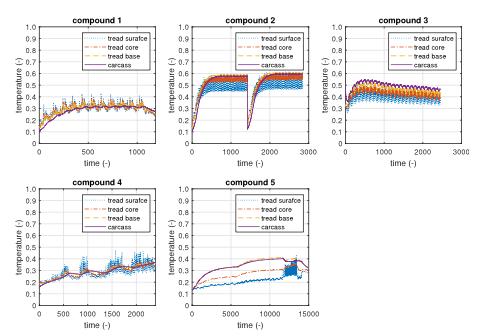
The paper shows simulated and experimental tire temperatures, confirming the relevance of thermal modeling in the complete wear framework. The temperature trends include warm-up phases and steady-state conditions, which are essential for understanding how wear evolves during a run.
Road Roughness and Contact Mechanics in Tire Wear Prediction
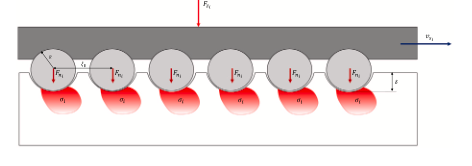
Road roughness plays a fundamental role in tire wear because the road profile determines how the tread is locally excited and indented. The model represents the road through equally spaced rigid indenters that interact with an elastic semi-space representing the tire compound. This simplified contact framework allows the model to compute indentation and stress-strain distributions inside the rubber.
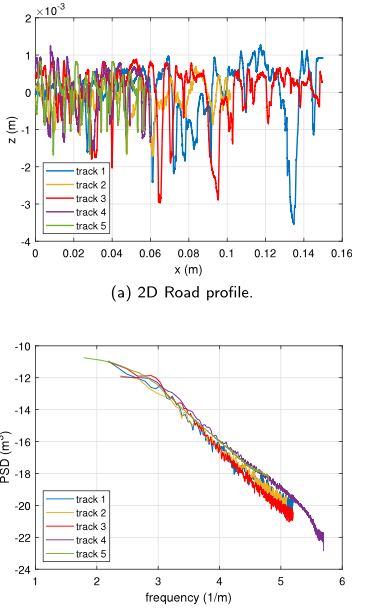
The indenters are defined from road roughness data, especially the parallel and perpendicular correlation lengths associated with the macro wavelength of the road profile. These quantities are used to estimate the excitation frequency experienced by the rubber according to the sliding velocity and road wavelength.
This link between roughness and frequency is technically important. A rougher or differently structured road profile can excite the compound in a different way, changing the apparent viscoelastic response through the time-temperature superposition principle. The road surface therefore affects wear not only geometrically, but also dynamically.
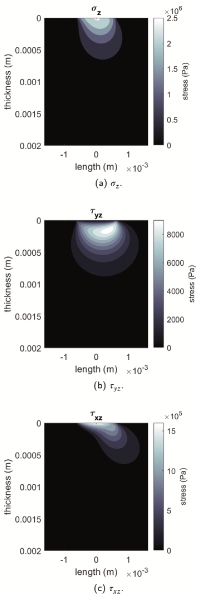
The contact mechanics block uses the instantaneous compound properties to calculate indentation levels and stress-strain distributions. These local stress fields are then used to evaluate equivalent stress at each node of the tread volume. This equivalent stress becomes one of the inputs for the damage accumulation process.
This approach makes the wear model more physically meaningful than a purely empirical mileage-based model. It connects road texture, contact mechanics, compound state and material fatigue into one simulation chain.
Tire Behavior: Stress, Damage and Material Removal
Tire behavior under wear conditions is linked to repeated local stresses generated by contact between the tread and road asperities. As the tire rolls and slides, local contact events occur many times. These repeated cycles progressively damage the material until a portion of tread rubber is considered detached.
The study uses Miner’s cumulative damage rule as the foundation for damage accumulation. In its basic form, this approach evaluates how repeated cycles consume the fatigue life of a material. The paper extends this idea to viscoelastic rubber by making the fatigue behavior dependent on temperature and excitation frequency.
This means that the number of cycles to failure is not a fixed material constant. It changes according to the local thermal and dynamic conditions. A tread volume operating at a different temperature or frequency can accumulate damage at a different rate. This is essential for tire wear modeling because real tires do not operate under constant conditions.
Once the elementary material volume reaches the ultimate damage condition, the model treats that material as removed from the tread. The adjacent node then becomes the new contact node for subsequent stress and strain evaluation. This allows the model to simulate the progressive evolution of tread thickness.
For technical users, this is one of the strongest parts of the formulation. It links local contact mechanics with material fatigue and tread thickness evolution, creating a path from operating conditions to predicted wear.
Tire Performance: Validation Across Motorsport, Passenger and Truck Applications
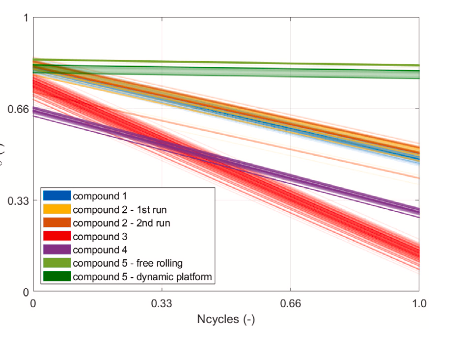
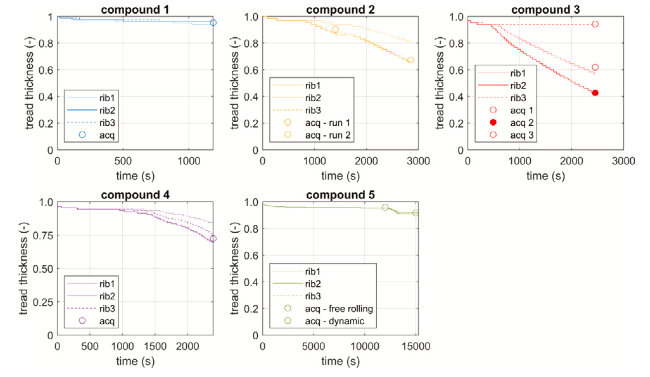
Tire performance and tire wear are strongly connected. A tire that wears too quickly may lose grip, change stiffness, alter thermal behavior and reduce consistency. The study validates the proposed wear model across five datasets selected to cover a wide range of applications and performance levels.
The validation includes motorsport single-seater tires, GT car tires, an ultra-high-performance single-seater slick, a sporty passenger car tire and a heavy-duty truck tire. These datasets are different in terms of normal load, temperature range, frequency range, tire structure and compound behavior.
This diversity is important because it tests whether the formulation can work outside a narrow operating window. The datasets include moderate, high and ultra-high performance tires, as well as a heavy-duty tire subjected to much higher loads and different dynamic conditions.
The paper reports that the model reproduces material removal with error percentages below 5% in all tested cases. This is a strong result because the validation covers different vehicles, different tire compounds, different road profiles and different thermal-dynamic operating conditions.
From an engineering perspective, this suggests that the model can support tire development, virtual testing, performance monitoring and advanced simulation environments. It can help move tire wear prediction from empirical observation toward physics-based interpretation.
Non-Destructive Tire Testing and the Role of VESevo
The study is highly relevant to non-destructive tire testing because it uses compound viscoelastic properties evaluated through VESevo technology as part of the broader modeling workflow. Traditional destructive methods such as Dynamic Mechanical Analysis require prepared specimens and can be impractical when the objective is to characterize tire tread compounds without damaging the tire.
VESevo supports this challenge by enabling the evaluation of tire tread viscoelastic properties in a non-destructive way. This is especially important in motorsport and advanced tire development, where access to accurate compound information can strongly influence modeling, simulation and performance prediction.
In the context of the wear model, non-destructive viscoelastic characterization is not an isolated measurement. It becomes an input for the physical formulation. Storage modulus and loss factor are used together with thermal and frequency information to determine the local behavior of the tread compound during operation.
This creates a direct link between VESevo non-destructive tire testing, viscoelastic material modeling, tire-road friction modeling and wear prediction. The result is a more complete understanding of how compound behavior, road roughness and temperature contribute to tire lifecycle evolution.
For tire manufacturers, laboratories and racing teams, this is valuable because it supports faster characterization, reduced destructive testing, improved simulation inputs and more accurate interpretation of tire behavior during use.
Why This Tire Wear Model Matters for Simulation and Control Systems
The proposed model has practical value because it can be adapted to different simulation environments. It can work with detailed finite element co-simulation approaches, where local quantities are available at many nodes, but it can also be used in simplified contact patch approaches where average quantities are adopted.
This flexibility is important for real-world engineering workflows. Some applications require high-fidelity offline simulations, while others require real-time compatibility for driver-in-the-loop simulators or advanced onboard monitoring systems. A wear model that can operate across different levels of detail is more useful than a formulation tied to one specific simulation architecture.
The model can also feed advanced tire dynamic models by providing information about reduced tread thickness or removed rubber mass. Since tread thickness affects thermal dynamics, stiffness and frictional behavior, wear prediction can improve broader tire and vehicle simulations.
In motorsport, this can support tire management, stint planning, grip evolution analysis and performance optimization. In road vehicles, it can contribute to safety and maintenance strategies. In heavy-duty applications, it can support durability analysis and environmental impact reduction related to tire particle emissions.
The study also points out current limitations. The formulation does not yet account for degradation effects linked to thermomechanical and chemical fatigue on viscoelastic and diffusivity properties. These effects are complex and require controlled laboratory investigation. This makes the current model a strong step forward, while also leaving a clear path for future research.
Frequently Asked Questions About Tire Wear Modeling
What is the main purpose of this tire wear model?
The model aims to predict tire tread wear by combining rubber viscoelasticity, road roughness, contact mechanics, tire thermal state and operating conditions into a multidisciplinary physical formulation.
Why is tire wear difficult to model?
Tire wear is difficult to model because it depends on local pressure, sliding velocity, temperature, road texture, compound viscoelasticity, stress-strain distribution and damage accumulation. These quantities change continuously during tire operation.
How does rubber viscoelasticity influence tire wear?
Rubber viscoelasticity influences stiffness, damping, hysteresis and stress distribution inside the tread compound. Since viscoelastic properties depend on temperature and excitation frequency, they directly affect damage accumulation and material removal.
Why is road roughness important in tire wear prediction?
Road roughness determines how the tire tread is locally indented and excited. The road profile influences contact mechanics, excitation frequency, local stress state and therefore the evolution of tread wear.
What role does temperature play in tire wear?
Temperature changes the viscoelastic properties of the compound. It affects storage modulus, loss factor, stress-strain distribution and fatigue behavior. A reliable tire wear model must therefore include the thermodynamic state of the tread.
What is the time-temperature superposition principle?
The time-temperature superposition principle is used to relate the material response at different temperatures and frequencies. It allows the model to evaluate compound properties under the actual operating conditions experienced by the tire.
How is damage accumulation modeled?
The study uses a fatigue-based approach derived from Miner’s cumulative damage rule. Damage accumulates according to the local stress cycles, temperature and excitation frequency until material removal occurs.
What data were used to validate the model?
The model was validated using five datasets from different tire and vehicle categories, including motorsport single-seaters, GT cars, passenger cars and heavy-duty trucks, covering different loads, temperatures and frequency ranges.
How accurate is the model according to the study?
The study reports final wear prediction errors below 5% in all analyzed cases, showing good agreement between simulated and experimental tread wear measurements.
Does the model use VESevo data?
Yes. The viscoelastic properties of the compounds are evaluated using non-destructive VESevo technology and then used as inputs for the wear modeling framework.
Can this model support motorsport applications?
Yes. The model can support tire management, grip evolution analysis, stint planning and virtual performance simulation by predicting how tread wear evolves under different thermal and dynamic conditions.
Can this model support road vehicle and truck applications?
Yes. The validation includes passenger and heavy-duty truck applications, showing that the formulation can be relevant beyond motorsport for durability, safety and environmental impact analysis.
Does the model replace experimental tire wear testing?
No. The model does not replace experimental testing. It provides a predictive and interpretive tool that can support test planning, simulation, compound comparison and analysis of tire wear mechanisms.
What are the future developments mentioned in the study?
Future developments include the investigation of degradation effects linked to thermomechanical and chemical fatigue, and their influence on viscoelastic and diffusivity properties of the tire compound.
Scientific Source
This article is based on the scientific paper: Sakhnevych, A.; Genovese, A. Tyre wear model: A fusion of rubber viscoelasticity, road roughness, and thermodynamic state. Wear, 542-543, 205291, 2024. DOI: 10.1016/j.wear.2024.205291.
Editorial note: The information provided in this article is technical and general in nature. It does not replace customized engineering analysis, laboratory validation, motorsport testing, road safety assessment or product-specific tire development. Any use of tire wear models, viscoelastic data, thermodynamic simulations or road roughness inputs for design, safety, racing or production purposes should be evaluated by qualified technical professionals.