
Polymers are used in engineering applications where stiffness, damping and energy dissipation can change significantly with temperature and excitation frequency. This makes their dynamic characterization essential whenever a component must operate under variable thermal or mechanical conditions.
Traditional characterization of polymers frequently relies on Dynamic Mechanical Analysis, or DMA. The technique provides detailed information about the material response, but it normally requires a dedicated polymeric sample and may involve extracting or preparing material that can no longer remain part of the original component.
The scientific study examined here investigates a different question: can non-destructive polymer characterization be extended beyond one reference testing frequency and eventually provide the information required to identify a material-specific Time–Temperature Superposition shift law?
The proposed approach builds on the VESevo indentation methodology. Instead of changing or destroying the tested material, the research explores modifications to the testing system itself, generating different indentation frequencies while preserving comparable initial impact conditions.
This makes the work particularly relevant for engineers interested in the viscoelastic properties of polymers, frequency-dependent characterization and repeated testing of a finished polymer component.
Polymer Testing: Why Frequency and Temperature Must Be Considered Together
Polymer testing is complicated by the fact that a viscoelastic material does not have one fixed dynamic response. The same material can behave differently when excitation frequency or temperature changes.
At low frequencies, molecular chains have more time to rearrange during loading and the material tends toward a more rubber-like response. At high frequencies, molecular movement becomes increasingly restricted and the response moves toward the glassy region.
Temperature produces an analogous effect in the opposite direction. Increasing temperature generally increases molecular mobility, while decreasing temperature restricts it. Consequently, polymer behavior at one frequency and temperature cannot automatically represent its response across the complete operating range.
This frequency-temperature equivalence is the physical basis of the Time–Temperature Superposition Principle, or TTSP. Instead of experimentally covering every possible combination of frequency and temperature, measurements obtained under different conditions can be related through shift factors.
A broader discussion of frequency-temperature-dependent mathematical models is available in our analysis of nonlinear viscoelastic material modeling for tire applications. The present article focuses instead on how the required frequency information may be generated experimentally without destructive specimen preparation.
Characterization of Polymers Through Storage Modulus and Loss Factor
The dynamic response of polymeric materials is generally described through the complex modulus. Its real and imaginary components represent different aspects of the material response.
- Storage modulus E′ describes the elastic component and the ability to store mechanical energy during deformation.
- Loss modulus E″ represents irreversible energy dissipation.
- Loss factor tan δ, obtained from the ratio between loss and storage modulus, provides a measure of viscoelastic damping.
The phase lag between applied stress and resulting strain is therefore fundamental to understanding the polymer’s viscoelastic behavior. A perfectly elastic response would exhibit no phase delay, whereas viscoelastic materials produce a hysteresis loop whose area represents dissipated mechanical energy.
These quantities are not constant. The viscoelastic behaviour of polymers evolves continuously across the rubbery, transition and glassy regions as temperature and frequency change.
This is also why characterizing only one operating condition can be insufficient when the final component experiences a wide range of mechanical excitation or thermal states.
Non-Destructive Polymer Characterization with Indentation
Conventional DMA typically evaluates a prepared specimen under controlled bending, torsional or related dynamic conditions. The methodology investigated in the paper instead uses an indentation-based procedure that can operate directly on the material surface.
The VESevo device contains a rod equipped with a semi-spherical indenter. The rod is released from a repeatable initial position, impacts the surface and rebounds. An optical sensor records its displacement while temperature is monitored simultaneously.
The resulting rebound signal contains information about both elastic and dissipative response. Its characteristics are processed to obtain temperature-dependent quantities related to storage modulus and loss factor.
The main advantage for characterization of polymers is that the material does not have to be cut into a dedicated specimen. A finished product or material sample can potentially be investigated repeatedly while remaining intact.
The basic indentation mechanism is described separately on the VESevo non-destructive viscoelastic measurement working principle page.
A Proposed Method for Multi-Frequency Polymer Characterization
The conventional configuration analyzed in the study provides material master curves at a reference frequency of approximately 1 Hz. This is already useful for comparing temperature-dependent viscoelastic response, but it introduces an important limitation.
A single master curve does not uniquely determine the relationship between temperature and frequency for the tested material. To identify a material-specific shift law, information at more than one frequency is required.
The proposed strategy is therefore to obtain at least three distinct viscoelastic master curves corresponding to three indentation frequencies. Their relative horizontal displacement could then provide the shift factors required to reconstruct the wider frequency-temperature relationship.
This represents an important conceptual evolution in non-destructive polymer characterization: instead of obtaining only a temperature sweep at one reference frequency, the measurement architecture is designed toward extracting frequency-dependent information from the same class of non-invasive indentation test.
How Indenter Mass Changes the Testing Frequency of Polymers
The study investigates whether indentation frequency can be modified by changing the mass of the semi-spherical indenter system.
Three different masses are analyzed. Increasing indenter mass modifies the dynamics of the rod, including rebound duration, sinking depth, impact velocity and detachment velocity. Because the characteristic indentation frequency is related to the interaction time between rod and material, different masses can generate distinct frequency conditions.
The simulations confirm this effect: the three selected masses produce three different normalized indentation frequencies.
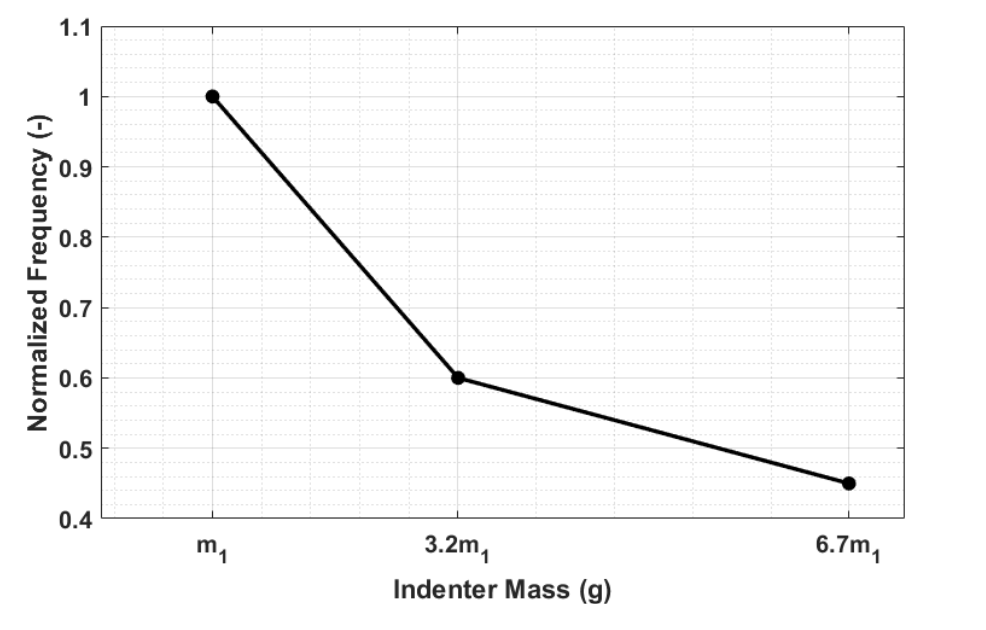
This result is central to the proposed methodology because generating physically distinct frequencies is a prerequisite for eventually constructing independent master curves for the same polymer.
Why Impact Conditions Must Remain Comparable
Changing the indenter mass creates another problem. If mass is varied while the remainder of the system remains unchanged, impact velocity and indentation depth also change.
This would make direct comparison difficult because the resulting variation in measured material properties could originate not only from frequency but also from different impact-energy conditions.
The study addresses this problem by redesigning the spring element associated with each mass. The spring stiffness is adjusted so that a common target impact velocity is obtained across the different configurations.
In other words, the methodology attempts to modify frequency while preserving comparable initial interaction conditions. This is essential if differences in the measured viscoelastic properties of polymers are to be interpreted as frequency effects rather than uncontrolled changes in the test itself.
Experimental Validation of the Multi-Frequency Testing System
The virtual testing system was not used in isolation. The proposed configurations were physically manufactured using the new masses and corresponding spring elements, producing three different sensor modules.
The study then compares the response predicted by the virtual model with data acquired using the real device on a reference material.
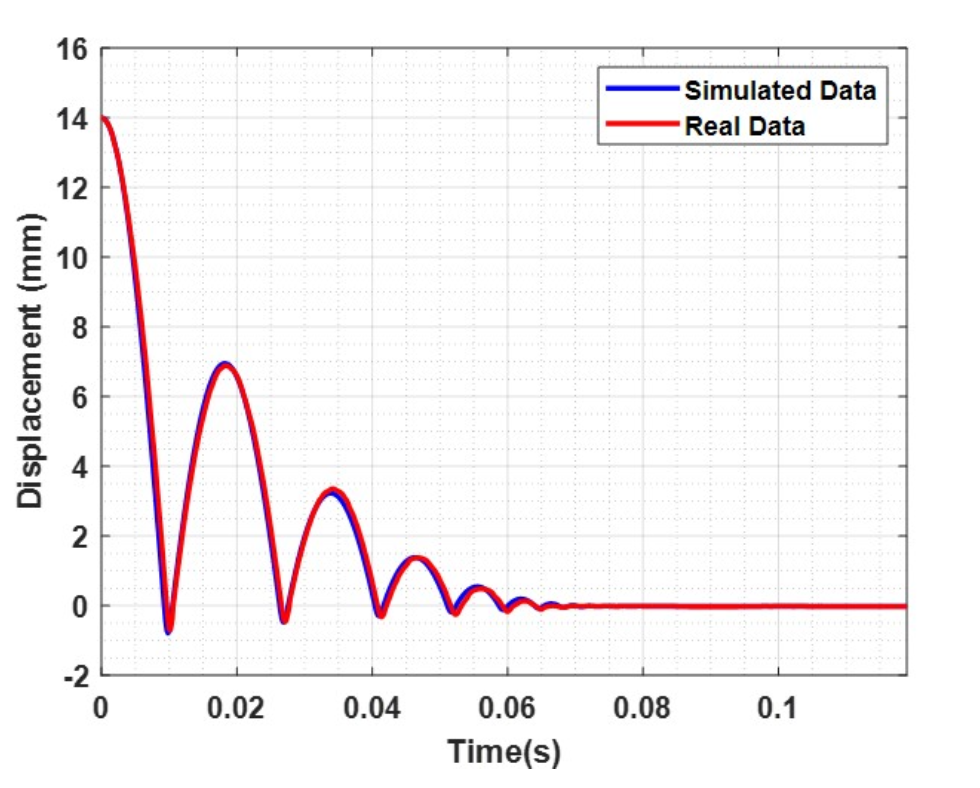
The close reproduction of the rebound trend provides experimental support for the virtual model used during development.
A further set of tests evaluates whether the redesigned modules preserve similar initial characterization conditions. Fifty tests were conducted for each of the three mass configurations and the resulting impact conditions were compared.
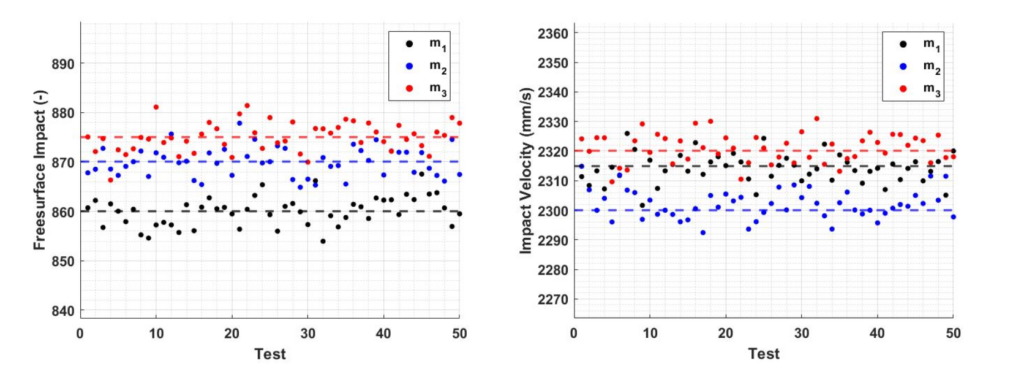
These results are particularly important because they demonstrate that multi-frequency testing cannot be achieved simply by installing a heavier indenter. The complete mechanical configuration has to be designed to preserve a controlled test condition.
Toward a Non-Destructive Time–Temperature Shift Law for Polymers
The ultimate objective is to obtain a temperature–frequency relationship without relying exclusively on destructive multi-frequency DMA testing.
Under the Time–Temperature Superposition Principle, master curves acquired at different frequencies can be horizontally shifted toward a selected reference condition. The magnitude of these shifts defines temperature-dependent shift factors.
The Williams–Landel–Ferry relationship is one of the most widely used laws for describing this behavior in polymeric materials. In conventional practice, material-specific coefficients may require experiments performed at several frequencies.
The approach investigated here aims to create the experimental conditions needed to estimate those shifts from nondestructive indentation measurements.
An important distinction must be maintained: the study demonstrates the feasibility of generating different indentation frequencies and validates the redesigned testing architecture, but it does not yet present the final experimentally identified shift law. The complete multi-frequency temperature-sweep campaign and the derivation of the corresponding shift algorithm are identified as subsequent steps.
This makes the research a methodological foundation for future non-destructive frequency-temperature characterization rather than a finished replacement for every DMA-based shift-law procedure.
Polymer Behavior Beyond a Single Master Curve
A broader frequency representation can provide engineers with a more useful description of polymer behavior than a single reference curve.
A polymer component may experience different excitation frequencies during its service life. Temperature can also change continuously during operation. Knowing how the two variables interact is therefore valuable when measured properties are used as inputs for simulation, durability analysis or product development.
This is especially relevant when engineers need to understand the polymer’s viscoelastic behavior under conditions that cannot be reproduced conveniently by one laboratory measurement.
For tire applications, these properties can influence grip, friction and wear models. For other engineering applications, they can support vibration control, damping analysis, insulation behavior and lifecycle monitoring.
The relationship between measured material properties and mathematical model construction is examined separately in our article on material testing and analysis of viscoelastic compounds.
Testing a Polymer Component Without Destroying the Product
The broader engineering relevance of this approach lies in the possibility of testing a polymer component while preserving the component itself.
Destructive sample preparation can be impractical when the object is expensive, unique, subject to regulations or needs to be monitored repeatedly. A non-invasive method can potentially allow the same point or component to be measured at different temperatures or at different stages of its lifecycle.
The study itself is primarily a methodological investigation and does not validate the proposed multi-frequency approach across every class of industrial polymer. However, the underlying concept has potential beyond tire tread compounds because many engineering polymers exhibit the same fundamental dependence on temperature and loading frequency.
For lifecycle-oriented applications such as aging, thermal treatments and repeated product monitoring, see our separate analysis of nondestructive material characterization across the product lifecycle.
Engineering Applications of Multi-Frequency Polymer Characterization
If the full experimental shift-law methodology is validated, multi-frequency characterization of polymers could provide useful physical inputs across several engineering workflows.
| Application | Polymer information | Engineering value |
|---|---|---|
| Dynamic simulation | Frequency-temperature-dependent viscoelastic properties | More representative material-model inputs |
| Tire engineering | Storage modulus and loss factor across operating conditions | Support grip, friction and wear models |
| Component monitoring | Repeated nondestructive measurements | Follow material evolution without specimen removal |
| Product development | Comparison of polymer formulations | Evaluate dynamic response under relevant conditions |
| Lifecycle analysis | Changes in viscoelastic response with temperature and time | Support degradation and performance studies |
The engineering value lies not simply in obtaining another material curve, but in potentially extending the viscoelastic properties of polymers over operating conditions that are more representative of the real application.
Need to Evaluate a Polymer or Viscoelastic Component?
Discuss your material, operating conditions and testing requirements with the VESevo team to evaluate whether a non-destructive characterization workflow is suitable for your application.
Limits of the Current Polymer Testing Methodology
- The paper establishes the feasibility of multi-frequency indentation testing but does not yet provide the final experimentally identified shift law.
- The complete temperature-sweep campaign using the three different frequencies remains a subsequent research step.
- Changing indenter mass requires corresponding spring redesign to preserve comparable initial impact conditions.
- The current approach requires interchangeable mass-and-spring modules, which increases testing time.
- The number and range of obtainable frequencies are constrained by the dimensions and mechanical architecture of the device.
- The methodology has not yet been validated for every type of polymeric material or component geometry.
- DMA remains an established reference technique and should not be considered universally replaced by the preliminary multi-frequency methodology.
These limitations are important when interpreting the study. Its contribution is the demonstration of a feasible path toward broader non-destructive polymer characterization, not the claim that complete multi-frequency DMA characterization has already been replaced.
Frequently Asked Questions About Polymer Testing
Why does polymer testing require different frequencies?
Viscoelastic polymers respond differently as excitation frequency changes. Testing at multiple frequencies helps characterize how stiffness and energy dissipation evolve across the operating range.
What is non-destructive polymer characterization?
Non-destructive polymer characterization evaluates useful material properties without extracting or permanently damaging the tested component. This allows the same material or finished product to be measured repeatedly.
Which viscoelastic properties of polymers are considered?
The methodology focuses on quantities related to storage modulus and loss factor, which describe the elastic and dissipative parts of the polymer response.
What is a polymer master curve?
A master curve describes a viscoelastic property over an extended frequency or temperature domain by applying the Time–Temperature Superposition Principle to measurements obtained under different conditions.
Why does the study use three indenter masses?
Different masses generate different rod dynamics and therefore different characteristic indentation frequencies. The study investigates three configurations as a basis for obtaining multiple master curves.
Why are different springs required for the three masses?
Changing mass alone also changes impact velocity and indentation conditions. Spring stiffness is therefore adjusted to compensate for these effects and maintain comparable initial testing conditions.
Has the new shift law already been identified experimentally?
No. The study demonstrates the feasibility of producing distinct indentation frequencies and validates the redesigned testing system. The complete experimental identification of the shift law is described as a subsequent research objective.
Can this methodology be applied to polymer components outside tires?
The physical principle is relevant to viscoelastic polymeric materials more broadly, but the present study does not experimentally validate every industrial polymer or component. Application-specific validation remains necessary.
Does non-destructive testing replace DMA?
Not universally. DMA remains an established laboratory technique. The research investigates whether nondestructive indentation can provide complementary multi-frequency information and eventually support shift-law identification without destructive specimen preparation.
Scientific Source
This article is based on: Sakhnevych, A.; Maglione, R.; Timpone, F. A Non-Destructive Methodology for the Viscoelastic Characterization of Polymers: Toward the Identification of the Time–Temperature Superposition Shift Law. Sensors 2023, 23, 9213. DOI: 10.3390/s23229213.
The scientific publication is distributed under the Creative Commons Attribution 4.0 International license.
Editorial note: This article focuses on the development and experimental validation of a multi-frequency nondestructive testing architecture for viscoelastic polymers. The cited study establishes the feasibility of the method but does not yet report the final experimentally derived Time–Temperature Superposition shift law.