
Material characterization is essential when the mechanical properties of a tire must be understood not only at the beginning of its life, but also after mileage, thermal cycles, aging and manufacturing processes. Tire tread compounds belong to the family of viscoelastic materials, whose response changes with temperature, excitation frequency and operating history.
This makes conventional one-time laboratory testing insufficient for several engineering questions. A destructive test can accurately characterize a specimen, but once material has been removed from a tire, the same product cannot be followed through subsequent stages of its lifecycle.
The scientific study examined here analyzes a different approach. VESevo combines a portable measurement device with a nondestructive indentation methodology to characterize rubber materials directly on the finished product and to repeat the measurement over time.
The significance of the study lies especially in the scenarios enabled by this capability: objective comparison of tire compounds, monitoring of wear and aging, optimization of curing cycles, analysis of manufacturing uniformity and quality control of other viscoelastic goods.
This application-oriented perspective complements the VESevo article on material testing and analysis of viscoelastic tire compounds, which focuses more specifically on experimental characterization and frequency-temperature-dependent mathematical modeling.
Material Testing: Fast and Nondestructive Viscoelastic Measurements
Traditional material testing of tire tread commonly relies on Dynamic Mechanical Analysis, or DMA, and other destructive procedures. These techniques require specimens with controlled geometry and usually involve cutting material from the tire.
For a highly deformable material such as tire rubber, specimen preparation itself can introduce additional uncertainty. The paper notes that cutting can modify the internal stress-strain equilibrium, while clamping conditions, specimen geometry and testing controls can also influence the measured response.
VESevo addresses a different need: obtaining useful viscoelastic information directly from the tire or rubber good without making it unusable. A steel rod equipped with a semi-spherical titanium indenter falls and rebounds on the tested surface. Its motion is recorded, while the temperature of the compound is measured simultaneously.
A high-precision internal mechanism ensures repeatable initial conditions for every drop. The same physical location can therefore be tested several times under different conditions or at different stages of the product lifecycle.
The complete operating principle is described in more detail on the VESevo nondestructive viscoelastic measurement working principle page.
From Indentation Signal to Material Properties
The displacement curve recorded during each acquisition contains three recognizable stages: the initial drop, the first penetration into the material and the subsequent damped transient.
The first indentation is particularly important for viscoelastic material characterization. By differentiating displacement, the processing algorithm obtains rod velocity and identifies the beginning and end of the first interaction with the rubber layer.
The change in kinetic energy across the indentation event is related to the dissipative behavior of the material and therefore to its loss factor. Other characteristics of the signal provide information related to storage modulus.
The final static displacement is described in the paper as being strongly correlated with the inverse of storage modulus, effectively behaving as an indicator comparable to the static hardness of the material. It should therefore be interpreted as a physical indicator derived from the indentation response rather than as a conventional hardness test.
Two Material Testing Strategies
The methodology can be used according to two principal testing strategies.
- Variable-temperature characterization: the sample is heated or cooled and measurements are acquired across its thermal evolution to reconstruct material master curves.
- Fixed-temperature testing: rapid acquisitions are performed at ambient or predefined temperatures to generate comparative viscoelastic indexes suitable for quality-control applications.
This distinction is important because full master curves and fast comparative measurements answer different engineering questions. The first is useful for understanding the temperature-frequency response of a material; the second allows fast comparison among positions, components or nominally equivalent products.
Material Analysis: Storage Modulus, Loss Factor and Friction Relevance
Material analysis begins with the characteristic behavior of a viscoelastic solid. Unlike a perfectly elastic solid or a purely viscous fluid, a viscoelastic material responds to deformation with a combination of elastic energy storage and dissipative behavior.
The complex dynamic modulus contains two principal components:
- storage modulus E′, associated with elasticity and the capacity to store mechanical energy;
- loss modulus E″, associated with energy dissipation.
The ratio between them defines the loss factor tan δ, which provides an index of the damping potential of the material.
These properties depend strongly on temperature and excitation frequency. Their relationship can be described using the Time-Temperature Superposition principle and the Williams-Landel-Ferry law, allowing measurements acquired under different thermal conditions to form broader master curves.
For tire engineering, this behavior is particularly significant because road interaction excites the tread across different spatial and frequency scales. Hysteretic friction is connected to deformation caused by surface roughness, while adhesive interaction occurs at smaller dimensional scales.
The paper links loss-related behavior primarily with hysteretic friction and storage-modulus-related behavior with adhesive interaction. A broader discussion of these mechanisms is available in the VESevo article on tire adhesion and viscoelastic material behavior.
Validation Against Dynamic Mechanical Analysis
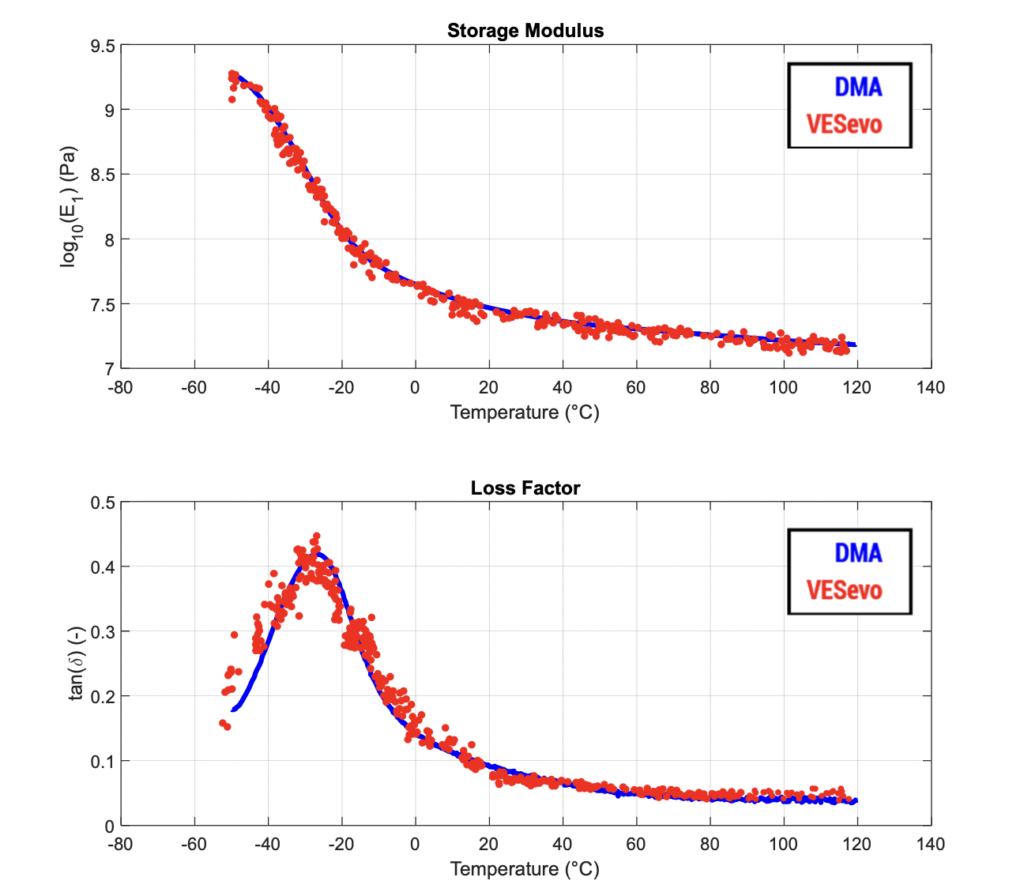
VESevo-derived storage-modulus and loss-factor curves were validated against destructive DMA measurements carried out using the same polymer compounds under corresponding temperature and reference-frequency conditions.
The resulting comparison supports the use of the methodology as a nondestructive characterization tool. The objective is not to reproduce the DMA test mechanically, but to obtain viscoelastic quantities that remain comparable with established laboratory characterization.
Material Master Curves for Tire Compound Characterization
One of the original applications of the methodology was motorsport, where technical regulations or tire-supply agreements can prevent teams from performing destructive analyses on race tires.
Terms such as soft, medium or hard provide useful operational labels, but they do not constitute a quantitative description of the actual material response. Measuring material master curves allows these labels to be translated into information about glass-transition temperature, storage modulus and dissipative behavior.
This makes the characterization useful as an input for physical friction, contact, finite-element and wear models. Instead of assigning nominal properties, engineers can use measurements corresponding to the actual material incorporated into the tire.
This specific compound-oriented application is developed further in the VESevo article on compound testing and nondestructive viscoelastic characterization.
The paper also discusses another interesting motorsport application: comparing measured tire characteristics with driver feedback. A tire reported as underperforming can be compared against tires exhibiting the expected response, providing objective information that can complement subjective evaluation.
The authors correctly note that such comparisons should not be interpreted as complete vehicle-level validation when corresponding telemetry information is unavailable. The material measurement adds evidence, but it does not independently identify every possible cause of underperformance.
Material Lifecycle Monitoring: Mileage, Wear and Viscoelastic Evolution
A major advantage of nondestructive material characterization is the possibility of testing exactly the same product repeatedly throughout its lifecycle.
With conventional destructive analysis, following one tire over time is impossible because obtaining the first DMA specimen alters or destroys the product. Comparing several nominally identical tires at different mileage levels also introduces uncertainty associated with production variability.
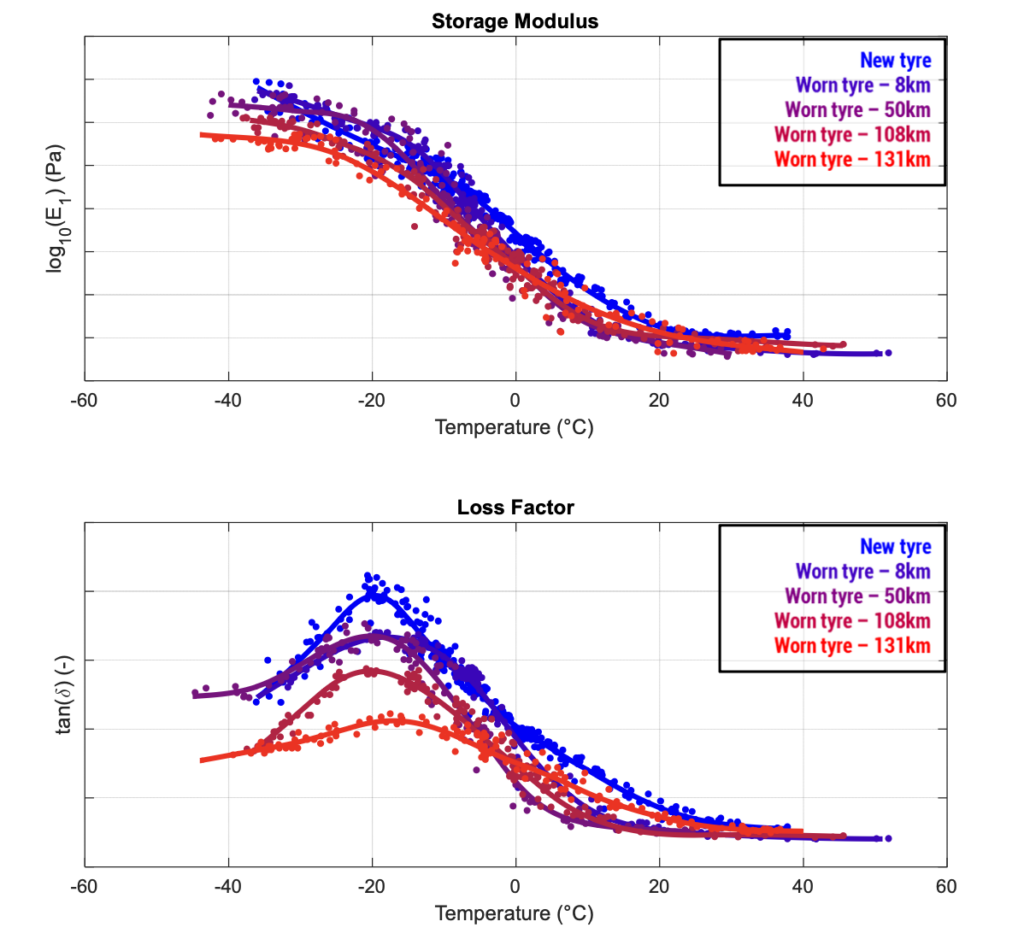
Repeated VESevo measurements allow engineers to observe how the same material evolves as mileage accumulates and to correlate changes in mechanical properties with the energy and mechanical history experienced by the component.
The experimental results show progressive changes in storage modulus and loss factor for the same tire at increasing mileage levels. One commonly observed trend is a reduction in storage modulus associated with decreasing tread thickness and lower structural stiffness, accompanied by reduced dissipative capability in a thinner material volume.
The paper emphasizes that this behavior is not identical at every temperature and is not universal across all materials. It should therefore be treated as an experimentally observed tendency rather than a fixed law of tire aging.
Monitoring Material Aging Without Destroying the Tire
Lifecycle monitoring also includes aging independently of mileage. Oxidative processes accelerated by environmental exposure such as ultraviolet radiation and ozone can progressively modify the mechanical response of rubber.
Periodic measurements can therefore reveal changes in the viscoelastic state of an unused but aging tire. This is relevant because degradation of tread characteristics may ultimately affect friction and safety even in the absence of substantial tread wear.
The relationship between material degradation and tread removal is explored from another perspective in the VESevo analysis of rubber wear, viscoelasticity and abrasion.
Material Characterization of Thermal Curing Cycles
Rubber materials can modify their viscoelastic properties when subjected to heating and cooling cycles even after the initial manufacturing and vulcanization process.
This is particularly relevant in motorsport, where teams may apply predefined thermal cycles using blankets, thermal guns or ovens. Traditionally, these procedures can be based heavily on previous experience and established routines.
Nondestructive measurements allow the same tire to be analyzed before and after individual thermal cycles. Engineers can therefore structure experiments around different temperatures, durations and numbers of cycles and evaluate the resulting changes objectively.
The example presented in the study illustrates this approach clearly. A one-hour curing treatment caused an undesirable increase in storage modulus, while a four-hour treatment allowed the material to relax and provided an increase in tan δ without the same hardening effect.
This result refers to the specific racing tire and test conditions analyzed in the paper and should not be interpreted as a universal curing prescription. Its engineering significance lies in demonstrating how repeated nondestructive measurements can be used to identify an appropriate treatment experimentally.
The same principle can also support evaluation of vulcanization time during manufacturing by measuring products after different curing cycles.
Material Quality Analysis: Tire Uniformity and Production Control
Another important application concerns industrial quality control. Tire manufacturing and vulcanization are complex processes, and local variations can generate differences in the viscoelastic response of different tread regions.
Fast nondestructive testing makes it possible to compare several areas of one tire and multiple tires belonging to the same production batch without sacrificing finished products.
The study demonstrates this scenario on a tire with five lateral tread ribs. The tire was divided into 28 circumferential sectors, and VESevo measurements were used to evaluate local variations in loss factor.
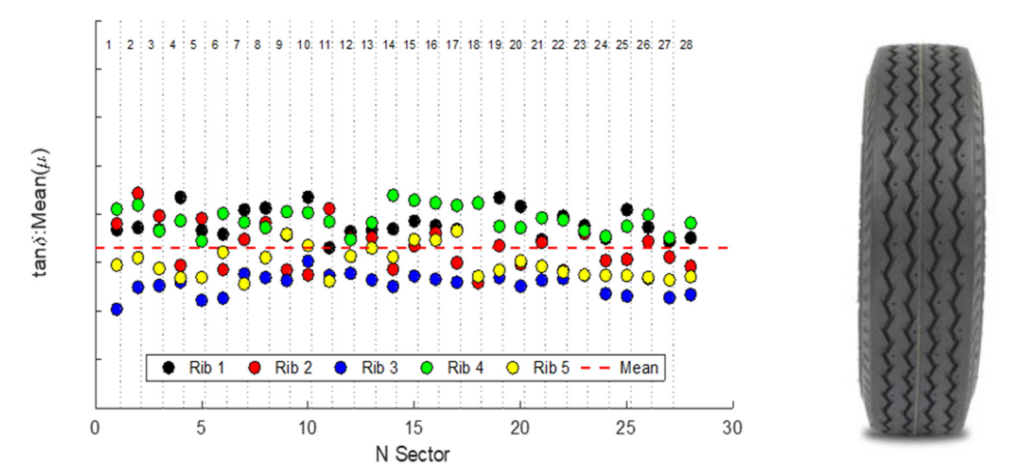
This type of spatial analysis transforms viscoelastic material characterization into a practical production-control tool. Rather than characterizing only one extracted specimen, manufacturers can investigate the actual distribution of properties across the finished tread.
The approach may support assessments of production uniformity, repeatability among products and deviations that could affect ride, comfort or safety.
A broader discussion of nondestructive measurements performed directly on finished tires is available in the VESevo article on nondestructive tire testing and viscoelastic characterization.
Viscoelastic Material Characterization Beyond Tire Applications
Although VESevo was initially developed for tire applications, the physical principle is not intrinsically limited to tire tread compounds. Other rubber and plastic goods can also exhibit a frequency- and temperature-dependent viscoelastic response.
The paper reports preliminary applications involving:
- running-shoe soles;
- padel rackets;
- rubber seals and rings;
- rubber cables, belts and transmission components;
- rubber-coated sheets;
- tennis resin playing surfaces;
- artificial textiles and natural leather.
These examples show that the value of the methodology lies more broadly in the ability to characterize a material directly in the finished product, especially when destructive sample extraction is undesirable.
The maturity and validation level of these applications should not automatically be considered identical to the tire-focused results. In the paper they are presented as recent and developing application scenarios rather than as fully validated replacements for established industry-specific procedures.
Engineering Value of Material Data for Tire Development
The engineering value of this methodology extends beyond obtaining a storage-modulus or loss-factor curve. Repeatable data from real products can support several stages of tire development and operation.
| Application | Material information obtained | Engineering purpose |
|---|---|---|
| Compound comparison | Master curves, Tg, E′ and tan δ | Objective material selection and modeling inputs |
| Motorsport assessment | Measured differences among tires | Complement driver feedback and setup analysis |
| Mileage monitoring | Evolution of storage modulus and loss factor | Study wear and mechanical degradation |
| Aging monitoring | Changes in viscoelastic response over time | Evaluate degradation without destroying the tire |
| Thermal curing | Property changes after repeated heating cycles | Optimize experimental curing strategies |
| Production quality | Spatial and product-to-product variations | Assess uniformity and manufacturing repeatability |
Measured material properties can also provide inputs for finite-element, friction and wear models. This is particularly useful when simulations require physical parameters representative of the real product rather than generic compound assumptions.
The relationship between material properties and tire-road interaction is analyzed further in the VESevo article on tire friction and local contact-area modeling.
Limits of Nondestructive Material Characterization
The study demonstrates several promising scenarios, but the results should be interpreted within their experimental boundaries.
- VESevo complements rather than universally replaces laboratory DMA.
- Some application scenarios presented in the study are preliminary.
- Material-property trends observed with mileage are not identical for every compound or thermal condition.
- The curing-cycle example is specific to the analyzed racing tire and cannot be generalized into a universal treatment duration.
- The underperforming-tire example lacks corresponding vehicle telemetry, preventing full validation of the driver feedback.
- Several industrial results are partially nondimensionalized or hidden because of confidentiality agreements.
- Interpretation of material properties still requires knowledge of the tire structure, operating conditions and intended engineering application.
The principal advantage of the methodology is therefore not that it eliminates every existing test, but that it makes repeated, localized and in-situ measurements possible on products that would otherwise have to be destroyed for conventional characterization.
Frequently Asked Questions About Material Characterization
What is viscoelastic material characterization?
Viscoelastic material characterization measures how a material stores and dissipates mechanical energy and how this response changes with temperature and excitation frequency.
Why is nondestructive material testing useful for tires?
It allows the same tire to be tested repeatedly without extracting a specimen, making it possible to monitor mileage, aging, thermal treatments and production uniformity over time.
Which material properties does VESevo evaluate?
The methodology provides information related to storage modulus and loss factor, describing the elastic and dissipative components of the viscoelastic response.
What are material master curves?
Material master curves describe how viscoelastic properties change across temperature or equivalent frequency conditions, allowing the behavior of different compounds to be compared over a broad operating range.
Can VESevo results be compared with DMA?
Yes. The study compares VESevo results with destructive DMA measurements under corresponding testing conditions and shows comparable trends in the characteristic viscoelastic response.
Can the same material be monitored throughout its lifecycle?
Yes. Because the test is nondestructive, repeated measurements can follow the evolution of one tire or material component as mileage, wear or aging progresses.
Can material testing support tire curing optimization?
The paper demonstrates that repeated measurements can quantify changes caused by different thermal curing cycles, supporting experimental identification of suitable treatment conditions.
How can material analysis support tire production quality?
Measurements can be repeated across multiple tread locations and products to identify local nonuniformity and compare production repeatability without destroying finished tires.
Does the technology apply only to rubber materials?
No. The paper reports developing applications involving other viscoelastic goods, including sports equipment, plastic and rubber components, resin playing surfaces, artificial textiles and leather.
Does nondestructive characterization completely replace DMA?
No. DMA remains an established laboratory characterization method. The main advantage of nondestructive testing is the ability to characterize finished products repeatedly and directly under scenarios in which destructive specimen extraction is impractical.
Scientific Source
This article is based on: Farroni, F.; Timpone, F.; Genovese, A. Analysis of the Scenarios of Use of an Innovative Technology for the Fast and Nondestructive Characterization of Viscoelastic Materials in the Tires Field. Sensors 2024, 24, 1136. DOI: 10.3390/s24041136.
The scientific publication is distributed under the Creative Commons Attribution 4.0 International licence.
Editorial note: This article provides a technical interpretation of the cited scientific study focused on material characterization and its application scenarios. It does not replace application-specific laboratory testing, manufacturing validation, tire development or engineering assessment.