
Viscoelastic rubber friction is fundamental to the analysis of tire-road interaction. It influences tire grip, braking, traction, cornering performance and the capability of a tire model to reproduce real operating conditions. Despite decades of research, accurately separating and predicting the physical contributions that generate rubber friction remains a complex engineering challenge.
When a rubber compound slides over a hard and rough substrate, the friction coefficient is generally described as the sum of two main mechanisms: a viscoelastic contribution generated by cyclic deformation over surface asperities and an adhesive contribution associated with molecular interactions inside the real contact area.
The scientific study examined in this article compares different formulations for estimating these contributions. In particular, it analyzes Persson’s multiscale theory and a simplified formulation proposed for viscoelastic friction, focusing on how empirical parameters influence the calculated results.
The analysis demonstrates that different combinations of cutoff wavelength, surface slope, adhesive parameters, constant friction terms and strain-softening corrections can provide similar agreement with the available experimental measurements. This creates a significant identification problem: a model may reproduce the measured friction curve without uniquely determining how much friction originates from adhesion and how much from viscoelastic deformation.
This topic connects directly with previous VESevo technical analyses concerning tire friction and local contact area modeling, tire adhesion and viscoelasticity, nonlinear viscoelastic material modeling for tire applications and non-destructive tire testing and viscoelastic characterization.
Rubber Friction in Tire-Road Interaction
Rubber friction differs from the friction behavior of many rigid materials. Tire tread compounds are viscoelastic, which means that their mechanical properties depend on deformation rate, excitation frequency, temperature and strain amplitude.
As the tread moves across a rough road, the rubber is continuously deformed by asperities of different sizes. These repeated deformations dissipate energy inside the material and generate a viscoelastic friction contribution. At the same time, molecular interactions and localized junctions inside the real contact area create an adhesive contribution.
The total friction coefficient can therefore be represented conceptually as the sum of:
- viscoelastic friction, associated with deformation losses in the tread compound;
- adhesive friction, associated with interfacial interactions in the real contact area.
In practice, the two mechanisms are difficult to separate because they can generate friction curves with similar shapes over large portions of the sliding-velocity range.
Viscoelastic Friction from Road Asperities
Viscoelastic friction originates from the energy dissipated when rubber is cyclically compressed, stretched and relaxed by road asperities. Each roughness wavelength generates a characteristic excitation frequency related to the sliding velocity.
The mechanical response therefore depends on the complex viscoelastic modulus evaluated at the relevant frequency and temperature. A stiffer compound, a different loss factor or a change in sliding speed can alter the resulting hysteretic energy dissipation and friction coefficient.
Adhesive Friction in the Real Contact Area
Adhesive friction develops within the portion of the nominal tire-road footprint where rubber and substrate are actually in contact. Rubber molecules can stretch, detach, relax and reconnect while sliding over the surface.
Existing adhesive models generally relate this contribution to an interfacial shear stress and the normalized real contact area. However, the shear-stress curve and its characteristic parameters are usually identified empirically from experimental friction data.
The adhesive contribution therefore remains particularly difficult to predict independently. Its estimation also depends on the contact-area model, which is influenced by surface roughness, compound stiffness and the selected high-wavevector cutoff.
Rubber Characterization: Complex Viscoelastic Modulus
Reliable tire characterization is a prerequisite for rubber friction modeling. The model requires the complex elastic modulus over a broad range of frequencies and, when nonlinear effects are considered, at different strain amplitudes.
Rubber Measurement: Modulus, Loss Factor and Frequency Response
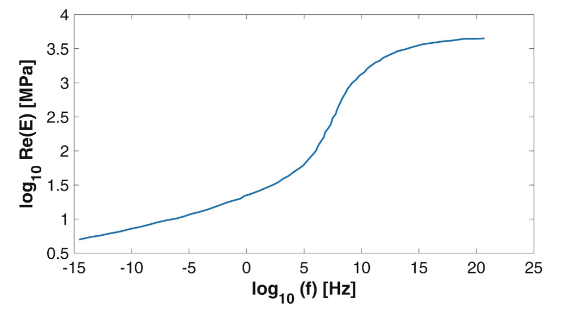
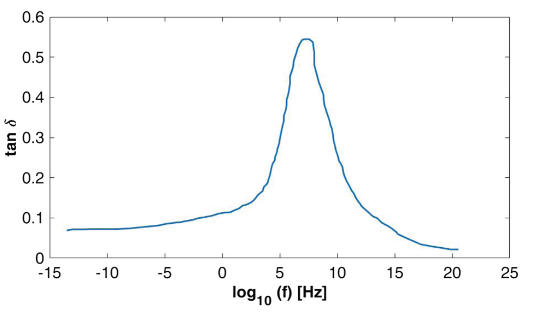
The experimental reference adopted in the study includes the real part of Young’s modulus and the loss factor of a tire tread compound at a reference temperature of 20 °C. The material properties were obtained over a wide frequency range using measurements shifted according to the time-temperature superposition principle.
The real part of Young’s modulus represents the elastic stiffness of the compound. In the data analyzed by the authors, the modulus increases significantly with frequency as the material response moves from a softer rubber-like region toward a stiffer glass-like state.
The loss factor, tan δ, describes the relationship between the dissipative and elastic components of the compound response. Its peak identifies the frequency region in which the material dissipates a particularly large proportion of mechanical energy.
Because road asperities excite the tread at frequencies related to their wavelengths and the sliding speed, the position and amplitude of the loss-factor peak strongly influence the predicted viscoelastic friction curve.
The importance of obtaining reliable compound inputs also explains the value of advanced non-destructive tire measurement and characterization. Although the study analyzed here uses previously available material data, its conclusions confirm that inaccurate or nominal viscoelastic properties can significantly compromise friction-model calibration.
Road Roughness Analysis for Rubber Friction Models
Road roughness analysis is another fundamental element of tire friction modeling. A rough surface contains asperities distributed across many spatial scales, from relatively long surface wavelengths to fine microtexture.
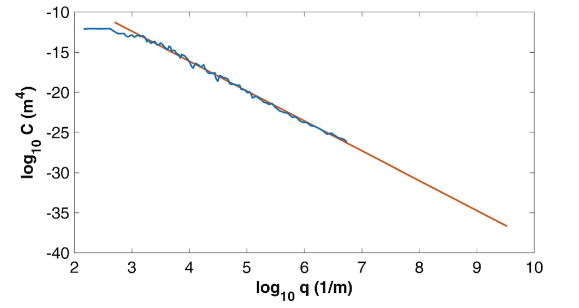
The study uses a concrete substrate as the reference rough surface. Its topography is represented through a two-dimensional Power Spectral Density, or PSD, which describes the amplitude of the surface roughness as a function of wavevector.
Within the relevant range, the concrete surface is approximated as a self-affine fractal surface with a power-law spectrum. The reported Hurst exponent is 0.86, representing how the statistical characteristics of the surface evolve across different length scales.
The PSD makes it possible to calculate several roughness descriptors used by contact and friction models, including:
- root-mean-square surface height;
- root-mean-square slope;
- root-mean-square curvature;
- lower and upper roughness wavevector limits.
The High-Wavevector Cutoff in Road Roughness
The choice of the upper wavevector limit is one of the most critical aspects of the model. This parameter determines the smallest surface scale included in the calculation and strongly affects the resulting root-mean-square slope.
As smaller and smaller roughness scales are included, the calculated surface slope can increase considerably. At extremely small scales, the concept becomes difficult to define physically and may be affected by measurement resolution, surface contamination and the breakdown of continuum assumptions.
The paper emphasizes that the lower wavevector cutoff has limited influence on the friction estimates considered, while the high-wavevector cutoff can substantially change both the viscoelastic and adhesive contributions.
Tire Friction Modeling with Persson’s Multiscale Theory
Persson’s theory is one of the most established approaches for modeling rubber friction on rough surfaces. It begins from the response of a viscoelastic medium in contact with a statistically rough rigid substrate and integrates the effects of multiple roughness scales.
The complete partial-contact formulation includes the surface PSD, the complex rubber modulus, nominal contact pressure, sliding velocity and the fraction of real contact area observed at different magnifications.
Several corrections are required because complete contact between the rubber and every surface scale is unrealistic under practical tire operating conditions. The resulting formulation involves nested integrations and empirical corrections introduced to reproduce numerical contact results.
One of these corrections contains an empirical fitting constant. More importantly, the final result remains dependent on the selected upper roughness wavevector. This means that a theoretically detailed multiscale model still requires a parameter whose physical selection is not uniquely established.
Real Contact Area at Different Magnifications
In Persson’s formulation, the normalized contact area changes according to the magnification at which the surface is observed. At low magnification, the interface may appear almost continuous. At higher magnification, the real contact is resolved into smaller and more localized regions.
This multiscale contact-area description affects both the deformation process and the adhesive friction calculation. The cutoff wavevector therefore influences not only the number of asperity scales included but also the estimated area available for adhesive interactions.
Simplified Viscoelastic Rubber Friction Modeling
A simplified formulation analyzed in the paper assumes that the finest relevant surface scale provides the dominant contribution to viscoelastic friction. Rather than integrating recursively across the complete roughness spectrum, the method evaluates the material response at the excitation frequency associated with the upper cutoff wavevector.
The resulting calculation depends mainly on:
- the root-mean-square surface slope;
- the upper roughness wavevector;
- sliding velocity;
- the complex viscoelastic modulus at the corresponding frequency.
This formulation is computationally much simpler than the complete multiscale approach. It avoids several nested integrations, interpolation procedures and implementation risks while preserving the main relationship among road roughness, sliding speed and compound viscoelasticity.
For the experimental case examined in the paper, the simplified model provides fitting capabilities that are broadly comparable with the full formulation over important parts of the measured velocity range.
Experimental Rubber Friction Across Sliding Speeds and Model Calibration
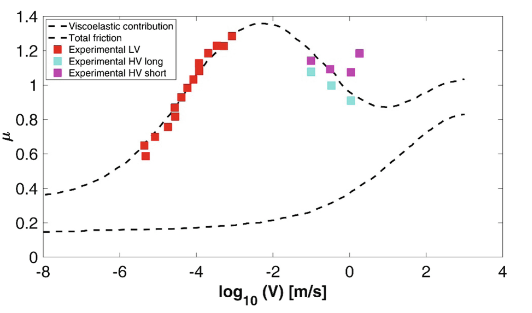
The reference rubber friction measurements were acquired over low- and high-velocity ranges using two experimental configurations. Low-speed data were obtained with an experimental method suitable for measuring the increasing branch of the friction-versus-velocity curve.
Additional friction coefficients were measured at sliding speeds of 0.1, 0.3, 1 and 1.8 m/s using a Linear Friction Tester. The combined measurements provide experimental reference points over a wider sliding-speed interval.
When the Persson formulation is applied, the total calculated friction includes the viscoelastic and adhesive contributions together with an additional constant term of 0.2. This constant was associated in the reference analysis with scratching of the concrete by hard filler particles in the rubber.
The study highlights that this additional term is itself an empirical assumption. Its introduction improves the fitting but also increases the number of quantities that cannot be independently identified from the friction measurements.
Rubber Analysis: Full and Simplified Friction Models
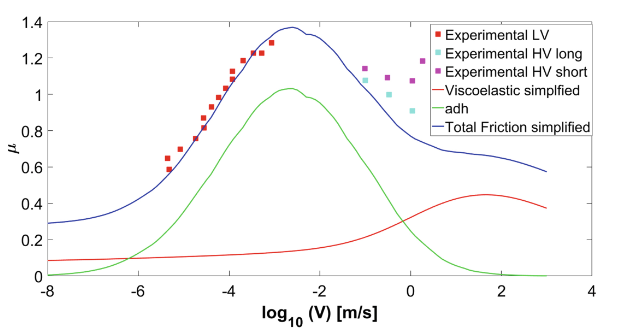
The comparison between the complete Persson model and the simplified formulation is particularly relevant for tire analysis. At low sliding velocity, both approaches produce similar results because this region is interpreted as being strongly influenced by adhesion.
Differences become more visible at higher sliding velocity, where the viscoelastic contribution grows in relative importance. However, the available high-speed measurements are not reproduced consistently by either formulation.
At high velocities, additional thermal effects may also become important. Rapid deformation and sliding can generate localized heating, changing the instantaneous viscoelastic modulus and generally reducing the friction coefficient. These effects further complicate direct comparison between isothermal model calculations and experimental data.
The simplified calculation separates the predicted curve into an adhesive contribution, a viscoelastic contribution and their combined total. The resulting curves illustrate how the two mechanisms overlap across the velocity range.
Adhesive Friction Models and Empirical Parameters
The adhesive contribution is represented through a bell-shaped function of the logarithm of sliding velocity. Its amplitude and position depend on empirical parameters describing the maximum interfacial shear stress and a reference velocity.
These parameters are generally obtained by fitting the difference between measured total friction and the calculated viscoelastic contribution. Consequently, any uncertainty in the viscoelastic model is transferred directly into the calibrated adhesive model.
This creates a circular identification problem:
- the adhesive curve is calculated after subtracting the estimated viscoelastic contribution;
- the viscoelastic contribution depends strongly on the selected roughness cutoff;
- the cutoff also affects the normalized real contact area used in the adhesive model;
- different parameter combinations can reproduce similar total friction curves.
The similar bell-shaped behavior of adhesive and viscoelastic friction means that the measured total curve alone may not contain enough independent information to distinguish the two mechanisms uniquely.
Nonlinear Viscoelasticity and Rubber Strain Softening
Nonlinear viscoelasticity introduces another level of uncertainty. The modulus of filled rubber depends not only on temperature and frequency but also on strain amplitude.
The reference analysis assumes that the local strain generated when a tread block slides over rough asperities is approximately equal to one. Experimental strain-sweep data are then used to introduce a strain-softening correction.
For the examined compound, this assumption produces a reduction of the small-strain modulus by approximately one order of magnitude, corresponding to a strain-softening factor of about 0.1.
A lower effective modulus increases the predicted real contact area and can therefore increase the calculated adhesive friction. However, the assumed strain level is linked to the smallest roughness wavelength included in the model, which is itself determined by the arbitrary cutoff wavevector.
The strain-softening correction and the surface cutoff cannot therefore be treated as completely independent parameters. This supports the need for physically consistent nonlinear modeling of tire viscoelastic materials across representative strain, frequency and temperature ranges.
Rubber Friction Sensitivity to Model Calibration
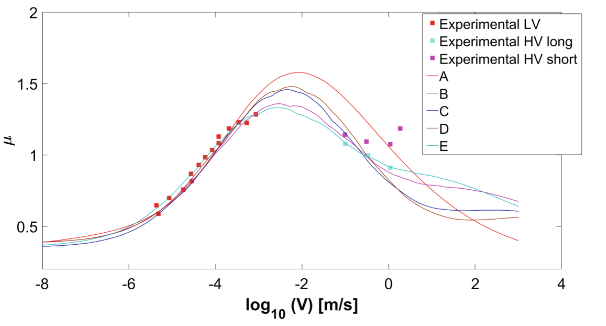
To demonstrate the problem of parameter non-uniqueness, the authors apply five different parameter sets to the same experimental measurements. The selected upper wavevector varies by several orders of magnitude, while the corresponding surface slope, constant friction term, adhesive parameters and strain-softening factor also change.
The tested upper wavevector values extend from approximately 3 × 10⁴ to 2 × 10¹⁰ m−1. The associated root-mean-square slope ranges from about 0.63 to 4.5, while the added constant friction contribution ranges from zero to 0.35.
Despite these large parameter differences, the available low-velocity experimental data can be reproduced with multiple combinations. One parameter set attributes most of the friction to the viscoelastic contribution, while other sets generate a much larger adhesive component.
This means that a good statistical fit does not necessarily demonstrate that the internal physical decomposition of the model is correct.
Rubber Performance Modeling: Friction Sensitivity and Uncertainty
The findings have important implications for tire performance simulation. Friction models are often used to evaluate compound behavior, compare road surfaces and estimate grip across different speeds and temperatures.
When several parameter combinations reproduce the same experimental curve, predictions outside the calibrated range may differ significantly. This is particularly relevant when models are extrapolated toward:
- higher sliding velocities;
- different road microtextures;
- different nominal pressures;
- different compound temperatures;
- different strain amplitudes;
- alternative tread compounds.
A model calibrated only against total friction may therefore provide insufficient confidence for compound development or vehicle-performance prediction. Additional independent measurements are required to constrain the physical mechanisms.
Implications for Tire Manufacturers and Laboratories
For tire manufacturers and testing laboratories, the study supports an integrated characterization strategy. Friction measurements should be combined with reliable viscoelastic master curves, nonlinear strain characterization, surface PSD measurements and contact-area information.
Using only a friction-versus-velocity curve may allow a model to be fitted, but it may not be sufficient to identify the adhesion and hysteresis mechanisms independently.
Implications for Motorsport Tire Modeling
In motorsport, errors in the decomposition of rubber friction can affect predictions of grip sensitivity to speed, track texture and compound temperature. The model may reproduce one reference test while producing inaccurate results on another circuit or under a different thermal state.
This reinforces the importance of combining friction models with physically measured compound properties and detailed track characterization. The relationship among friction, contact area and temperature is also explored in the article on tire-road local contact area and friction prediction.
Full Multiscale Theory or Simplified Tire Friction Model?
The study does not conclude that multiscale contact mechanics is irrelevant. Surface roughness clearly acts across multiple spatial scales, and the PSD remains essential for describing the substrate.
However, for the analyzed experimental case, the increased mathematical complexity of the full multiscale formulation does not provide a clearly superior or uniquely identifiable friction decomposition.
The simplified formulation offers several practical advantages:
- faster calculation;
- fewer nested numerical integrations;
- simpler implementation;
- lower risk of interpolation or coding errors;
- comparable fitting capability for significant portions of the available data.
Its predictions still depend on the high-wavevector cutoff and empirical adhesive parameters. Simplification therefore reduces computational complexity but does not eliminate the fundamental identification problem.
Limits of Current Viscoelastic Rubber Friction Models
The paper identifies several limitations that should be considered when applying current friction formulations:
- the upper roughness wavevector is not selected through a universally accepted physical criterion;
- the adhesive shear-stress curve requires empirical calibration;
- additional constant friction terms may be introduced without independent validation;
- adhesive and viscoelastic curves overlap over broad velocity ranges;
- strain softening depends on an uncertain local deformation level;
- high-speed friction measurements are not always reproduced accurately;
- temperature generation and flash-temperature effects can further modify the compound response.
These limitations do not make the models unusable. They establish the conditions under which their results should be interpreted: as physically informed estimates that require careful calibration and experimental validation, rather than universally predictive formulations.
Frequently Asked Questions About Viscoelastic Rubber Friction
What are the main contributions to rubber friction?
Rubber friction on a hard rough surface is generally described through a viscoelastic contribution generated by deformation losses and an adhesive contribution generated inside the real contact area.
What causes viscoelastic tire friction?
Viscoelastic tire friction is generated when road asperities cyclically deform the tread compound. The resulting hysteretic energy dissipation depends on compound modulus, loss factor, temperature, sliding speed and roughness wavelength.
What causes adhesive rubber friction?
Adhesive rubber friction is associated with molecular interactions and localized junctions between the rubber and substrate inside the real contact area.
What is Persson’s multiscale rubber friction theory?
Persson’s theory calculates friction by considering surface roughness across multiple wavevector scales together with the frequency-dependent viscoelastic response and the evolution of real contact area.
Why is the roughness cutoff wavevector important?
The upper cutoff determines the smallest surface scale included in the model. It strongly affects surface slope, viscoelastic excitation and the estimated real contact area.
Can adhesive and viscoelastic friction be separated experimentally?
Not uniquely from the total friction curve alone. The two contributions can have similar velocity-dependent shapes, and their calculated values depend on several empirical parameters.
What is rubber strain softening?
Rubber strain softening is the reduction in effective dynamic modulus that occurs when filled rubber is subjected to larger strain amplitudes. It can significantly modify predicted contact area and adhesive friction.
Why does temperature affect rubber friction?
Temperature shifts the viscoelastic response of the compound. It changes storage modulus, loss factor and the frequency range in which maximum energy dissipation occurs.
Is the full multiscale model always more accurate?
No. In the analyzed case, a simplified formulation produced comparable fitting capability over significant parts of the experimental velocity range, although both approaches retained important parameter uncertainties.
Can these models predict tire grip without experimental testing?
Not reliably in every condition. The models require experimental material and surface inputs, empirical calibration and validation across the intended operating range.
Which measurements improve rubber friction modeling?
Useful measurements include viscoelastic master curves, strain-amplitude dependence, road-surface PSD, friction across velocity and temperature, contact area and local thermal behavior.
Why is this research relevant to tire development?
It shows that reproducing a measured friction curve does not guarantee a uniquely correct physical model. Better parameter identification is essential for reliable compound comparison and extrapolation to new tracks or operating conditions.
Scientific Source
This article is based on the scientific publication: Genovese, A.; Carputo, F.; Ciavarella, M.; Farroni, F.; Papangelo, A.; Sakhnevych, A. Analysis of Multiscale Theories for Viscoelastic Rubber Friction. In: Carcaterra, A. et al., Lecture Notes in Mechanical Engineering, pp. 1125–1135, Springer Nature Switzerland, 2020. DOI: 10.1007/978-3-030-41057-5_91.
Editorial note: This article provides a technical interpretation of the cited scientific study. It does not replace compound-specific testing, tribological analysis, tire development, road-surface characterization or validation by qualified engineers. Friction models should be calibrated and applied only within operating ranges supported by reliable experimental data.