
Compound testing is fundamental to understanding how a tire tread responds to temperature, deformation and road excitation. The mechanical behavior of a tire is strongly influenced by the viscoelastic properties of its tread compound, which determine how the material stores elastic energy, dissipates energy and changes its response under different working conditions.
Traditional characterization techniques such as Dynamic Mechanical Analysis, or DMA, provide valuable information about tire compounds, but they generally require dedicated compound samples. These specimens can be specifically manufactured for laboratory testing or extracted directly from the tread, making the procedure destructive when the objective is to characterize the finished tire.
VESevo was developed to address this limitation. The technology enables compounds viscoelastic characterization directly on the tire tread or on rubber slabs through a non-destructive indentation-based measurement. Storage modulus, loss-related quantities and temperature-dependent behavior can therefore be investigated while preserving the tested product.
This article focuses specifically on the compound viscoelastic response and on how VESevo distinguishes different compounds. For the broader tire-oriented analysis of the same scientific study, including tire testing, measurement, lifecycle monitoring and manufacturing applications, see the VESevo article on non-destructive tire testing and viscoelastic characterization.
Compound Testing: Why Non-Destructive Characterization Matters
The properties of a tire compound measured in a laboratory do not necessarily reproduce perfectly the properties of the compound in the finished tire. The paper highlights the importance of the vulcanization and manufacturing processes, which can make actual tread mechanical properties different from those obtained from separately prepared laboratory specimens.
This distinction is particularly relevant when engineers need information about the actual tires tread compound incorporated into a production tire. Obtaining a conventional DMA specimen directly from that region normally requires cutting material from the tread, which prevents repeated testing of the same tire.
A non-destructive approach changes the testing strategy. Instead of comparing different nominally equivalent specimens at different stages, engineers can perform repeated acquisitions on the same compound surface, at different temperatures or after different usage conditions.
This is particularly valuable in motorsport, development and production environments where available tires may be limited, destructive procedures may not be permitted, or repeated measurements are required to monitor how the compound evolves.
VESevo therefore complements conventional laboratory characterization rather than eliminating its role. The scientific study specifically validates the non-destructive methodology by comparing its results with standard DMA measurements.
Compound Viscoelastic Response: Storage Modulus, Loss Modulus and Tan δ
A tire tread compound is a viscoelastic material. Its response combines elastic and viscous components, meaning that deformation does not occur in perfect phase with the applied mechanical solicitation.
When a sinusoidal stress is applied, the corresponding strain exhibits a phase delay. This behavior is described through the complex dynamic modulus, which contains two principal components:
- Storage Modulus, related to material elasticity and the ability to store energy;
- Loss Modulus, associated with the dissipative component of the response.
The ratio between loss modulus and storage modulus defines the loss factor, tan δ, which provides an indicator of the overall damping behavior of the material.
These quantities help describe both compound deformation and the compound’s attitude to store or dissipate mechanical energy. They are therefore considerably more informative than a single static hardness value when studying dynamic tire behavior.
The importance of these parameters also connects this study with VESevo research on tire adhesion and viscoelasticity characterization, where the relationship between compound response, temperature and tire-road interaction is examined from a friction-oriented perspective.
Compound Temperature: From Rubbery to Glass-Like Response
Compound temperature is essential when interpreting viscoelastic measurements. The same material can show very different stiffness and damping characteristics depending on temperature and excitation frequency.
At low excitation frequencies, polymer chains have more time to rearrange during loading and the compound behaves closer to the rubbery region. At sufficiently high frequencies, molecular rearrangement becomes increasingly restricted and the material moves toward a glass-like response.
Temperature produces a comparable shift in material response. This frequency-temperature equivalence is represented through the Time-Temperature Superposition principle and the Williams-Landel-Ferry relationship.
By combining tests performed under different thermal conditions, viscoelastic master curves can describe the response over a wider domain than the range directly accessible through one experimental configuration.
This makes temperature measurement an integral part of compound characterization rather than an auxiliary parameter. A storage-modulus or loss-factor value has limited engineering meaning if the thermal condition at which it was obtained is unknown.
VESevo Working Principle for Compound Viscoelastic Characterization
VESevo is based on a controlled mechanical interaction between a steel rod equipped with a semi-spherical indenter and the material being tested. The rod can fall and bounce on the surface while moving inside a guide designed to minimize parasitic damping effects.
A repeatable release mechanism ensures that each acquisition starts from the same initial position. The prototype described in the paper incorporates an optical sensor with a response frequency of 100 kHz and a displacement resolution of 10 µm.
A compact infrared pyrometer simultaneously measures the temperature of the tested compound. The combination of displacement and thermal information allows each impact signal to be associated with the instantaneous state of the material.
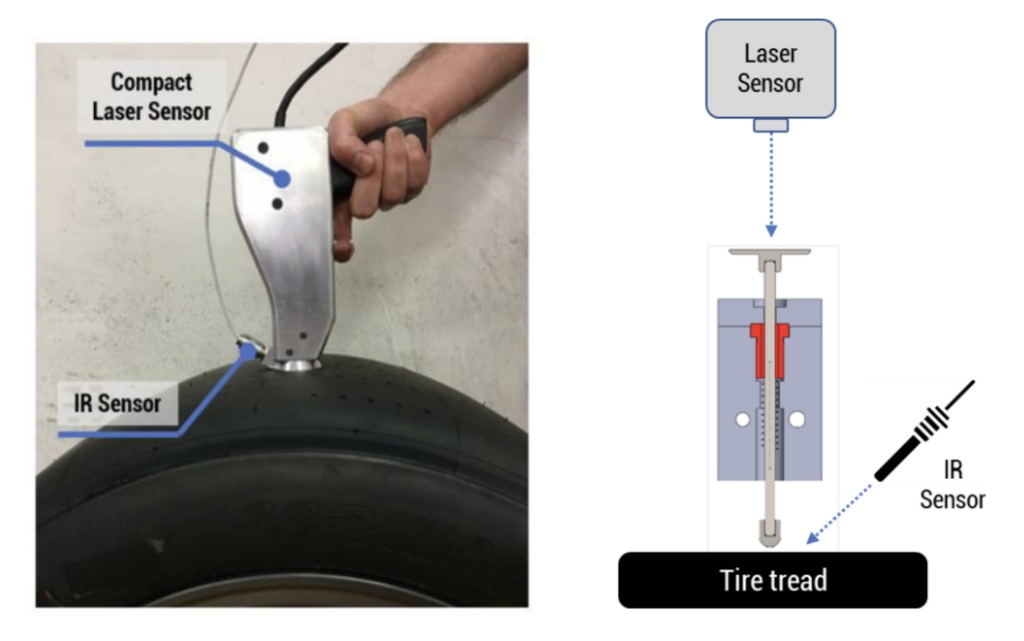
The device was designed to support stable and repeatable measurements while remaining compact enough for practical testing. This makes the principle particularly relevant where conventional laboratory equipment or destructive specimen preparation is undesirable.
The operating principle is also described on the VESevo working principle page, where the relation between rod motion, storage modulus and dissipative response is presented from a practical technology perspective.
Compound Surface Testing and the VESevo Displacement Signal
During a single acquisition, VESevo is positioned vertically on a tire tread compound or on a slab. The indenter is raised to a mechanically controlled position and released so that the initial conditions remain repeatable from one test to the next.
The resulting displacement signal can be divided into three main stages:
- the drop phase, before contact with the material;
- the indentation phase, during the first interaction with the compound;
- the transient phase, characterized by progressively damped rebounds.
The drop phase is largely independent of compound temperature because no material contact has yet occurred. The indentation and transient phases are instead directly affected by the viscoelastic response of the tested surface.
Tests performed over a range of temperatures show that the signal changes visibly as the compound thermal state varies. At lower temperatures, the transient phase becomes shorter and the rebound amplitudes decrease. At higher temperatures, the rod reaches larger displacement values during subsequent rebounds.
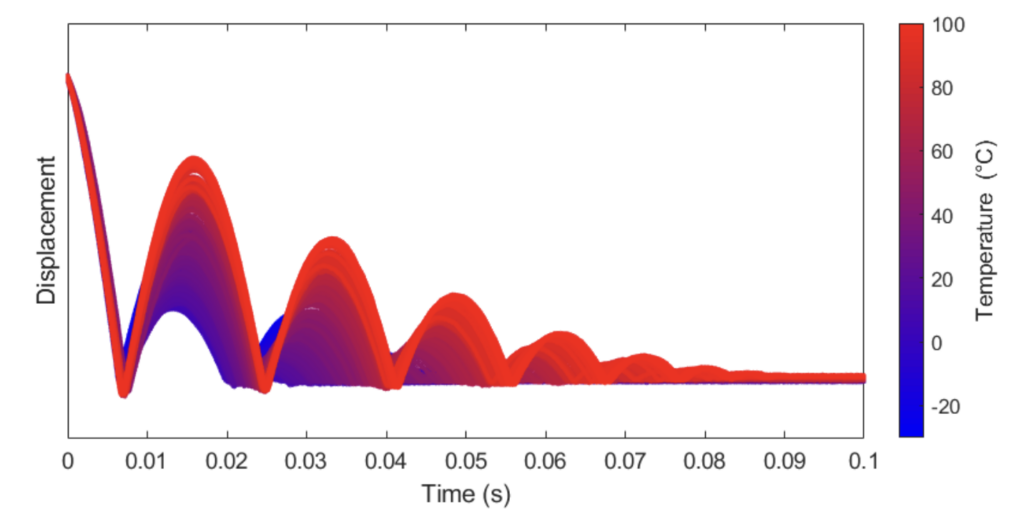
The shape of these signals provides a direct experimental indication that a compound cannot be characterized independently of temperature. The same material produces a different dynamic contact response as its viscoelastic state changes.
Compound–Substrate Contact: Indentation and Viscoelastic Response
The Compound – substrate interaction measured by VESevo must be converted from a displacement signal into physically meaningful quantities. The processing procedure first identifies the duration of the initial contact between the rod and the tested compound.
The filtered displacement signal is differentiated to obtain rod velocity. Contact starts when the rod reaches the compound and its velocity begins to decrease in absolute value. Maximum indentation occurs when the velocity reaches zero. The end of contact is identified when the rebound velocity reaches the condition at which the compound no longer exerts force on the indenter.
The duration of this contact depends on the viscoelastic state. According to the experimental observations, lower temperatures produce shorter contact durations, while increasing temperature lengthens the indentation phase.
Modeling Compound Deformation During the First Contact
The indentation interval is approximated through the free response of a second-order non-conservative mass-spring system. A nonlinear least-squares optimization identifies parameters related to the damped motion and extinction of the response for every test temperature.
From these identified quantities, the methodology estimates contact stiffness and damping coefficients. Both vary with temperature because they reflect the instantaneous viscoelasticity of the compound surface.
The mass of the indenter rod used in the formulation is 2.5 g. Contact stiffness, damping and indentation depth are subsequently connected with viscoelastic properties using indentation mechanics based on Sneddon and Hertz contact formulations.
From Contact Mechanics to Storage Modulus and Loss Factor
The estimated contact parameters are used to obtain storage modulus, loss modulus and loss factor. The contact area between the semi-spherical indenter and the compound is calculated from the measured maximum indentation depth.
This processing stage is what transforms VESevo from a rebound measurement device into a system for compounds’ viscoelasticity evaluation. The objective is not simply to distinguish a harder compound from a softer one, but to reconstruct quantities that can be compared with established viscoelastic characterization methods.
Tire Compounds: Comparing VESevo with Dynamic Mechanical Analysis
The experimental validation focuses on three different tire compounds, identified as Compounds A, B and C. Each was tested with VESevo across a wide temperature range and compared with temperature-sweep DMA results obtained at a reference frequency of 1 Hz.
The VESevo measurements do not directly produce the same reference master curve as DMA. For comparison, the individual measurements are shifted using the Williams-Landel-Ferry relationship. The WLF coefficients used in the study were supplied by a tire manufacturer and remain confidential.
The resulting values are also normalized because of industrial confidentiality. The scientific objective is therefore not to disclose absolute proprietary compound properties but to verify whether the non-destructive methodology reproduces the same trends and relative differences identified by conventional laboratory testing.
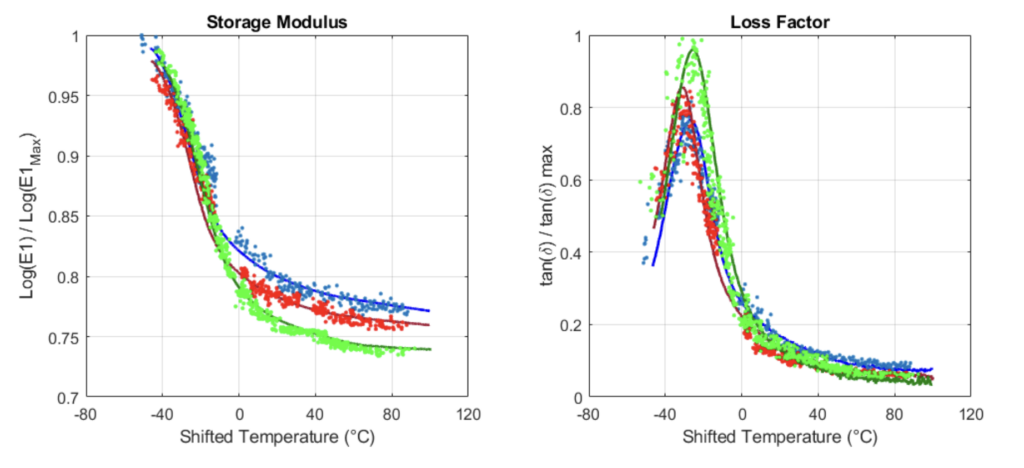
The comparison shows that the VESevo processing procedure identifies the principal trends of all three compounds. The glass-transition temperatures derived from the loss-factor curves are close to those obtained through DMA, and the method reproduces the main viscoelastic behavior in both the low- and high-temperature regions.
Most importantly for comparative compound development, the relative ranking among the compounds remains unchanged between the two techniques for both storage modulus and loss factor.
Compound Comparison: Distinguishing Compounds A, B and C
A useful characterization technology must not only reproduce a general master-curve shape. It must also distinguish compounds with different mechanical and dissipative behavior.
The study demonstrates this capability through the three tested compounds. VESevo reproduces their relative differences consistently with the corresponding DMA curves.
Compound C is particularly distinguishable in the reported dataset. The processed results identify it as the material with the highest loss-factor value and the lowest storage-modulus plateau at high temperatures among the three tested compounds.
This does not imply that one compound is universally superior to another. It demonstrates that the measurement system can identify meaningful differences in the way each compound behaves, which can then be interpreted according to the intended tire application.
For compound engineers, the value lies in objective differentiation. Two products that may appear similar through basic inspection can show different energy-storage and dissipation characteristics when tested over the relevant thermal range.
Innovative Compounds and Direct Testing of the Finished Tire
The development of innovative compounds requires reliable feedback between formulation, manufacturing and final-product behavior. Laboratory data provide essential information, but the final tread can be affected by processing and vulcanization conditions.
This is why direct measurements on the finished product can complement conventional compound development. Engineers can assess whether the final tread behaves consistently with expectations without extracting a destructive specimen.
Repeated non-destructive measurements can also support the comparison of nominally equivalent products, batches or production conditions. In this context, the objective is not to replace laboratory rheology but to add information about the compound in its actual manufactured state.
The relationship between material measurement and broader engineering models is also relevant to the VESevo analysis of material testing and analysis of viscoelastic tire compounds, which examines how experimental characterization data can support frequency-temperature-dependent constitutive modeling.
Compound Testing for Quality, Repeatability and Lifecycle Monitoring
The non-invasive nature of VESevo allows the same compound or tire to be investigated repeatedly. This creates application scenarios that are difficult to reproduce with destructive DMA specimens.
Potential uses identified by the study include:
- comparison of different compounds;
- evaluation of final-product quality;
- assessment of production-process repeatability;
- monitoring material properties after progressive mileage;
- analysis of aging-related changes;
- temperature-dependent compound characterization;
- motorsport testing where destructive procedures are restricted or impractical.
Because the same specimen remains intact, longitudinal analysis becomes possible. Instead of comparing different compound samples before and after an event, researchers can potentially monitor changes in the same material or finished tire.
This is particularly relevant when the objective is to quantify how the compound response evolves through thermal history, mileage or aging while minimizing specimen-to-specimen variability.
Why Compound Characterization Matters for Tire Engineering
The tread compound is directly involved in tire-road interaction. Its viscoelastic response changes with temperature and excitation conditions, influencing deformation and energy dissipation at the interface.
For engineering applications, this information can support a more physical interpretation of differences among tires and compounds. Storage modulus describes the elastic contribution of the response, while loss-related quantities provide information on dissipative behavior.
The compound’s attitude to respond to road excitation cannot therefore be described reliably through compound designation or nominal hardness alone. Temperature-dependent viscoelastic characterization adds a quantitative layer to the analysis.
Direct compound characterization is particularly useful when linked to tire-road friction, adhesion and wear models. These applications require representative material inputs if their predictions are expected to reproduce the behavior of the actual tire rather than an idealized laboratory material.
This relationship between measured material response and surface interaction is discussed further in the VESevo article on rubber wear, viscoelasticity and rough-surface contact.
Limits of Non-Destructive Compound Characterization
The experimental results demonstrate the potential of VESevo, but the methodology should be interpreted within the boundaries of the study.
- The validation involves three tread compounds identified as A, B and C.
- Absolute master-curve values are normalized because of industrial confidentiality.
- The WLF coefficients required for shifting the VESevo measurements were supplied by a tire manufacturer and are not disclosed.
- The method relies on signal processing and contact-mechanics relationships rather than reproducing the DMA test itself.
- The study validates the main viscoelastic trends and relative compound ranking, not every possible tire formulation or operating condition.
VESevo should therefore be viewed as a non-destructive viscoelastic characterization technology that complements established laboratory methods and enables measurement scenarios that destructive testing cannot easily provide.
Frequently Asked Questions About Compound Testing
What is compound testing in tire engineering?
Compound testing evaluates the mechanical or viscoelastic properties of the rubber formulation used in a tire. In this study, the focus is on storage modulus, loss-related behavior and their dependence on temperature.
Why is tire compound viscoelasticity important?
Tire compounds deform and dissipate energy during road interaction. Their response changes with temperature and excitation frequency, making viscoelastic characterization important for tire mechanics and performance analysis.
How does VESevo test a compound?
VESevo releases a steel rod with a semi-spherical indenter onto the compound surface. The rod displacement and compound temperature are measured, and the first contact response is processed to estimate viscoelastic properties.
Is VESevo compound testing destructive?
No. The methodology is designed to characterize the material without cutting a specimen from the tire or permanently damaging the tested surface.
Which compound properties are estimated?
The processing methodology estimates storage modulus, loss modulus and loss factor from the measured indentation response and contact parameters.
Why is compound temperature measured during every test?
Compound temperature changes its viscoelastic state, affecting contact duration, indentation response, stiffness and damping. Temperature is therefore required for meaningful comparison among measurements.
Can VESevo distinguish different tire compounds?
Yes. In the study, VESevo identifies differences among Compounds A, B and C and preserves their relative ranking compared with DMA for both storage modulus and loss factor.
How does VESevo compare with DMA?
The processed VESevo measurements reproduce the principal temperature-dependent trends observed with DMA, while the relative differences among the three tested compounds remain consistent between the two methods.
Can the same tire compound be tested repeatedly?
Yes. Because the procedure is non-destructive, repeated measurements can be performed on the same tire or specimen to study temperature effects, mileage, aging or other lifecycle changes.
Can compound testing support tire production?
The paper identifies product-quality analysis and production-process repeatability as potential application areas for fast, non-destructive compound characterization.
Scientific Source
This article is based on: Carputo, F.; Genovese, A.; Farroni, F.; Sakhnevych, A.; Timpone, F. VESevo, an innovative device for non-destructive and smart viscoelastic characterization of tires compounds. AIP Conference Proceedings 2872, 120007, 2023. DOI: 10.1063/5.0164060.
Editorial note: This article provides a compound-focused technical interpretation of the cited scientific study. It does not replace compound-specific laboratory characterization, tire testing, manufacturing validation or application-specific engineering assessment.