
Tire friction testing can be performed under controlled laboratory conditions or directly in real vehicle operation. These two approaches provide different but complementary information: laboratory testing isolates the tire-road interaction under repeatable conditions, while racing-track testing captures the complete response generated by the tire, vehicle and road working together.
The scientific study examined here combines both environments. A reference compound is investigated through indoor friction testing using an evolved British Pendulum and through an outdoor friction testing campaign performed with an instrumented high-performance vehicle on five different racing tracks.
The objective is not simply to obtain a single friction coefficient. The experimental methodology investigates how different surfaces generate different friction values, how maximum friction can be identified from track telemetry and whether laboratory and outdoor observations provide physically consistent relative friction levels.
This article focuses specifically on the experimental methodology used to measure and compare friction. The mathematical development of the Greenwood–Williamson contact model and the real-to-nominal contact-area ratio is discussed separately in our analysis of tire friction and local contact-area modeling.
Friction Testing: Why Laboratory and Track Measurements Are Complementary
Friction testing is challenging because tire-road interaction does not depend on the rubber compound alone. Surface texture, temperature, normal load, sliding velocity and the dynamic operating condition of the tire all affect the measured response.
The two frictional partners are fundamentally different: a deformable viscoelastic rubber material interacts with a hard and irregular road surface. Because the rubber does not conform perfectly to every road asperity, the effective contact area is smaller than the nominal one.
Laboratory testing provides tighter control over these variables. Outdoor testing introduces the actual tire, vehicle dynamics, track morphology and real operating conditions. Considering both environments therefore provides a stronger view of overall friction behaviour than either approach alone.
The experimental campaign uses the same reference compound while changing the interacting surfaces. This makes it possible to evaluate whether differences in tire friction remain consistent when moving from controlled measurements to racing-track operation.
Friction Measurement: From Forces to Tire Friction Coefficient
Friction measurement begins with the forces exchanged between tire and road. The tire friction coefficient is defined as the ratio between tangential force and vertical load.
This quantity can be evaluated separately in the longitudinal and lateral directions. Longitudinal friction is associated with the longitudinal force component, while the lateral friction coefficient is obtained from the lateral component.
For the outdoor racing campaign, the analysis focuses primarily on lateral interaction because the loss of lateral grip is particularly relevant to vehicle performance. The resulting coefficient is therefore evaluated together with tire sideslip angle in conditions approaching the limit of adhesion.
An experimental friction coefficient should not be interpreted as an immutable material constant. It refers to a specific combination of compound, surface and operating state. Different friction conditions can therefore produce different coefficients even when the tire compound remains unchanged.
Outdoor Friction Testing in Racing Environments
The outdoor friction testing campaign was performed with a high-performance vehicle equipped with multiple sensors. The same reference compound was evaluated on five tracks characterized by different road roughness properties.
The acquired telemetry contains a large amount of information, but not every operating point represents the limit of tire performance. For this reason, the analysis identifies specific grip-limited zones corresponding to conditions where the vehicle operates close to the boundary of the adherence ellipse.
Thresholds are applied to parameters including slip ratio, sideslip angle, longitudinal and lateral acceleration, vehicle velocity, vertical load and tire surface temperature. This allows the experimental friction testing process to focus on conditions characterized by high grip rather than on points that provide little information about the available friction limit.
The filtered measurements produce a relationship between the lateral friction coefficient and tire sideslip angle for each circuit.
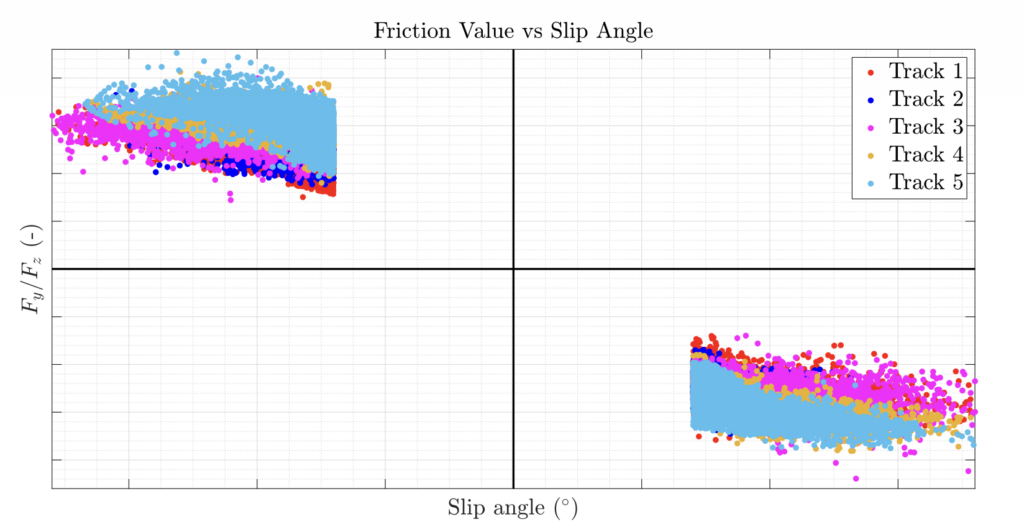
The spread of the points highlights one of the fundamental differences between indoor and outdoor measurements. Real track data include the effects of complete vehicle operation and require careful processing before a representative maximum friction coefficient can be extracted.
This experimental approach complements the predictive methodology discussed in our article on grip prediction using road roughness, viscoelasticity and telemetry.
Maximum Friction Conditions and the Lateral Friction Envelope
Determining maximum friction requires more than selecting the highest individual telemetry point. Isolated measurements can be influenced by noise, transient conditions and data uncertainty.
The study therefore builds an optimized envelope from the relationship between lateral friction coefficient and slip angle. Multiple local maxima are identified and averaged to obtain a more robust representation of the maximum achievable interaction.
The peak of this lateral interaction curve provides the representative maximum friction coefficient for each track. These values describe the maximum friction conditions reached during the analyzed outdoor campaign.
The resulting comparison identifies Tracks 4 and 5 as those associated with the highest friction, Track 3 at an intermediate level, and Tracks 1 and 2 with the lowest friction values within the investigated group.
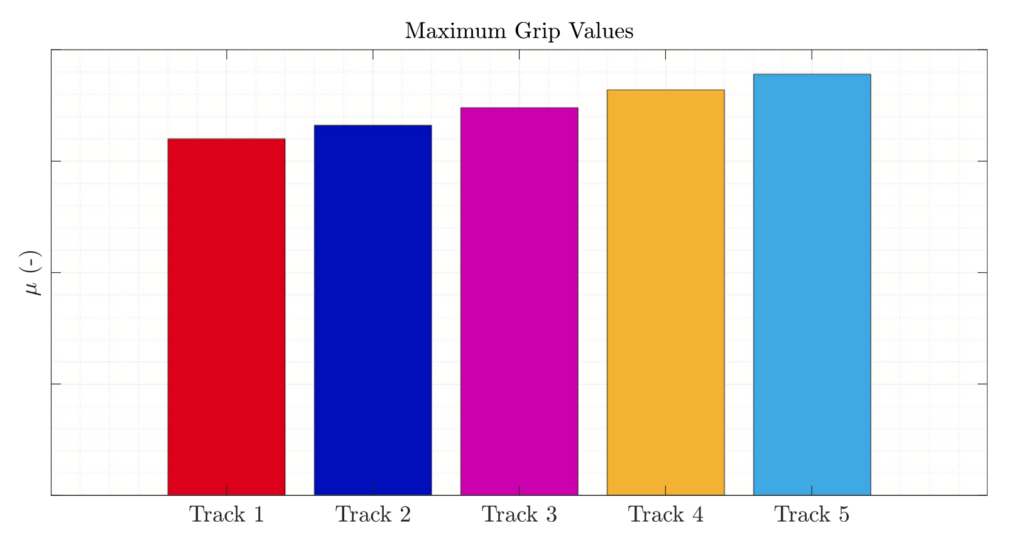
The ranking is particularly useful from an engineering perspective because it permits comparison of surfaces even when absolute outdoor experimental friction values cannot be disclosed.
Indoor Friction Testing with an Evolved Friction Tester
The indoor friction testing campaign follows a different experimental approach. Instead of measuring complete vehicle behavior, a rubber specimen interacts directly with road specimens under controlled conditions.
The friction tester used for this activity is an evolved version of the British Pendulum developed at the University of Naples Federico II.
The device is equipped with a triaxial load cell and an encoder. These sensors allow the tangential and normal forces generated during sliding to be measured together with the velocity of the pendulum arm.
A pre-loading mechanism is used to maintain the required contact pressure between the rubber specimen and the road sample. The resulting signals are acquired digitally and processed to determine the corresponding friction coefficient.
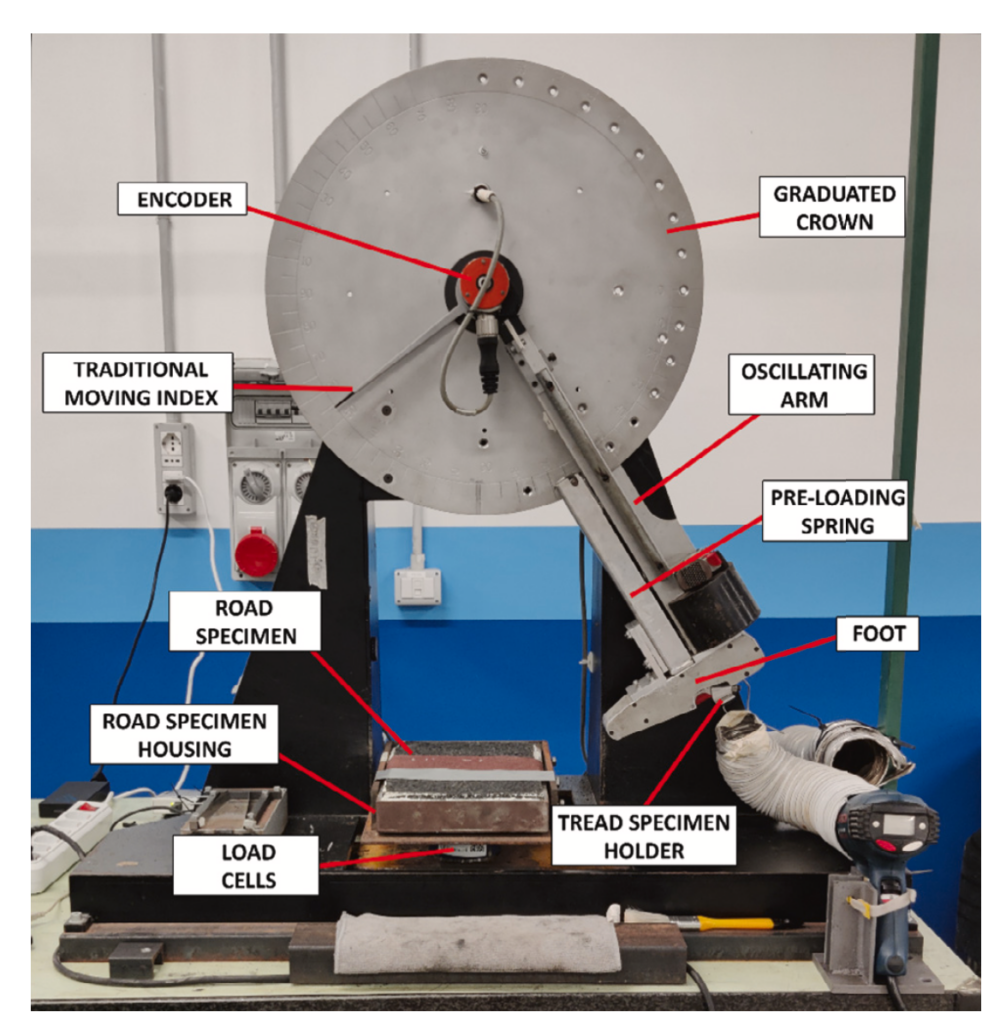
This controlled configuration removes much of the variability associated with complete vehicle dynamics. Temperature and sliding conditions can be defined while the investigated surface is changed, making the test particularly useful for comparative friction measurements.
Friction Analysis Across Different Road Surfaces
The indoor friction analysis includes five road specimens and two sandpapers with different grit sizes, all evaluated using the same reference compound.
Across the investigated conditions, Road Specimens 4 and 5 can be classified as high-friction roads and high-friction surfaces, Road Specimen 3 produces an intermediate response, while Road Specimens 1 and 2 represent low-friction surfaces.
The two sandpapers extend the analysis toward unconventional surface textures. Their measured friction coefficients are higher than those obtained for the road specimens, providing an additional challenge for the experimental and modeling methodology.
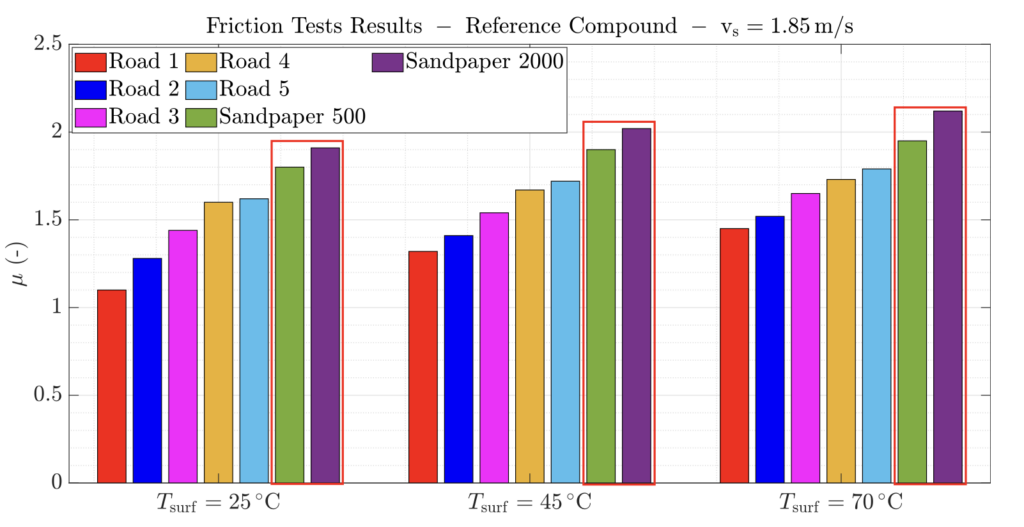
The experiment demonstrates that the measurement system can distinguish clearly between surfaces producing different friction levels, from conventional low-friction road specimens to the significantly higher response produced by the sandpapers.
Experimental Friction Values and Surface Classification
The individual experimental friction values are useful, but their ranking across surfaces provides an additional engineering metric.
In the indoor campaign, Sandpaper 2000 produces the largest measured friction coefficient, followed by Sandpaper 500. Among conventional road specimens, Road 5 produces the highest value, followed by Roads 4 and 3, while Roads 2 and 1 occupy the lower end of the classification.
The outdoor campaign produces a similar classification concept. Tracks 5 and 4 exhibit the highest levels, Track 3 remains intermediate and Tracks 2 and 1 exhibit the lowest relative friction levels.
This does not mean that indoor and outdoor coefficients can simply be exchanged numerically. The testing procedures and interacting systems are different. What can be compared is the ability of the methodology to distinguish surfaces according to their measured friction response.
Local Friction and the Role of Real Contact Area
Although this article focuses on testing, the measured response has a physical connection with the microscopic interaction between rubber and surface.
Road roughness prevents the entire nominal tire footprint from being in intimate contact with the surface. Instead, forces are transmitted through local asperity contacts. This makes real contact area relevant when interpreting local friction.
The study uses an extended Greenwood–Williamson formulation to estimate the ratio between real and nominal contact area, Ac/A0. Tire viscoelasticity, surface roughness, sliding velocity, contact pressure and temperature are introduced as model inputs.
Viscoelastic characterization is particularly relevant because the rubber modulus changes with temperature and excitation frequency. These properties also contribute to estimating the upper limit of the local friction coefficient.
For the complete physical and mathematical treatment of Ac/A0, asperity indentation and the Greenwood–Williamson extension, see our dedicated article on tire-road local contact area and tire friction.
Rubber Friction and Compound Viscoelasticity
Rubber friction cannot be analyzed independently of the dynamic properties of the tread compound. Storage modulus and dissipative behavior change with both temperature and excitation frequency, modifying how the rubber deforms around road asperities.
In the study, these material properties are obtained through non-destructive characterization of the reference tire compound. This information becomes a physical input for interpreting contact and friction without destructively extracting material from the tested racing tire.
The measurement approach is discussed in greater detail in our article on non-destructive compound testing and viscoelastic characterization.
For a deeper treatment of the physical contributions to rubber-road friction, including adhesive and hysteretic mechanisms, see friction analysis and measurement in viscoelastic rubber.
Friction Behaviour Across Temperature, Pressure, Sliding Velocity and Road Texture
The friction behaviour observed experimentally cannot be separated from operating conditions.
Increasing temperature changes the viscoelastic state of the rubber. Contact pressure modifies the indentation of the tread into the surface. Sliding velocity changes the excitation frequencies experienced by the compound, while surface roughness controls the geometry and distribution of the asperities involved in contact.
These interactions explain why a friction coefficient should always be associated with clearly defined friction conditions. A coefficient measured for one surface, temperature or load cannot automatically be transferred to another operating condition.
This is also the point at which friction theory, friction models and experimental testing become complementary. Models provide a physical interpretation of surface interaction, while measurements determine whether the resulting trends correspond to real behavior.
Adhesive interaction provides another part of the physical picture and is discussed separately in our analysis of tire adhesion and viscoelasticity.
Indoor vs Outdoor Friction Testing: What Does Each Method Measure?
| Method | Primary information | Main advantage | Main limitation |
|---|---|---|---|
| Indoor friction testing | Tangential and normal forces between rubber and surface | Controlled and repeatable operating conditions | Does not reproduce the complete vehicle system |
| Outdoor friction testing | Telemetry-derived tire forces and lateral friction | Real tire, road and vehicle interaction | Greater variability and more complex data processing |
The two methods should therefore be considered complementary rather than interchangeable.
Indoor testing is particularly effective for controlled surface comparison. Outdoor testing determines whether the observed differences remain meaningful when the tire operates on a complete vehicle near maximum friction conditions.
Together, they provide a stronger experimental basis for understanding tire-road interaction than relying exclusively on either laboratory measurements or racing telemetry.
From Friction Measurements to Predictive Friction Maps
The broader engineering objective is to move from individual measurements toward predictive friction maps capable of describing the expected interaction between a specific tire compound and a specific road.
The present study does not yet provide a complete physical friction map. Instead, it establishes a consistent relationship between experimental friction and the simulated real-to-nominal contact-area ratio.
This is an important distinction. The current results support the classification of expected friction levels across different surfaces, while the implementation of a complete physical model capable of predicting friction maps is identified as a further development.
Such a future approach could combine road characterization, compound viscoelasticity, operating conditions and contact mechanics to estimate expected tire-road friction before extensive experimental campaigns are performed.
Limits of Experimental Tire Friction Testing
- Outdoor measurements contain greater variability because they include complete vehicle dynamics and real operating conditions.
- The outdoor maximum friction coefficient is obtained through telemetry processing and envelope identification rather than through a single direct measurement.
- Absolute outdoor friction values are not disclosed because of confidentiality.
- The experimental comparison uses one reference compound and does not establish universal values for every tire formulation.
- Friction changes with temperature, sliding velocity, pressure and surface morphology.
- The observed relationship between real contact area and experimental friction does not imply that contact area is the only physical mechanism governing friction.
- Predictive friction maps are identified as a future development rather than a completed output of the present study.
Frequently Asked Questions About Tire Friction Testing
How is tire friction measured?
Tire friction is evaluated by relating the tangential force generated at the tire-road interface to the corresponding vertical load. The specific measurement procedure depends on whether testing is performed in a controlled laboratory environment or on a complete vehicle.
What is outdoor friction testing?
Outdoor friction testing evaluates tire-road interaction during real vehicle operation. In this study, an instrumented high-performance vehicle was tested on five racing tracks and telemetry was processed to identify high-grip lateral operating conditions.
What is indoor friction testing?
Indoor friction testing reproduces rubber-surface sliding under controlled conditions. The study uses an evolved British Pendulum to measure tangential force, normal force and sliding velocity for different road specimens and sandpapers.
What friction tester is used in the study?
The laboratory campaign uses an evolved British Pendulum equipped with a triaxial load cell, encoder and pre-loading system.
How is the maximum friction coefficient determined on track?
The lateral friction coefficient is analyzed as a function of sideslip angle. An optimized envelope is then fitted to the experimental point cloud, and multiple local maxima are used to obtain a representative maximum friction level.
Which tracks produced the highest friction?
Within the outdoor dataset, Tracks 4 and 5 produced the highest friction levels, Track 3 showed an intermediate response and Tracks 1 and 2 produced the lowest levels.
Which surfaces produced the highest indoor friction?
The two sandpapers produced the highest friction coefficients. Among the conventional road specimens, Roads 5 and 4 were identified as high-friction roads, Road 3 showed an intermediate level and Roads 2 and 1 produced the lowest friction response.
Do laboratory and racing-track friction measurements produce the same values?
No. The two environments use different experimental configurations and the coefficients should not be treated as directly interchangeable. Their value lies in identifying consistent physical and relative trends across different surfaces.
What is the relationship between contact area and friction?
For the reference compound and surfaces investigated in the study, higher simulated real-to-nominal contact-area ratios consistently correspond to higher experimental friction levels. The relationship should be interpreted within the tested compound and operating conditions rather than as a universal friction law.
Can tire friction testing be replaced by friction models?
No. Friction models provide a physical interpretation of tire-road interaction and can support predictive developments, while experimental measurements are needed to determine whether the predicted trends correspond to real behavior.
Scientific Source
This article is based on: Farroni, F.; Stefanelli, R.; Napolitano Dell’Annunziata, G.; Timpone, F. Impact of the tire/road local contact area on tire friction, with a novel approach based on Greenwood–Williamson theory and validation in both laboratory and outdoor racing environments. Tribology International, Volume 210, 110772, 2025. DOI: 10.1016/j.triboint.2025.110772.
The scientific publication is distributed under the Creative Commons Attribution 4.0 International license.
Editorial note: This article focuses on the experimental friction-testing methodology reported in the cited scientific study. The results refer to the investigated compound, surfaces and operating conditions and should not be interpreted as universal friction coefficients applicable to arbitrary tire-road combinations.